
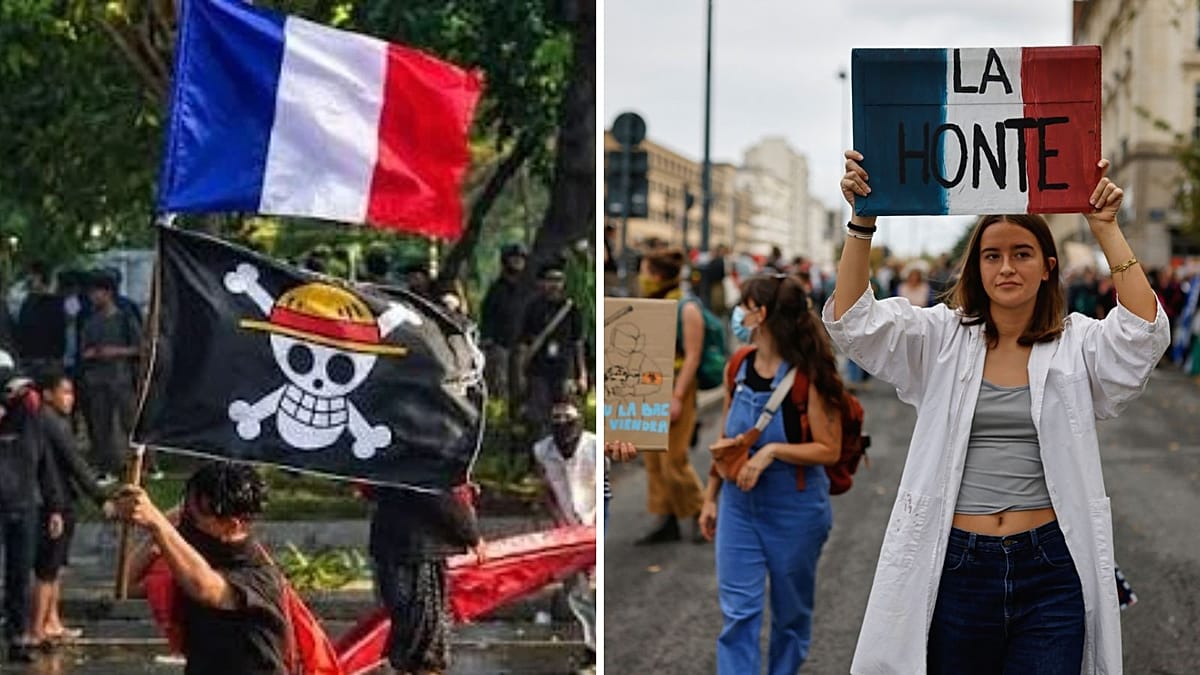
When young people challenge the establishment, they often adopt fictional works or popular culture iconography in their protests, with some images and symbols becoming unlikely rallying cries.
Amid the banners, placards and slogans seen on the streets of France, a black flag with a smiling skull wearing a straw hat frequently pops up.
The pirate emblem immediately speaks to fans of the manga series One Piece: it’s the “Jolly Roger”, one of the most recognizable logos in pop culture.
The iconography was already present during last year’s September protests in France, and it has re-emerged during the ongoing student protests and street demonstrations across France – as well as in Belgium, Italy and Greece.
But how has the One Piece pirate flag become a country and continent-spanning symbol against repression and government corruption?
A bit of background first. For those of you who aren’t familiar with One Piece, it’s a popular Japanese manga created by Eiichiro Oda. In a nutshell, it follows the adventures of the Straw Hat Pirates, who stand up for those oppressed by repressive rulers and authoritarian corruption – a fight against tyranny under their flag, the “Jolly Roger”.
First published in 1997 – the year which coincidentally marks the first year of Gen Z births – the manga has become a worldwide phenomenon, selling more than 500 million copies and being translated into 40 languages. It holds the Guinness World Record for the most copies published in the same comic book series by a single author, and has spawned an animated TV series, a live-action Netflix show, as well as several films.
In France, the show is extremely popular and its volumes are bestsellers.
Over the years, the flag of the grinning skull has been seen at protests in Nepal, Indonesia, the Philippines, Morocco, Italy, the UK, and has been omnipresent during the protests rocking France in the past few weeks.
Whether the One Piece image is seen at student protests, rallies against police brutality, protests on government social media bans, or at pro-Palestine demonstrations, the common visual denominator reflects how the manga symbol has resonated with Gen Z, who have adopted it as their symbol for defiance and ultimately, hope.
It is hardly an unexpected symbol, as it stands for freedom and resistance against oppression for the source material’s ragtag rebels. And now IRL, speaking to disaffected youth and Gen Z aching to be heard.
The fictional world making its way into the real one represents a useful transfer as narratives and their values are not limited to borders or causes, thereby creating a global sense of unification and a shared language of solidarity. It’s also an advantageous transferral, as transforming fictional touchstones into real-world emblems of defiance means these symbols are harder to suppress by governments who still seek to maintain an anti-authoritarian appearance.
The use of the Jolly Roger once again reveals that culture and politics are inextricably intertwined – especially for young activists and a digitally-savvy generation who use social media to communicate their thoughts and fears through cultural references.
There’s plenty of precedence, as the Jolly Roger flag isn’t the only pop culture symbol to have been used in protests over the years.
Here’s a look five instances of cultural touchstones used as political expression in the last 15 years.
V for Vendetta
Inspired by 2005’s V for Vendetta, the international hacktivist group Anonymous started using the movie’s iconic Guy Fawkes mask to conceal their identities during protests. The mask became widespread in 2011 during the “Occupy” movement, and has lasted as a face-of-dissent symbol, taking aim at corrupt systems and governments. As V states: “People should not be afraid of their governments – governments should be afraid of their people.”
The Hunger Games
The series of YA books by Suzanne Collins and the subsequent films starring Jennifer Lawrence contain several symbols of resistance, from the Mockingjay pin to the three-finger salute. This silent gesture of defiance was used by the character Katniss Everdeen as a way to show her solidarity with the oppressed, and it has since been seen in protests from 2014 onwards, from anti-military coup demonstrations in Thailand to Hong Kong’s protest for universal suffrage.
The Handmaid’s Tale
In 2017 and 2018, women across the US wore scarlet cloaks and white bonnets from Margaret Atwood’s “The Handmaid’s Tale”, as a response to anti-abortion legislation and policies threatening female reproductive rights. In the dystopian book and TV series, the handmaids are made to wear the uniform under the law of Gilead, the dystopian country in which fertile women are forced into childbearing servitude. The costume frequently reappears in women’s rights demonstrations worldwide – from Argentina’s 2018 demonstrations for abortion rights, to the 2019 protests against US President Trump’s visits to the UK.
The Joker
In the aftermath of civil war, Lebanese protestors demonstrating against the government’s new austerity measures in 2019 adopted the likeness of the Clown Prince of Crime, with many taking inspiration from Joaquin Phoenix’s face paint in Joker. It’s a get-up that is recognised worldwide, one which grants anonymity to demonstrators and in the case of Lebanese protestors, allowed their strife to gain heightened visibility. The Joker also stands as a symbol of rebellion, embodying a disregard for societal norms and conventions. As such, the use of the clown face signifies a reminder to embrace irreverence towards the established order, making it a popular emblem in protests worldwide.
Pepe the Frog
The alt-right, MAGA and Trump himself, who tweeted a meme of Pepe during the 2016 US presidential election, adopted the green frog as a way to appeal to the youth. American cartoonist Matt Furie created the image in 2005 and was furious at how his creation had been co-opted in such a hateful way. Before killing off the character in a 2017 comic, he wrote an essay for TIME in 2016 in which he said: “It’s completely insane that Pepe has been labelled a symbol of hate, and that racists and anti-Semites are using a once peaceful frog-dude from my comic book as an icon of hate.” Despite Pepe being used by the alt-right in the West, it was re-appropriated and reclaimed by Hong Kong protestors in pro-democracy demonstrations in 2019.