




Published on
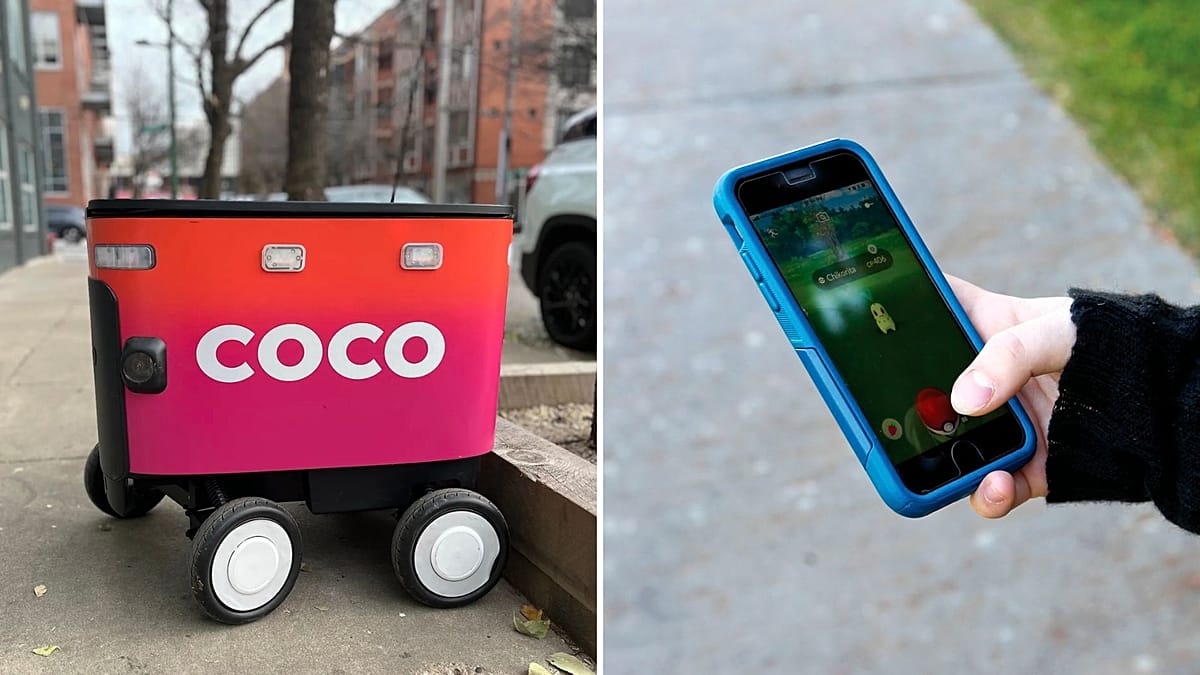
Players chasing down a rare Snorlax or trying to pin a Pikachu to their pavement in Pokémon Go may have been doing more than just “catching them all” – they’ve also been unknowingly helping train real life delivery robots.
Since the augmented reality game exploded into popularity in 2016, Pokémon Go has built up a huge database of more than 30 billion real-world images, captured as players explored parks, streets and landmarks with their cameras.
Now that data is being put to work by Niantic Spatial, a division of Niantic (the developer behind Pokémon Go), which has turned it into a highly accurate navigation system, otherwise known as a Visual Positioning System (VPS).
Instead of signals from space, the system uses visual cues from the environment to determine position and orientation, which proves very useful indoors or in dense urban areas, where satellite navigation can sometimes struggle.
Niantic Spatial has recently partnered with Coco Robotics, which operates small, wheeled delivery robots in cities like Los Angeles, Chicago and Helsinki. The company’s tech will now combine GPS with VPS to better navigate complex environments.
Coco Robotics’ fleet – around 1,000 robots capable of carrying groceries or multiple takeaway orders – has already completed roughly half a million deliveries.
“The promise of last-mile robotics is immense, but the reality of navigating chaotic city streets is one of the hardest engineering challenges,” said Niantic Spatial CEO John Hanke.
He added that the challenge of making a digital character move convincingly through the world mirrors that of guiding a robot safely through it: “It turns out that getting Pikachu to realistically run around and getting Coco’s robot to safely and accurately move through the world is actually the same problem.”
“We’re excited to bring the Niantic Spatial and Coco Robotics engineering teams together in this unique design partnership. It gives us reliable access to localisation services that further improve robot navigation,” said Zach Rash, co-founder and CEO of Coco Robotics.
In-game Pokémon Go features such as “Field Research” have encouraged users to scan statues, landmarks and public spaces in exchange for rewards – thus strengthening the VPS system’s accuracy.
It’s important to note that Niantic has always made participating in scanning features optional, with users required to opt in. The company has also stated since 2019 that it is transparent about how such data is collected and used.