
Driving down a bustling street in Cairo, an Uber driver pointed out various businesses repeating the same refrain, “Huwa gaysh” – “That’s army.”
A burger restaurant, a hotel, even the cement used to build the bypass above. He turned into a petrol station and nodded. “Gaysh.”
In fact, their household brands are omnipresent for those living in the country.
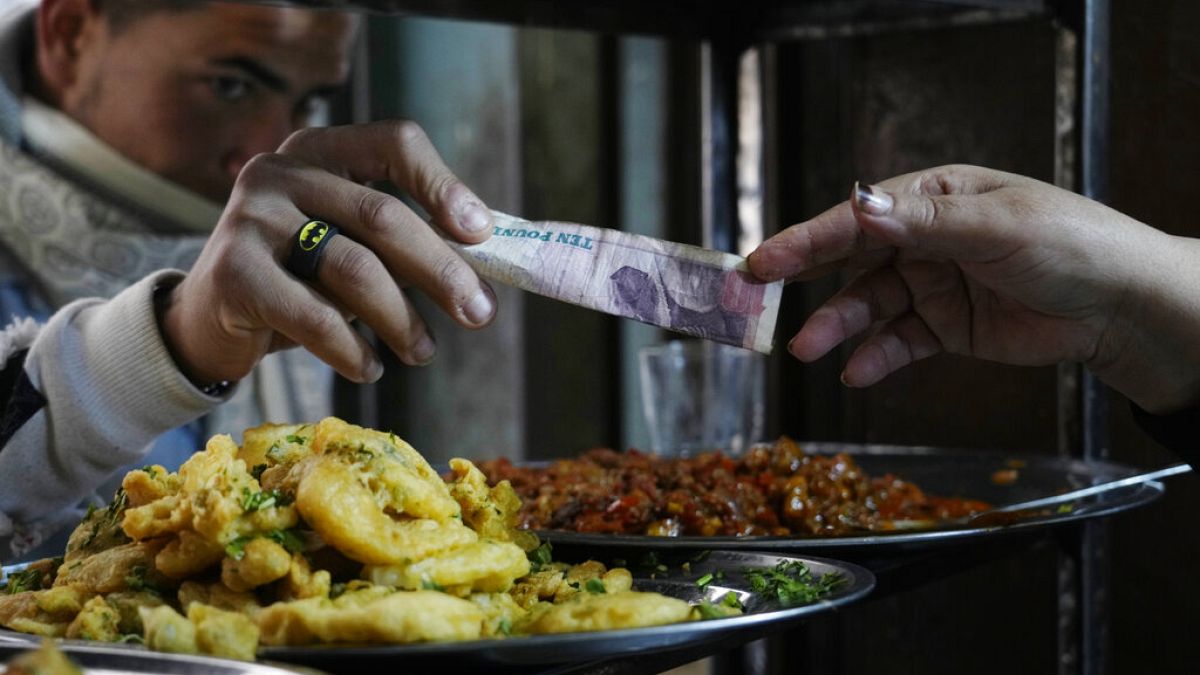
Egypt’s national dish koshary recently won recognition from UNESCO for intangible cultural heritage.
If you eat the dish — a mix of lentils, chickpeas, vermicelli and macaroni topped with fried onions and a spicy sauce — there is a good chance that many ingredients were produced by, you guessed it, the Egyptian military.
“What is extraordinary in Egypt is that a lot of these products made in military factories are sold in the general economy,” research fellow at the Netherlands Institute of International Relations Clingendael Matteo Colombo told Euronews.
“If you go to an Egyptian supermarket, you can easily find a bottle of water that is produced by the army.”
The IMF has agreed to lend Egypt €6.8 billion to address mounting economic challenges, but disbursements have been delayed due to what the organisation described as an economy “dominated by public-driven investments, an uneven playing field, and state-owned entities, including military ones.”
The military’s grip on Egypt’s economy is nothing new, but its scale has expanded dramatically since 2011.
Military officers who ruled Egypt from the 1950s onwards used the armed forces to centralise state control.
President Gamal Abdel Nasser, who led from 1954 to 1970, brought the army into civilian production during a tumultuous post-independence period marked by conflicts with Israel.
Who started it all?
“It didn’t start with Egyptian President Abdul Fattah al-Sisi,” Professor Khaled Fahmy told Euronews. “It started actually in the early 60s under Abdel Hakim Aymer, the head of the army under Gamal Abdel Nasser.”
Fahmy, professor of Middle Eastern Studies at Tufts University, said the logic was that the army could respond more quickly in times of crisis. “That of course means no supervision, no auditing,” he said.
But it was Nasser’s successor, Anwar es-Sadat, who cemented the army’s economic role.
In 1979, the same year Egypt signed a peace treaty with Israel, es-Sadat established the National Service Projects Organisation to oversee military production of both military and civilian goods.
“The peace treaty did not result in the reduction of the size of the army,” Fahmy said. “The question was, what do we do with the army, and how do you maintain the loyalty of senior officers now that they don’t have the bonuses that they get from campaigns and war service.”
Running lucrative subsidiaries of the NSPO became the answer.
Yezid Sayigh, author of Owners of the Republic: An Anatomy of Egypt’s Military Economy, said the 2011 revolution catalysed a military economic boom.
“The military’s share of any market sector was small before 2011, but grew dramatically in ‘strategic’ sectors such as cement and steel, building on strong presidential support and the military’s political dominance,” he told Euronews.
“The major changes since 2011 are twofold: in sheer volume, but also in acquiring a direct role in economic policy-making and state investment strategy.”
This has had profound economic impacts.
‘A sense of national pride’
Since 2015, Egypt’s economy has experienced significant challenges. Inflation has generally risen sharply, peaking at 38% in September 2023. It has since slowed to 12.3%, almost five times the EU rate.
Egypt’s currency, which the country unpegged from the US dollar in 2016, has depreciated significantly. In 2015, 1 euro would buy roughly 9 Egyptian pounds. Now that figure stands above 55.
Colombo observed that military presence in the economy could serve as a bulwark against the struggles families faced with the cost of living.
“The army would say to you that it has a good effect because it allows for a product to be sold at a lower price, affordable for Egyptians and that the army contributes to the production of Egypt,” he said.
Colombo also cites “a sense of national pride” as motivating Egyptians to purchase these products, even if the quality is lower.
“Some people in Egypt do see the army as something to be proud of.”
However, he also sees the possible downsides to this: “You run the risk that if you have a large military production, you have fewer possibilities for others, so it kind of creates an uneven field.”
Meanwhile Sayigh questioned the specific dominance of military-owned products in many sectors of the economy.
In the mineral water market, army made water had less than 5% of the market share, while the “famed Macaroni Queen Company” was only producing a sixth of its production capacity, accounting for “a mere 1.5 kilograms per capita annually, or under 100 grams per soldier daily.”
However, this does not preclude the military from distorting the broader market.
“The main macro effects are diverting credit, thus squeezing the private sector’s ability to borrow, and dominating investment opportunities, weakening the incentive for private investment,” Sayigh explained.
“A secondary impact is to raise market prices and operating costs for private actors in sectors where state demand is very high,” he added.
Euronews has reached out to the Egyptian Ministry of Defence for comment.
How much does the army control? No one knows
There has been significant pushback on the military economy in recent times, especially internationally.
Ben Fishman, who served in the administration of US President Barack Obama, praised certain parts of the Egyptian government for its actions.
“The government budget itself is run by clear reformers. Specifically, the minister of finance and the Ministry of Investment and Development,” he told Euronews.
“They understand these ideas, they’re getting things run more efficiently, they’re digitalising certain systems. They’re creating tax initiatives for private sector enterprises,” he said.
Fishman added that reforming the economy “is not something that al-Sisi can do overnight,” due to a range of factors, including the military’s role in politics.
Fishman also cites money flowing in from the Gulf and the EU in aid and investment — despite concerns about military economic dominance — as perhaps allowing Egypt off the hook.
Another problem in liberalising the economy, cited by many of those Euronews spoke to, is the total lack of clarity about what the army actually has a financial stake in.
“People try to find out the percentage of the Egyptian economy that is controlled by the military. I think that’s the wrong question. No one knows. Not even they know,” Fahmy said.