

Published on •Updated
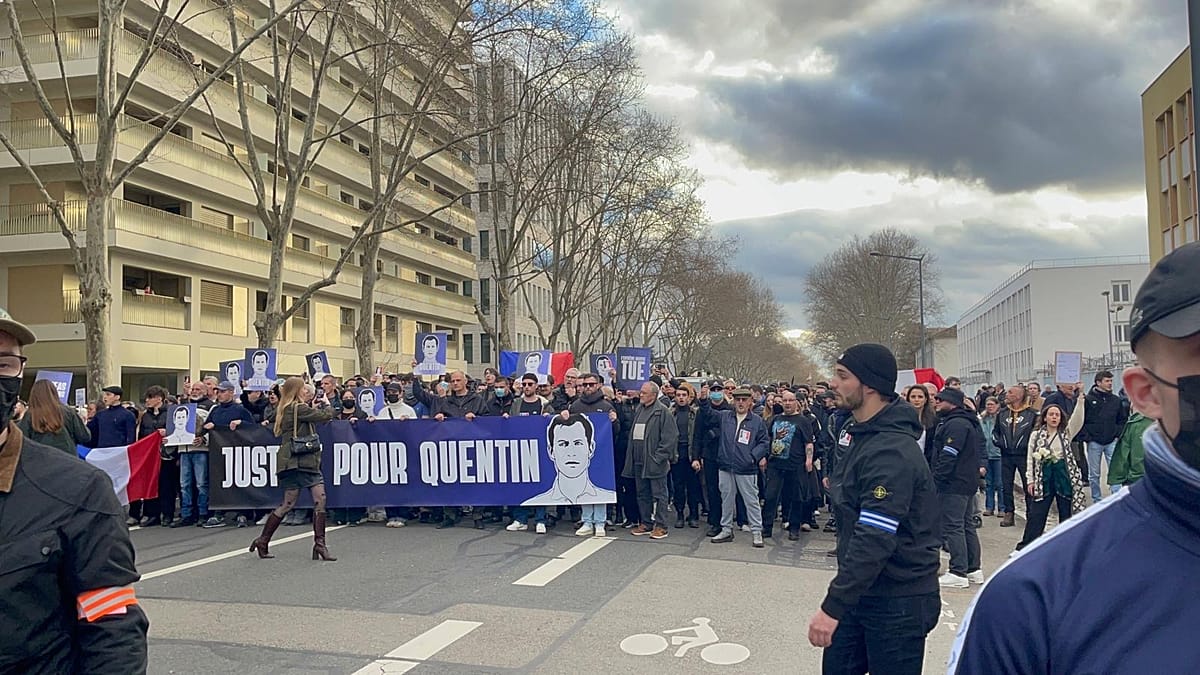
Around 3,200 people took part in a demonstration led by far-right groups on Saturday, following the death of a nationalist activist who was beaten in the French city of Lyon.
French President Emmanuel Macron called for calm ahead of the tribute to Quentin Deranque, 23, who died of brain injuries in a hospital last week. The demonstrations took place under heavy police scrutiny, with no major incidents reported.
The mayor of the 7th arrondissement neighbourhood, Fanny Dubot, told Euronews that security had been stepped up at potentially threatened locations, such as an LGBT bar and a mosque.
“This is a moment of remembrance and respect for this young compatriot who was killed, for his family and loved ones. That must come first. And then it is a moment of firmness and responsibility,” Macron said.
Seven people have been handed preliminary charges. The Lyon public prosecutor’s office requested that each of them be charged with intentional homicide, aggravated violence and criminal conspiracy. Six of the accused were charged on all three counts. The seventh was charged with complicity in intentional homicide, aggravated violence and criminal conspiracy.
Deranque was attacked during a fight that erupted between far-left and far-right supporters on the margins of a student meeting where a far-left lawmaker, Rima Hassan, was a keynote speaker.
Macron said he will hold a meeting with ministers next week to carry out a comprehensive review of all violent activist groups that have links to political parties. He hinted that some groups could be dismantled.
“In the republic, no violence is legitimate,” he said. “There is no place for militias, wherever they come from. We must be absolutely uncompromising.”
Lyon emerges as a battleground
The main tribute to Deranque took place in Lyon, where clashes between far-right activists and far-left groups have become frequent. Their fighting often takes the form of organized street battles in the city, sometimes involving groups of several dozen people.
Lyon’s far-left-leaning militant groups are more recent and were created in reaction to the many far-right groups that have been present for several decades. The city is seen by intelligence services as the cradle of far-right activism in France.
Deranque’s parents also called for calm and did not take part in the tribute, which was not banned by French authorities.
Deranque’s death triggered a storm of recriminations, mostly blaming the far-left France Unbowed party and its leader, Jean-Luc Mélenchon. Among the suspects is the parliamentary aide of a France Unbowed lawmaker who set up the anti-fascist group The Young Guard.
There was a minute’s silence before the start of the march. Some demonstrators held white tulips and displayed stickers bearing the slogan: “Quentin, killed by Mélenchon’s militia.”
Many men dressed in black, some with their faces partially covered, joined the march. Christian Petiteau, 70, who traveled from the neighboring Isère region, said Deranque was “cowardly murdered” and that he came to honor his memory.
Far-left in focus
France Unbowed’s opponents accuse it of fomenting violence and tensions with its combative far-left politics. Mélenchon has condemned the violence and insisted that his party bore no blame for the tragedy.
Mélenchon stood for the presidency in 2012, 2017 and 2022, but failed to advance to the decisive runoff round. He is preparing for another expected run next year, when Macron’s second and last term ends.
France is holding municipal elections next month and right-wing political forces have been using the incident to demonize France Unbowed. Far-right National Rally leader Jordan Bardella has called for a common front against Mélenchon’s party.
Criticism also came from prominent figures on the left, including former French President François Hollande. He said the mainstream left, including his Socialist Party, must not team up again with Mélenchon’s party for the upcoming elections, as they did in the past.
Video editor • Rory Elliott Armstrong
Additional sources • Omid Lhabi