
The opinions expressed in this article are those of the author and do not represent in any way the editorial position of Euronews.
“Rabbi, you speak about peace and coexistence, but look at what is happening around us. Is that even realistic?” a fellow synagogue member asked me in Istanbul this morning.
And then, not long after: “Rabbi, how can you not condemn what is happening in the West Bank? And the language being used by people online, even those who call themselves rabbis?” a noted Muslim professor of Judaic studies remarked, quite harshly.
I do not dismiss either. Both come from a place of concern, reflecting the moment we are living in, shaped by outrage on one side and fear on the other.
Jewish Passover: Responsibility toward the suffering of others
As Jews prepare for Passover, I find myself thinking less about the ritual and more about the responsibility it carries. The Mishnah in Pesachim teaches that in every generation, each person is obligated to see themselves as if they personally left Egypt.
The standard reading is about memory. But I read it as an obligation. If you personally left Egypt – if you know what it is to be the stranger, the persecuted, the displaced – then Passover does not only give you a story about your own suffering. It gives you a responsibility toward the suffering of others. And yet the region feels anything but shaped by that responsibility.
Today, the Jewish presence in Egypt is almost gone. A community that once numbered in the tens of thousands is now reduced to a few individuals, some ten in Cairo and perhaps twenty in Alexandria.
On a recent visit to Fostat in Cairo, I stood in the 1,000-year-old Ben Ezra Synagogue, now a tourist site. “Don’t pray here. It is a museum,” the guard told me. Like the small Jewish community in Syria, they rely on shipments of matzah and other basic necessities of Jewish life brought in each year through the Alliance of Rabbis in Islamic States.
Antisemitism is directed at Jews who have no connection to political events
In recent months, I have heard the deep anger and pain felt across much of the Muslim world over the suffering in Gaza. It is real and deeply felt. It cannot be dismissed.
But I have seen how that outrage travels and is magnified. Too often, it spills over into antisemitism directed at Jews who have no connection to the events being protested. As I write these lines, I am reading reports of four Hatzalah ambulances set on fire in London in what appears to be an antisemitic attack.
Fear has taken hold in Jewish communities since the October 7 massacre. It has reshaped how people think about safety and belonging, even far from the conflict, in the United States and in Europe.
All of this is happening as the war in the Middle East intensifies, now extending into direct confrontation with Iran. Countries in the Gulf, including Saudi Arabia, the United Arab Emirates and Qatar, where we have many friends, have come under missile and drone attacks despite not being direct actors in the war.
West Bank: violence against civilians deepens fear and mistrust
In places like the West Bank, there is recurring violence against civilians, including by young Jews, that only deepens fear and mistrust. This kind of violence does not only harm its immediate victims.
It endangers neighbors and brings shame and danger to everyone. In moments like this, I ask myself what our role is as religious leaders. I cannot influence governments or military decisions, and unfortunately I do not have the ability to persuade zealots. But I do have a voice within our own communities. And I have learned that how we use that voice matters.
There is a strong instinct to demand condemnation. To say the right words and draw moral lines. I understand that instinct. But I also ask: does it change anything? In my experience, it rarely does. More often, it deepens divisions, discredits the messenger, and raises the temperature without lowering the pain. This does not mean that wrong should be ignored. But words alone are not enough.
The Talmud in Gittin teaches that we feed the poor of non-Jews alongside the poor of Israel, visit their sick, and bury their dead – mipnei darkei shalom, for the sake of peace. This is not modern interfaith dialogue. It is a rabbinic obligation, codified law more than fifteen hundred years old.
Let us do good: Jews and Muslims – our future is together
What follows is not innovation. It is Jews doing what Jews have always been required to do. In our own building in Istanbul, neighbors share ashure and exchange greetings on each other’s holidays in the building WhatsApp group.
These are small gestures, but they keep relationships intact even when the world outside feels like it is pulling people apart. Through ChabadAid, Jewish volunteers have distributed over 100,000 Ramadan food packages in Nigeria and helped bring clean water to Muslim villages. In Damascus, together with the Syrian Mosaic Foundation, Joe Jajati and Bekhor Chemantob distributed meat to families in need during Ramadan in cooperation with the Imam of the Lale Pasha Mosque.
People do not live in statements. They live in neighborhoods. And in those neighborhoods, the question is not who is right. It is whether people can still look at each other without fear. Rabbi Tarfon taught in Pirkei Avot: It is not your duty to finish the work, but neither are you at liberty to neglect it.
That is the answer to the questions I was asked this morning. You do not have to solve the Middle East. You are not permitted to do nothing. The Lubavitcher Rebbe taught that bringing light into the world is not an abstract idea but a practical responsibility, one action at a time. So let us do good. Jews and Muslims – our future is together. Hag Sameach!
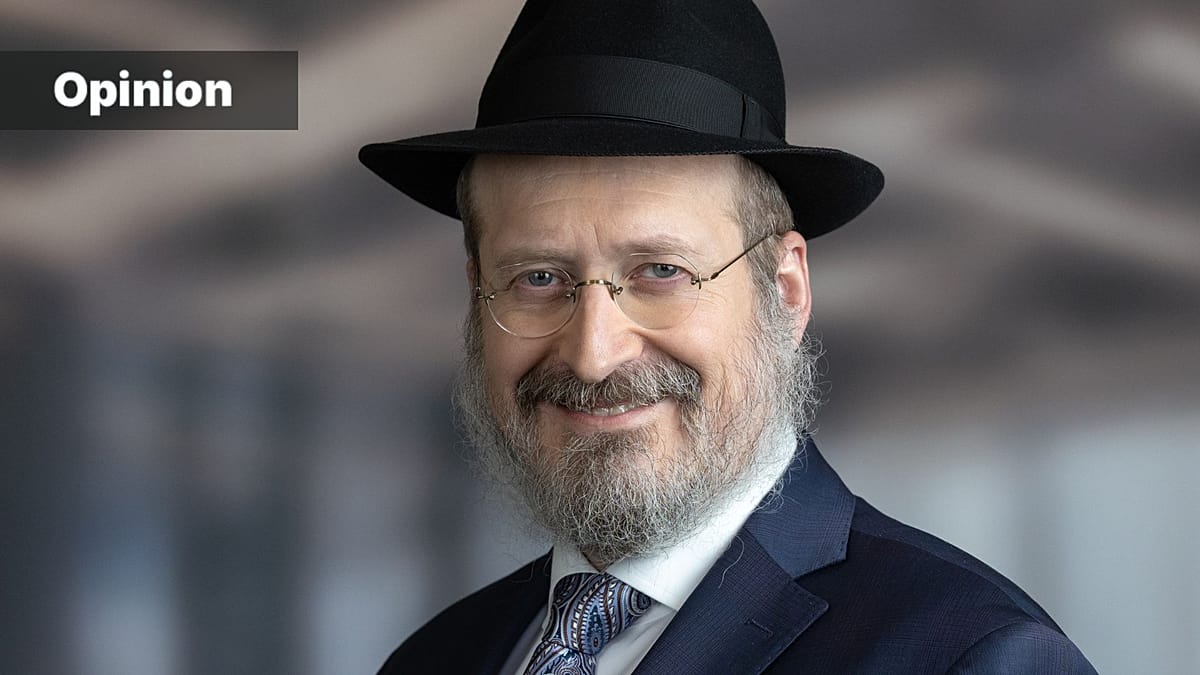
Rabbi Mendy Chitrik is Chairman and Founder of the Alliance of Rabbis in Islamic States; he himself serves as a rabbi in Istanbul, Turkey. The organisation includes rabbis active in Albania, Azerbaijan, Morocco, Turkey, Tunisia, Iran, Kazakhstan, Kosovo, Kyrgyzstan, the United Arab Emirates, Nigeria, Uganda, and Uzbekistan.