
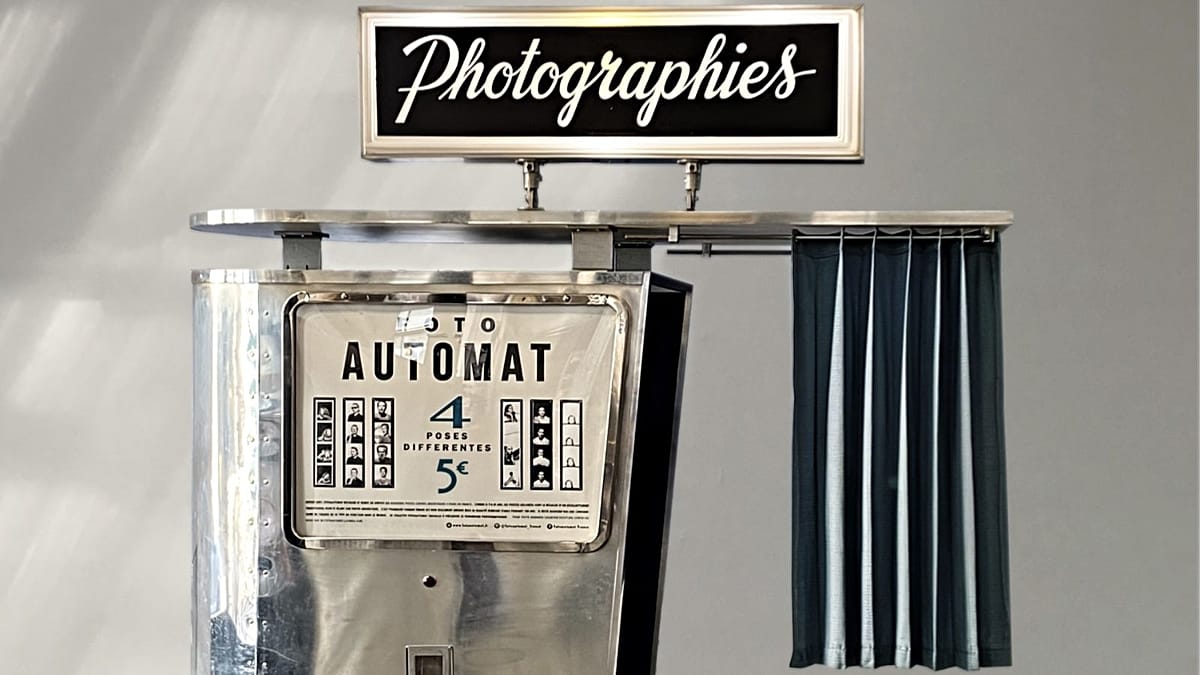
In this digital age, photo booths have almost become relics of the past.
You sometimes pass them in the corners of desolate shopping centres, train stations or hear a person grumbling inside as they attempt to get just “one decent passport photo”.
They’re still around, but hauntingly inconspicuous – like furniture from a home that’s long been abandoned.
Yet within each one remains a myriad of memories. Every swish of the curtain, every flash of the camera once hosted a stranger’s private expressions; their printed memento a rare form of permanence in this fleeting existence.
Photo booths first emerged more than 100 years ago, when Jewish immigrant Anatol Josepho installed the first of his automatic ‘Photomatons’ on Broadway, New York, in 1925.
“The machine made eight pictures in twenty seconds and the British Journal of Photography noted that the machines were ‘besieged nightly by queues of amused theatre goers’,” Dr Michael Pritchard, a photography historian and former CEO of The Royal Photographic Society, told Euronews Culture.
Similar to a gumball machine, they worked via an inserted coin. This spontaneously triggered the shutter and flash, followed by the chemical processing of black and white images on to photosensitive paper.
Back then, such immediacy was unheard of. If you wanted your photograph taken, you had to find a professional, which was often expensive and required a decent amount of luck. As such, demand for photo booths spread quickly – and so did a newfound artistic autonomy.
“The Photomaton offered photography without a photographer. You were both the subject and the photographer,” Raynal Pellicer, a French filmmaker and author, told Euronews Culture.
“You were now free to break with all photographic conventions: turning your back to the lens, letting yourself go and making all kinds of funny faces. Above all, it was an intimate space. A space of total freedom for couples… All kinds of couples: gay, interracial.”
Final curtains
As digital technology took over at the turn of the millennium, most of the old machines were replaced. The newer models featured touch screens, internet connectivity, and the ability to preview pictures, which made them feel slicker and more controlled – but less magical.
“Analogue booths have become rare artefacts; they are part of a photographic heritage that nearly vanished,” Eddy Bourgeois, the co-owner of French company Fotoautomat, told Euronews Culture.
“The digital booths that replaced them allowed for rapid photo production while drastically cutting maintenance and operating costs – though at the expense of the final result, as print quality was never a decisive factor.”
Bourgeois began restoring old photo booths in around 2007 – a time when analogue media was fast disappearing.
However, as he installed the machines in museums around Paris, he noticed something unexpected: They became novel again. Portals to a past world that once again encouraged creativity and playfulness.
“People stopped using it for identification purposes and started using it for fun, to shed their inhibitions, to experiment, and to create,” he told Euronews Culture.
“The medium itself lends itself perfectly to this: the quality of the four-pose prints and the vertical, cinematic format invite storytelling.”
Spanning time
Throughout the decades, the curtained confines of photo booths have stirred many an artist’s imagination. These include Andy Warhol and Salvador Dalí, both of whom embraced their liminal appeal: unconscious spaces, free from societal rules and rationality.
“The [photo booth] image is never fully controlled; it retains a spontaneous, slightly accidental quality – the antithesis of the polished, retouched images seen everywhere today,” said Bourgeois.
“There is also the paradoxical intimacy of the booth: an enclosed space within a public setting.”
In films like Buffalo ’66 (1998) and Amélie (2001), this “paradoxical intimacy” has made them mechanisms for exposing characters’ internal emotions and conflicts.
It’s a bright red Photomaton that introduces Amélie to her love interest – a man who collects discarded photo strips – and becomes a catalyst for romance, mystery and adventure.
More than that, it’s a powerful metaphor for the movie’s themes: a symbol of the quiet ways we connect with others, and allow ourselves to be seen.
In an era of incessant self-promotion, the photo booth remains an antithesis. It is somewhere free from criticism, comparison or overthinking. Somewhere anonymous, unpredictable, and completely human.
Pellicer, who has been collecting old photo booth images for decades, believes these qualities are what will keep them alive.
“The younger generation is showing incredible enthusiasm for this old school style of self-portraiture. Collectives in major European and American cities are restoring and operating these vintage booths,” he said.
“In the digital age, few would have bet on the survival of these analogue booths; fifteen years ago, only about fifty were still in operation worldwide. Today, there are between 300 and 400.”
Maintaining the old booths has become even more challenging, however. The specialised black and white paper used in classic analogue machines was famously made by a Slavich company in Russia, which is no longer accessible due to the Ukraine war.
“Then there is the mechanical aspect,” said Bourgeois. “The booths still run on original period parts, which must be repaired and preserved, as they are impossible to replace. We therefore constantly have to find and develop alternatives to keep them operational.”
But despite this, the effort is worth it for enthusiasts.
While digital photo booths still have their place – especially at pop-up events and weddings – the older models provide something hard to find anywhere else.
A flicker of nostalgia; a feeling of escape.
“Once the curtain is drawn, freedom is absolute, guaranteed by the absence of negatives or internal memory: each print is a unique copy,” said Bourgeois.
“Then there is the black-and-white aesthetic, the distinctive sharpness of analogue film, and the experience of walking away with a tangible image in hand.”