
The Venice Biennale is one of the world’s most prominent art happenings, a dynamic, global event coloured by and, in turn, commenting on the socio-political order of the day.
For the 61st edition, however, late curator Koyo Kouoh’s vision was to reorient the show away from the “anxious cacophony of the present chaos raging through the world” to focus on softer tones of emotion, connectivity and grounding, encapsulated in the theme ‘In Minor Keys’.
After Kouoh’s passing in May 2025, the Cameroonian-Swiss curator’s concept for the Biennale is now being realised by her team. It provides a framework for the works on show in the central exhibition, spread across two principal venues in the Giardini and the Arsenale and featuring 111 artists, as well as a guiding theme for the national pavilions.
Soulful, sensory and spiritual
Kouoh’s polyphonic theme manifests itself in a series of interconnected motifs: Shrines, Procession, Schools, Rest and Performances. Weaving between them are core values of quietude, nurture, intimacy and reflection.
The exhibition explores how connectivity can be unconscious, emerging when the interests of unrelated artists and movements find affinity – an expansion of what Kouoh called “relational geography” defined by encounters and the memories formed.
Visitors are invited to move through the show in a meditative state, reconnecting with the soulful, sensory, and spiritual – to “tune in sotto voce”. It’s a radical invitation in today’s world: to slow down in a space where “time is not corporate property nor at the mercy of relentlessly accelerated productivity”, Kouoh wrote in her manifesto.
Gardens and oases
A key conceit in the exhibition is the introduction of “an archipelago of oases”: spaces rich with memory and emotion that were central to major artists’ universes. There’s Issa Samb’s former courtyard (La Cour) on Rue Jules Ferry in downtown Dakar; Marcel Duchamp’s last studio, where he worked for 20 years in secret on the same installation; and Werewere Liking’s Village Ki-Yi MBock, a theatrical cooperative in Abidjan, Côte d’Ivoire.
Another imaginative space is the garden, both experiential and metaphorical, designed as a place of sustenance and reconnection. For example, Linda Goode Bryant’s Still Life will take the form of an urban farm, which will be tended to by formerly incarcerated women throughout the duration of the exhibition.
Kouoh’s Schools motif is also a kind of garden, for the nourishment and nurture of learning and creativity. Represented by artist-led organisations such as Raw Material Company in Dakar, GAS Foundation in Lagos, and the Nairobi Contemporary Art Institution, what connects these homegrown institutions is “an ethos to convene, share knowledge, to stay a while, to take apart, to sow seeds of intent, and build centres that proliferate without the intervention of commercial markets”.
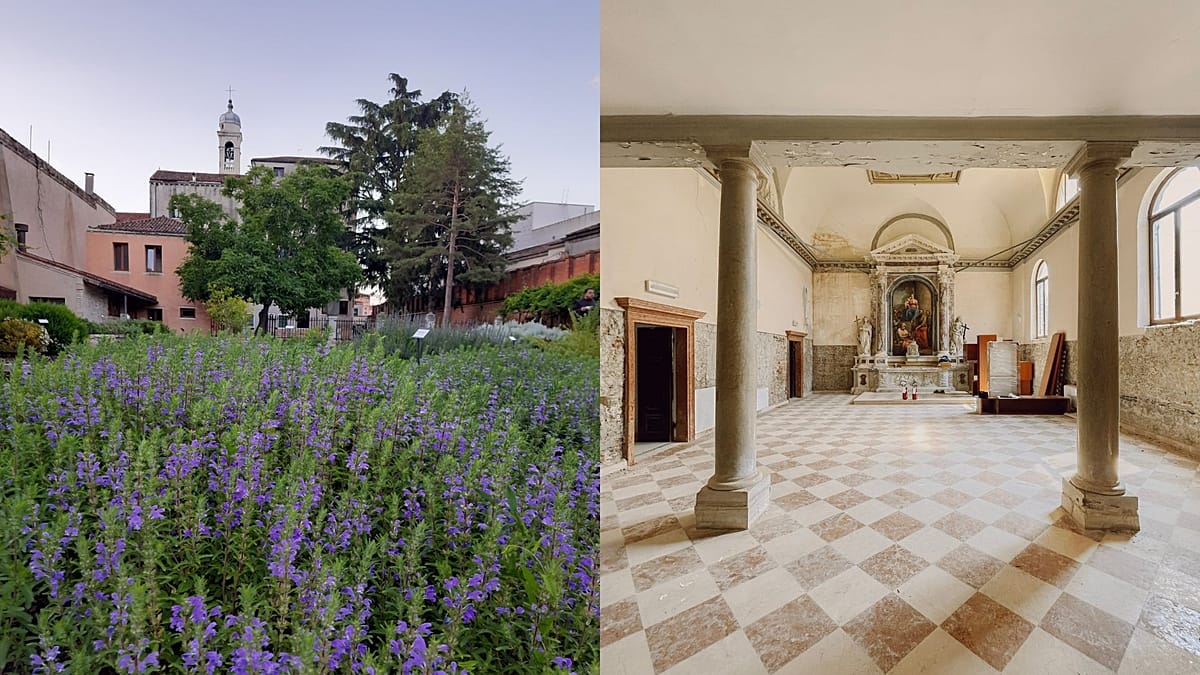
Some national pavilions will also be transformed into spaces of contemplation and connection. The Holy See Pavilion will feature a sound-based experience inspired by the writings of 12th-century abbess Hildegard of Bingen, allowing visitors to listen to a “sonic prayer” as they meander through the cloistered 17th-century garden.
For Qatar, artist Rirkrit Tiravanija has designed a tent-like structure to serve as a place for cultural exchange, with a film by Qatari-American artist Sophia Al-Maria, live performances organised by Lebanese artist Tarek Atoui, a large-scale sculpture by Kuwaiti-Puerto Rican artist Alia Farid, and a culinary programme of Middle Eastern cuisine designed by Palestinian chef Fadi Kattan.
Processions and the carnivalesque
Kouoh’s Procession motif celebrates human connection and collective participation. Artists including Big Chief Demond Melancon, Nick Cave, Alvaro Barrington, Daniel Lind-Ramos, and Ebony G. Patterson explore gatherings whose purpose ranges from circadian celebrations and rituals in diasporan centres and peripheries, to communions between the living and the ancestors.
Carnival is also represented as “a stitch in time where relations of power are momentarily subverted and scrambled”. Established norms in art history and classical literature are subverted in the work of Johannes Phokela, Tammy Nguyen, Buhlebezwe Siwani, Sammy Baloji and Godfried Donkor.
The installation of the central exhibition by Wolff Architects draws inspiration from two books – One Hundred Years of Solitude by Gabriel García Márquez and Beloved by Toni Morrison – to create a visitor experience that is more sensory than didactic and encourages intimacy and interaction.
The Japan Pavilion also embraces participation, with Grass Babies, Moon Babies by Japanese American queer artist Ei Arakawa-Nash. Upon entering, visitors are invited to carry one of 200 baby dolls through the Pavilion’s pilotis, gardens and interior spaces. Visitors participate in an act of collective care by changing the dolls’ diapers and activating a QR code that delivers a “diaper poem” based on each baby’s assigned birthday.