


Published on •Updated
The sixth Nomad Games closed with a grand concert and ceremony at the venue of the games, the great hippodrome in Cholpon Ata on the shore of the Issyk-Kul lake in Kyrgyzstan.
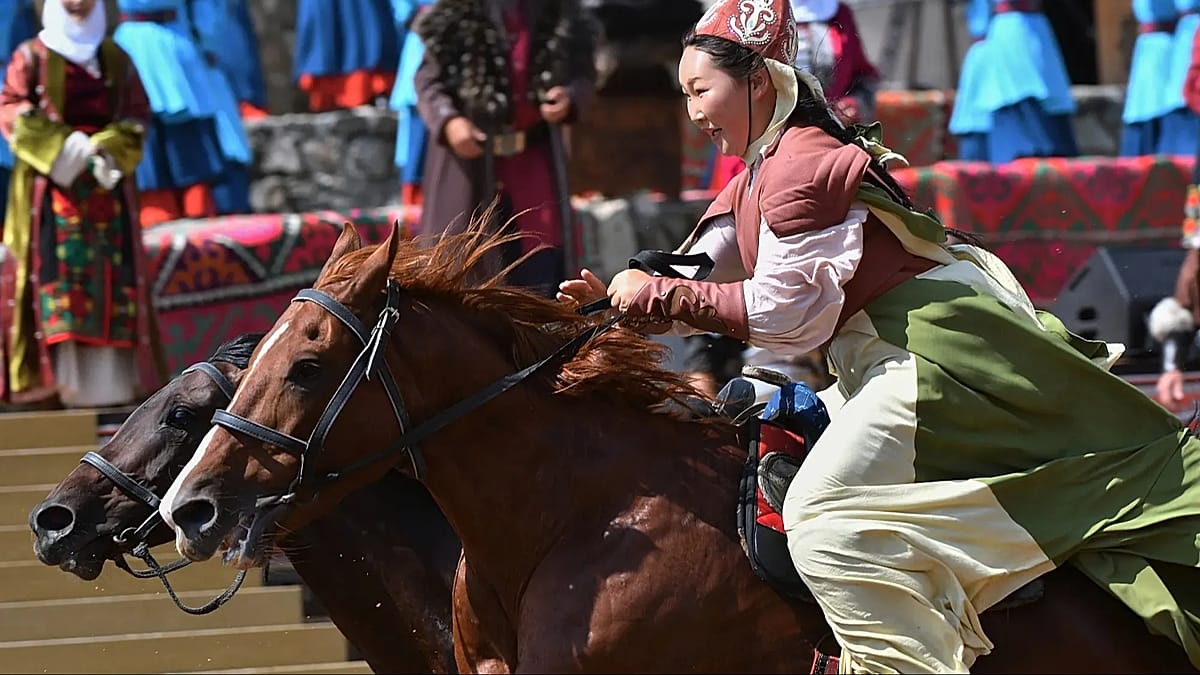
But, not before they gave the spectators the treat they had been waiting for for two years, the finals in kokpar and kok boru equestrian games by far the most popular event in any Nomad Games. Kokpar is traditionally Kazakh game and kok boru Kyrgyz. They are very similar, requiring the mounted teams of four players to carry a weighted dummy (representing a goat carcass) to the opponents huge pot (kok boru) or circle marked on the ground (kokpar).
The main powerhouses in the sports are the ones they originated from, Kyrgyzstan and Kazakhstan and they met in the finals after beating other teams in their groups.
The tickets for the matches were sold days in advance and more than 30,000 were sold. The big hippodrome in Cholpon Ata was full to the last seat with some more people standing in the surrounding fields. Many travelled from the regions of Kyrgyzstan but there was also a sizeable (and loud) crowd who travelled from the neighbouring Kazakhstan.
In two previous Games, Kazakhstan emerged victorious but this time around the Kyrgyz team successfully defended their home turf. Kazakhs suffered a painful 12:0 defeat in kok boru and another one in kokpar 7:2.
The bronze medal in kokpar went to the Russian Federation team after they beat Uzbekistan 5:4.
Six days of the games saw more than 3,000 sportsmen from 109 countries competing in 42 traditional disciplines. It was the most numerous edition of the Games so far with many newcomers from all continents such as Afghanistan, Cape Verde, Algiers, Barbados, Brunei, Saudi Arabia, Bhutan, Croatia, to name but a few.
At the closing press conference, the organisers said that the most successful team in the number of medals was the home team, Kyrgyzstan, with 71 medals. The second on the list was Kazakhstan with 65 medals.
However, after overnight deliberation on how the medals are actually counted, the final medals standing put Kazakhstan at the top of the list with 72 medals, 32 of which are gold, with Kyrgyzstan following closely with 77 medals, 30 gold ones.
The President of Kazakhstan Kassym-Jomart Tokayev congratulated the Kazakhstan team for the successful performance. He emphasized that the achievement was possible because of the commitment, hard work and iron will of the athletes.
He expressed gratitude to the champions and prize winners, trainers and all the specialists whose work strengthens the international authority of Kazakhstan as a country which nurtures national types of sports.
Closing the Games, the Prime Minister of Kyrgyzstan Adylbek Kasymaliev said that the Nomad Games gradually become comparable to the Olympic Games and the footbal World Cup – a big sports event followed by the people all over the world, while at the same time, establishing itself as a new force in the world of culture.
Culture of the nomads
The main goal of the Games is to promote and revive nomad traditions and culture. Therefore, along the games more than 600 cultural events took place. Exhibitions, song contests, music festivals, culinary competitions and workshops and handicraft exhibitions engaged thousands of visitors.
The most important scientific event was the conference “Nomadic Civilizations: Heritage, Paradigms, and Prospects”. It gathered researchers, scholars and experts from 21 countries. They exchanged knowledge and debated the role and influence of nomadic culture in the modern world and agreed to organize joint research, establish a common digital data base and apply for cooperation with relevant international institutions.
More than 2,000 domestic journalists, 250 foreign ones and 300 bloggers reported from the Games. The next ones will be held in 2028 in Kazan in the Republic of Tatarstan in the Russian Federation.