




A question many of us have posed in our minds is where would you go if you had a time machine?
Would you head for the year 3000 to see what has become of the human race? Or would you crank the dial backwards like Marty McFly and risk sabotaging your own future? Before you start packing, a physicist has some news that may ruin a few Marvel movies: you may only be able to go one way, and it isn’t backwards.
Hongsheng Zhang, a researcher at the University of Jinan in China, has shown that in a broad class of theoretical universes, travelling into your own past is impossible.
The whole argument rests on one fact: “light can never point sideways to a traveller’s direction in time,” Zhang says.
Imagine spacetime sliced into layers that light itself can travel along. Anything moving slower than light must cross these surfaces in the same direction, like climbing a staircase that never lets you step down.
If you can only ever go up, you can never arrive back on the step where you started.
“My paper asks a narrower question: when does a spacetime permit such a loop, and when does the geometry itself forbid one?” Zhang told Euronews Next.
The two loopholes
Physicists call journeys to the past “closed timelike curves”: routes through spacetime that loop back to the very place and moment they began.
“Suppose you wanted to shake hands with your younger self,” Zhang says. “To do that you would need a path through spacetime that loops back on itself without ever exceeding the speed of light.”
Einstein’s equations allow such paths in a handful of scenarios, such as near the core of a spinning black hole.
Crucially, Zhang’s research, which has been submitted for peer review, also reveals exactly how a time machine could get around it, and there are only two ways.
The first is twist. Imagine light rays that, instead of travelling side by side, spiral around one another like the strands of a rope. When that happens, the neat surfaces of light can’t form, so there is no staircase to keep you climbing.
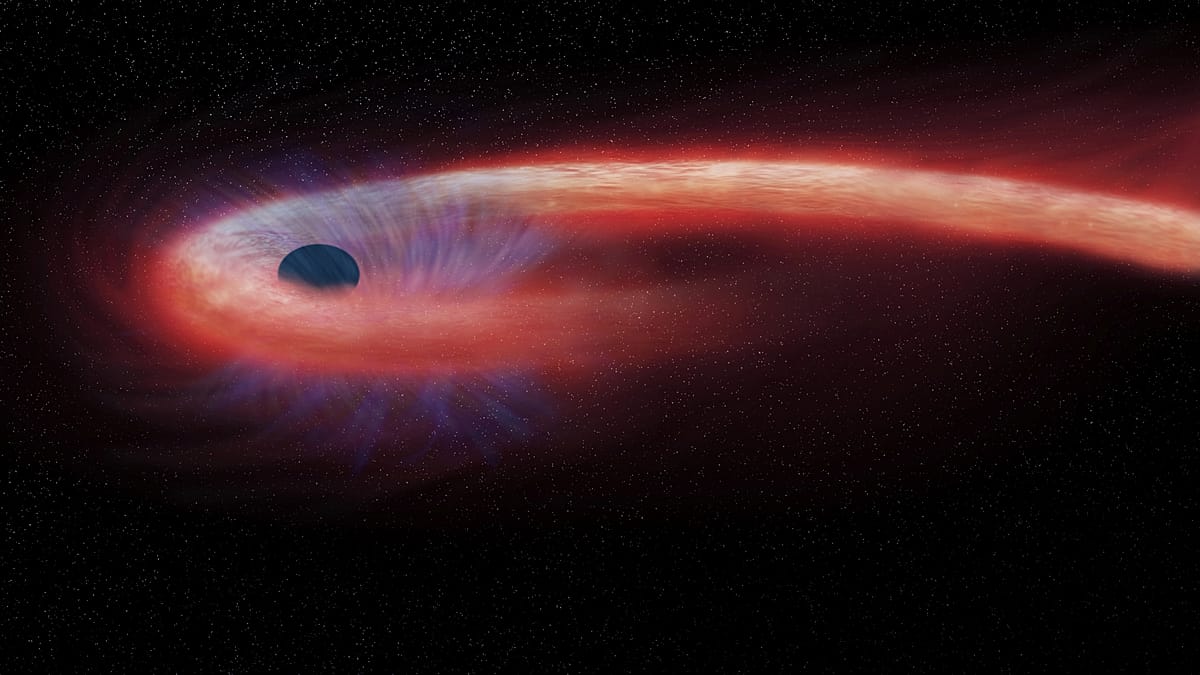
This is what happens near the centre of a spinning black hole. Einstein’s theory says a spinning mass drags space and time around with it, and close to the black hole’s core the drag is so strong that moving “forward in time” is bent into a circle.
A traveller following that circle would see their clock ticking forward in time as normal, yet their journey would arrive back at the moment they set off. Physicist Brandon Carter showed in 1968 that such loops exist inside spinning black holes.
But Zhang stresses that twist alone is not the culprit. “Twist on its own does not create a closed curve. It only blocks my argument,” Zhang says. “Twist is everywhere in the universe and, as far as we know, harmless.”
The second is the shape of the universe itself. The staircase might be perfectly built, but it could lead around the sides of a building, so the top step leads straight back to the bottom, like the impossible staircases in an Escher drawing. You would keep climbing and still end up where you began. Most of the time machines physicists have designed on paper, including those built from wormholes, rely on this trick.
Physicists call this loophole topology, and Zhang believes it is the one to watch. “The loophole that could matter is topology, and that is exactly the one that looks least likely to arise without deliberate engineering,” Zhang says.
Destination: tomorrow
Trips to the future, by contrast, are already well established. Einstein showed that moving very fast, or sitting in strong gravity, slows your clock relative to everyone else’s. Astronauts returning from six months aboard the International Space Station are about five thousandths of a second younger than they would otherwise have been, according to the European Space Agency.
Zhang is keen to stress the limits of the work. “This is not a claim that time travel is impossible,” Zhang says.
For now, though, you may want to pack for tomorrow rather than yesterday… unless you have the Time Stone, of course.