
Close Menu
Daily Guardian EuropeDaily Guardian Europe
  • Home
  • Europe
  • World
  • Politics
  • Business
  • Lifestyle
  • Sports
  • Travel
  • Environment
  • Culture
  • Press Release
  • Trending
What's On

Hamas to blame for lack of progress on phase two of ceasefire, Board of Peace report says

May 20, 2026

Meloni blasts far-right Netanyahu ally for taunting Italian activists – POLITICO

May 20, 2026

Europe Today: EU strikes deal on trade pact with US as Putin meets Xi Jinping in China

May 20, 2026

No country has ever developed without urbanising, World Bank economist tells Euronews at Baku forum

May 20, 2026

High-stakes Makerfield by-election set for June 18 – POLITICO

May 20, 2026
Facebook X (Twitter) Instagram
Web Stories
Facebook X (Twitter) Instagram
Daily Guardian Europe
Newsletter
  • Home
  • Europe
  • World
  • Politics
  • Business
  • Lifestyle
  • Sports
  • Travel
  • Environment
  • Culture
  • Press Release
  • Trending
Daily Guardian EuropeDaily Guardian Europe
Home»World
World

No country has ever developed without urbanising, World Bank economist tells Euronews at Baku forum

By staffMay 20, 20263 Mins Read
No country has ever developed without urbanising, World Bank economist tells Euronews at Baku forum
Share
Facebook Twitter LinkedIn Pinterest Email
By&nbspEsmira Aliyeva&nbsp&&nbspToby Gregory

Published on
20/05/2026 – 20:18 GMT+2

“No country has ever fully developed without urbanising,” World Bank Senior Economist Mark Roberts told Euronews at the World Urban Forum in Baku, in direct response to governments that treat urban growth as an issue to be managed rather than progress to be guided.

Roberts said the scale of investment required, particularly in Africa, was beyond any single actor.

“When it comes to urban infrastructure, the financing needs are tremendous for Africa in particular, as well as all the very fast-urbanising regions,” he said.

“No one agency, donor organisation or the public sector by itself is sufficient. It’s really about catalysing finance from a range of different sources, including from the private sector.”

Flooding and extreme heat were among the threats he cited as already disrupting how cities function.

On the growth pressures that urbanisation brings — traffic jams, rising land prices, housing strain — Roberts was direct.

“We get traffic congestion within cities, land prices tend to increase, but that’s because cities are attracting people,” he said.

“And that attraction of people to cities provides these tremendous opportunities in terms of economic growth and job creation.”

“Urbanisation is not something to be feared,” he said.

Not everyone shares Roberts’s optimism. Experts and local leaders alike argue that rapid, poorly managed urbanisation in Africa and South Asia has produced vast informal settlements, worsening inequality and environmental degradation.

Dr Moges Tadesse, chief resilience officer for the city of Addis Ababa, warned that for many African cities the pressures of rapid urban growth are already outpacing governments’ ability to respond.

“Climate change is a global challenge, but it doesn’t affect only housing. It affects the economy, it affects also the human life, and it is very disastrous,” he told Euronews, calling for greater international investment to help vulnerable countries absorb costs generated largely by wealthier nations.

The World Urban Forum was established by the UN General Assembly in 2001 alongside the creation of UN-Habitat and has been held in a different city every two years since its first edition in Nairobi in 2002, which drew around 1,200 participants.

Previous host cities include Barcelona, Vancouver, Rio de Janeiro, Abu Dhabi, Katowice and Cairo.

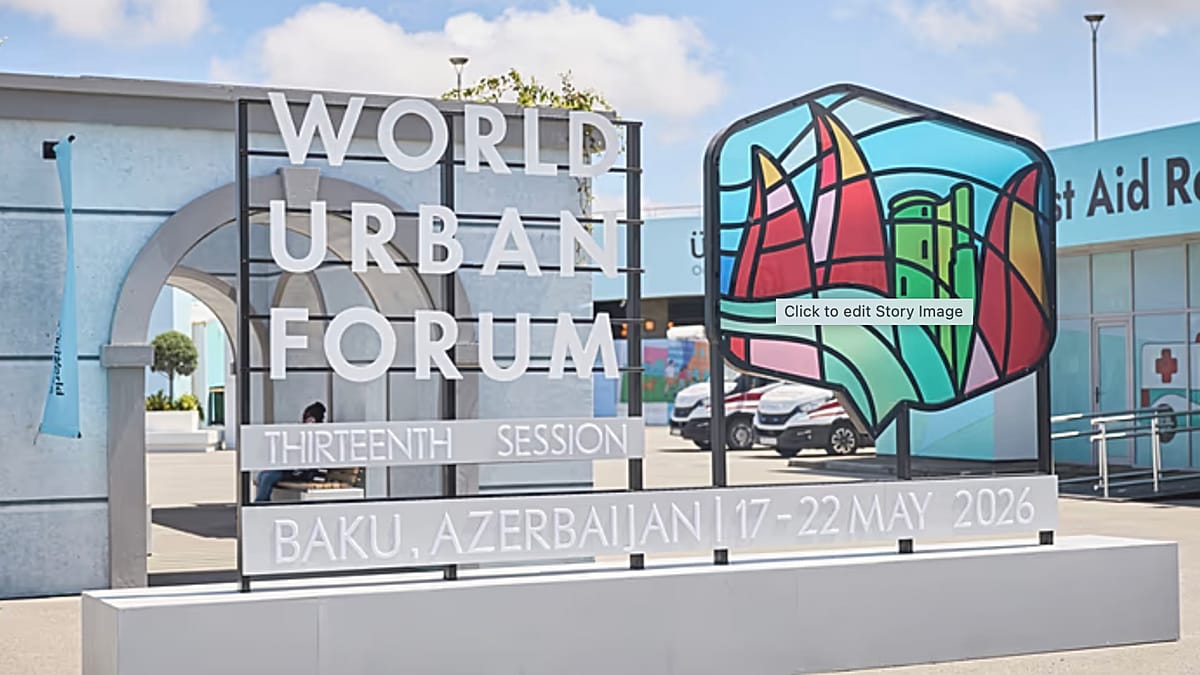
The 13th session, WUF13, is taking place in Baku from 17 to 22 May under the theme “Housing the world: Safe and resilient cities and communities.”

More than 40,000 delegates from 182 countries have registered, making it one of the largest editions in the forum’s history. For the first time, Azerbaijan convened a dedicated session at heads of state level.

The forum is expected to produce the Baku Call to Action, the outcome document intended to support the UN’s New Urban Agenda.

Share. Facebook Twitter Pinterest LinkedIn Tumblr Email

Keep Reading

Hamas to blame for lack of progress on phase two of ceasefire, Board of Peace report says

Video. Activists use giant Tedros and Bill Gates balloons at World Health Organization protest

Video. Rare aardvark born at UK’s Chester Zoo

Qatar’s tourism sector shows resilience and is ready to welcome visitors again

Putin – Xi meeting: 3 things you need to know

George Soros’ foundation pledges $300m to bolster US democracy amid government pressure

Video. Eurovision winner Dara turns Sofia into a giant ‘Bangaranga’ party

Tehran’s tiered internet leaves most Iranians in the dark 82 days on

Tripoli court acquits 31 Gaddafi-era officials of crushing 2011 Libyan uprising

Editors Picks

Meloni blasts far-right Netanyahu ally for taunting Italian activists – POLITICO

May 20, 2026

Europe Today: EU strikes deal on trade pact with US as Putin meets Xi Jinping in China

May 20, 2026

No country has ever developed without urbanising, World Bank economist tells Euronews at Baku forum

May 20, 2026

High-stakes Makerfield by-election set for June 18 – POLITICO

May 20, 2026

Subscribe to News

Get the latest Europe and world news and updates directly to your inbox.

Latest News

‘Global race for critical raw materials is about power,’ EU Commission says

May 20, 2026

Video. Activists use giant Tedros and Bill Gates balloons at World Health Organization protest

May 20, 2026

Greens chief Bas Eickhout quits EU Parliament after acknowledging ‘relationships’ – POLITICO

May 20, 2026
Facebook X (Twitter) Pinterest TikTok Instagram
© 2026 Daily Guardian Europe. All Rights Reserved.
  • Privacy Policy
  • Terms
  • Advertise
  • Contact

Type above and press Enter to search. Press Esc to cancel.