
Hello from Brussels. I’m Maïa de La Baume.
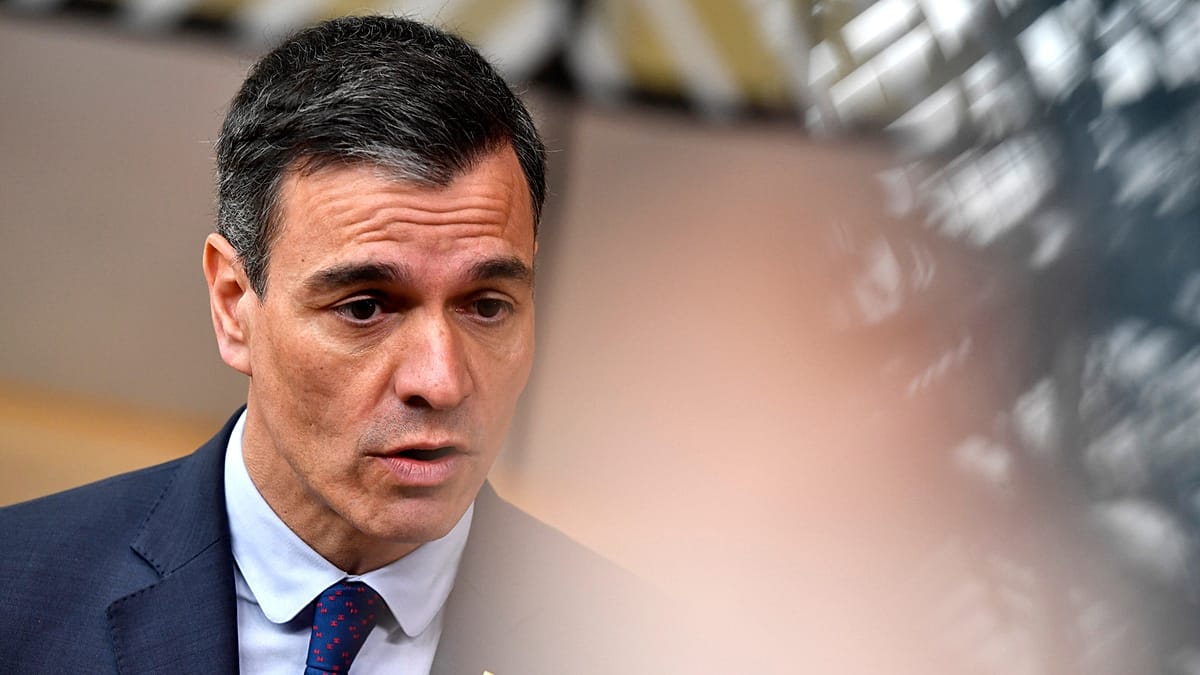
Spanish Prime Minister Pedro Sánchez issued a strong rebuke this morning to USPresident Donald Trump’s threat to halt trade with Spain, expressing his opposition to war and warning against what he described as the “erosion of international law.”
“The government’s position can be summed up in four words: No to war,” Sanchez said in a TV address from his Moncloa palace.
Reminder: Yesterday evening, the US President Donald Trump embarked on an unremitting denunciation of Spain and threatened to sever all trade ties with the country after Madrid denied the use of its military bases to U.S. forces involved in the attack on Iran. Trump also lashed out against Spain for not increasing its defence spending to meet his 5% of GDP target.
“Spain has been terrible,” Trump said during a meeting alongside German Chancellor Friedrich Merz on Tuesday. “We’re going to cut off all trade with Spain. We don’t want anything to do with Spain,” he added.
Since the war in the Middle East broke out last week, Spain has emerged as one of the most critical voices in Europe regarding the joint Israel–US strikes in Iran. In addition to denying the use of its military bases, Sánchez was the only European leader to openly condemn the strikes within hours of the outbreak of hostilities, warning that they could escalate regional tensions and “contribute to a more uncertain and hostile international order.”
Whether the current U.S.–Spain rift will lead to concrete consequences that ultimately affect Madrid remains an open question.
Amid this diplomatic uncertainty, attention in Europe is also turning to the economic consequences of the Middle East war, now in its fifth day.
With the halt of LNG production from Qatar’s and the closure of the straight of Hormuz, wholesale gas prices have soared in reaction to the war. Europeans are increasingly concerned that the bloc might soon face a prohibitive bill to refill its underground reserves, which are running low after the heating season.
Nadia Calviño, President of the European Investment Bank, told Europe Today this morning that the war in the Middle East “makes it more urgent” for Europe to “reinforce its strategic autonomy” in the field of energy as well as security and defense.
But gas prices kept climbing at a blistering pace in Europe on Tuesday. Europe’s benchmark gas contract, the Dutch TTF, climbed to more than €60 per megawatt hour (MWh) at around 12:30 CET on Tuesday, a significant jump from the low €30s at the end of last week. The European Commission convened an Oil and Gas Coordination Groups this morning, with officials saying that there was no immediate security of supply concern.
Disruptions of international trade also featured in a TV address by French president Emmanuel Macron yesterday evening. Macron announced that he had ordered the aircraft carrier Charles de Gaulle to be deployed to the Mediterranean, and that he would “build a coalition” to “restore and secure traffic along these maritime routes that are essential to the global economy.”
“Today, the Strait of Hormuz is effectively closed, and around 20% of the world’s oil and liquefied natural gas transit through it,” Macron explained. “The Suez Canal and the Red Sea are also under strain and under threat.”
Following the strikes against a British base in Cyprus, Macron also announced that his country would deploy “additional air defense assets” and the frigate Languedoc, “which will arrive off the coast of Cyprus as early as this evening.”
Concerns about Europe’s energy reserves also dominated the first visit to Brussels by the new Dutch prime minister, Rob Jetten.
In other news, the Commission is set to unveil its long-awaited industrial plan on Wednesday, aiming to protect the EU market from foreign competition, particularly from China.
The proposal is expected to include a 70% EU-origin requirement for electric vehicles, directly targeting Beijing’s dominance in the sector.
The plan marks a significant shift toward greater economic protectionism, amid concerns over the loss of about 200,000 jobs since 2024 in strategic industries such as steel and automotive manufacturing, with the goal of reviving production and encouraging new factories across the bloc.
Macron orders first evacuations of citizens as France boosts defences in the Middle East
In a televised address on Tuesday night, French President Emmanuel Macron blamed Tehran for the unfolding crisis while also criticising the US-Israeli strikes that triggered it, before announcing a raft of military and consular measures.
The Islamic Republic of Iran bears primary responsibility for this situation,” Macron said. At the same time, he argued the initial Israeli-American military operations “were conducted outside international law,” even as he urged the fighting to stop alongside Germany and the United Kingdom.
Macron also confirmed that a second French military facility had been hit in the strikes, sustaining only material damage, and said security would be reinforced at France’s bases in the region.
He announced that France will deploy air defence capabilities to several of these allied countries as part of a “defensive” force. The aircraft carrier Charles de Gaulle, he said, is heading towards the Mediterranean.
The French President also warned that key maritime corridors were at risk and said France was taking the initiative to protect them.
“We are leading efforts to build a coalition to bring together the means to restore and secure traffic,” in the Strait of Hormuz and the Suez Canal, which he described as essential sea routes for global trade and energy supplies.
More here from Sophia Khatsenkova
Iran war puts Von der Leyen’s expanding foreign policy role under scrutiny
Critics of European Commission President Ursula von der Leyen are casting her reaction to the US-Israeli war in Iran as the latest example of a foreign policy “power grab” – even as the commission’s formal diplomatic powers are limited and member states themselves are still grappling with how to respond.
When the war began with US strikes on Iran last Saturday, von der Leyen was the first leader across Europe to issue a reaction, calling the developments in Iran “greatly concerning”.
Since then, she has issued 12 posts involving Iran on X and held talks with at least 12 EU and gulf leaders, including the Crown Princes of Saudi Arabia and Bahrain.
She was also the first European leader to call for a “credible transition” in Iran – a stance not endorsed by the 27 member states, and one that aligns with the US and Israel in favouring regime change.
Three days after the first strikes, von der Leyen convened a “special Security College” meeting bringing together all 27 commissioners, including those with portfolios not traditionally associated with security policy, such as intergenerational fairness and social rights.
The meeting is intended to help the Commission “switch into a preparedness mindset” and improve understanding of emerging threats, including hybrid threats. However, the concept remains unclear to many in Brussels.
Von der Leyen’s critics argue that the emphasis on preparedness has become a vehicle for expanding institutional authority and projecting EU influence in foreign policy. Under EU rules, neither the Commission nor its president has any formal foreign policy role.
“She tries to take the lead in a field that should not be her field,” said Marc Botenga, a Belgian MEP from The Left. “She tries to concentrate power. If she does these things without mandate, this is not going to strengthen her position”
Read the story here.
More from our newsrooms
Middle East flights: Virgin Atlantic resumes scheduled Dubai to London route. Emirates, Etihad Airways and flydubai are continuing to operate a limited schedule, while Qatar Airways has extended its flight suspension until 6 March. More.
Iran war and your wallet — have you checked the bill? Following US and Israeli strikes this week Iran moved to block the Strait of Hormuz, the ultimate geopolitical chokepoint connecting the Persian Gulf to the open ocean. Euronews investigates the economic impact.
We’re also keeping an eye on
- Press conference of Executive Vice President Stéphane Séjourné on the Industrial Accelerator Act.
That’s it for today. Remember to sign up to receive Europe Today in your inbox every weekday morning at 08.30.