

Morning Brussels.
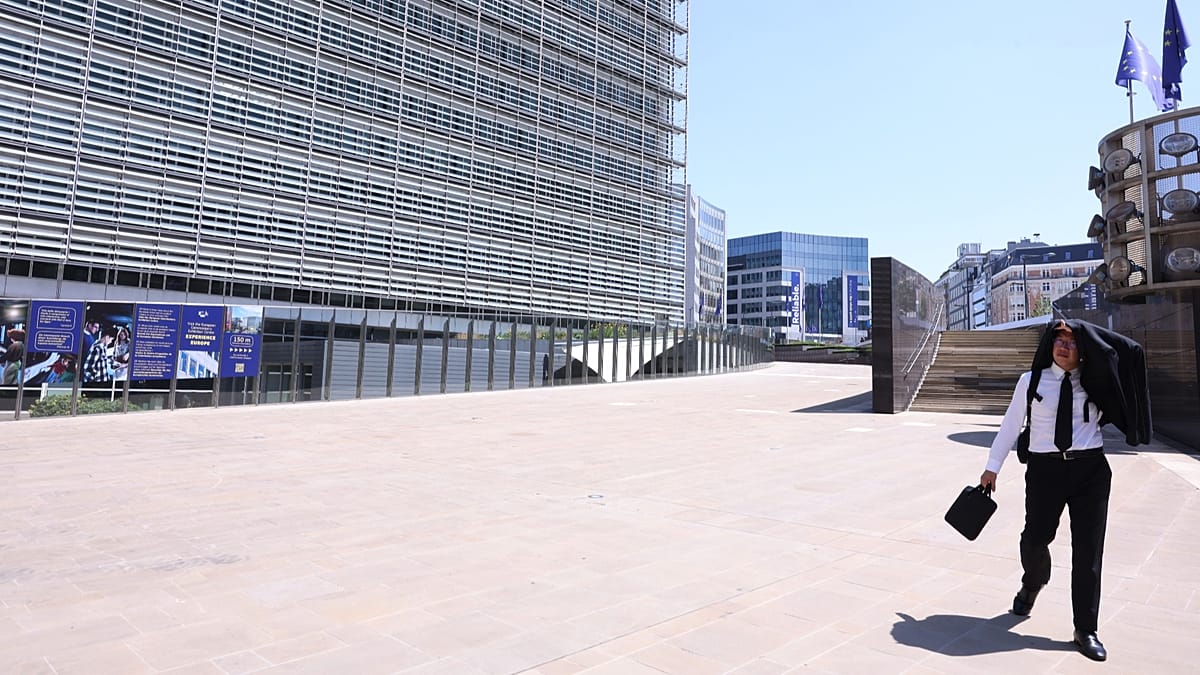
Angela Skujins sending you this newsletter on this scorching Thursday. Temperatures are set to soar across the continent, with no exception in the Belgian capital, as the country joined a longer list of nations to issue alerts due to the extreme heat.
Things are also expected to heat up almost 1,300 kilometres away in the Polish city of Gdańsk for the Ukraine Recovery Conference. NATO’s top boss Mark Rutte also continued a two-day trip to Washington, DC, using charts for dramatic effect, where things could also get spicy. And a high-ranking EU official will pay a visit to the Mediterranean island country of Malta to discuss the hotly-discussed issue of corruption.
First, let’s start with Ukraine.
As my colleague Sasha Vakulina wrote in an expected play-by-play published this morning, Ukraine’s President Volodymyr Zelenskyy’s absence from the two-day affair starting today could become the conference’s most significant political moment.
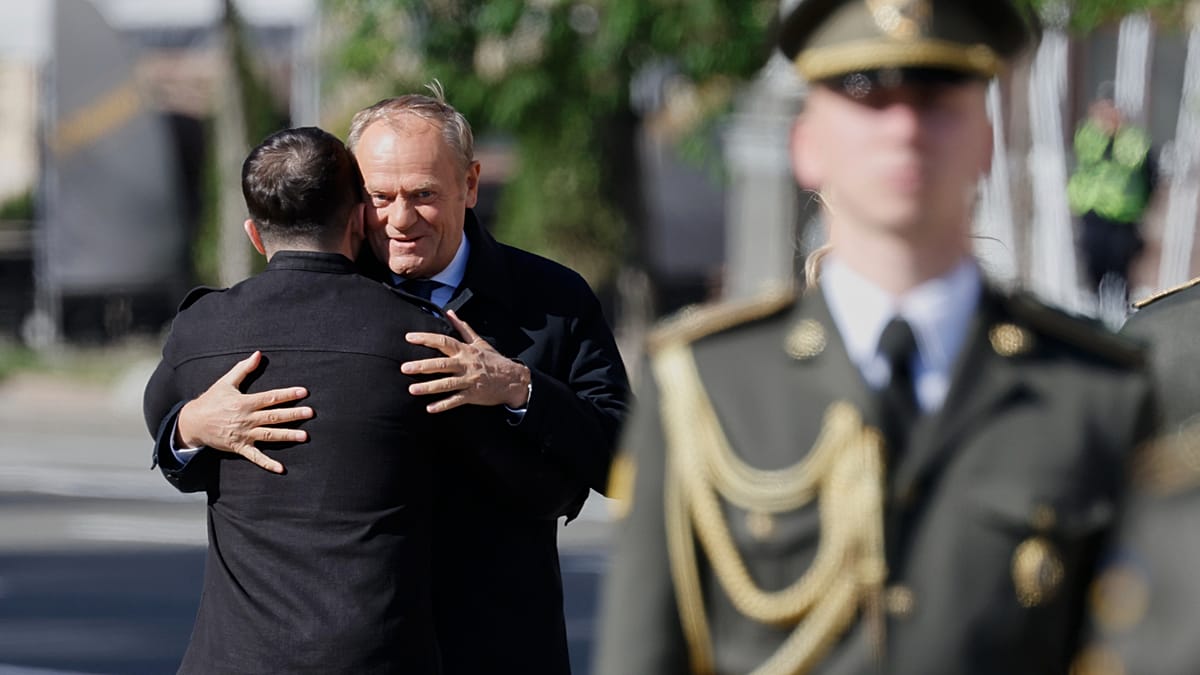
Partners at odds. From the outside, relations between Ukraine and Poland are facing their deepest crisis in years, driven by a sharp resurgence of what is viewed in both countries as one of the most painful and unresolved issues. The president’s absence comes amid a deepening rift with Warsaw over the naming of a military unit after the World War II-era Ukrainian Insurgent Army (UPA).
The Polish delegation is led by Prime Minister Donald Tusk, who is seeking, if not to resolve the dispute, then at least to prevent it from escalating further. “Given Poland’s strategic security, I will not have a hand in fuelling these tensions,” he said.
“It is in the long-term interests of Poland to build relations with Ukraine based on a vision of the future.” Ukraine’s delegation is led by the country’s Prime Minister Yulia Svyrydenko.
Among the other senior international figures due to attend are German Chancellor Friedrich Merz, Lithuanian President Gitanas Nausėda, Czech Prime Minister Andrej Babiš, European Council President António Costa and European Commission President Ursula von der Leyen.
But it is not all doom and gloom. Von der Leyen is set to announce the first disbursement to Ukraine under the €90 billion loan package agreed by EU leaders in December. The €3.2 billion tranche will help Kyiv cover its financial and budgetary needs, with a second payment of about €5 billion destined for drone production to be announced before the end of the month.
Charts on Capitol Hill. NATO Secretary General Mark Rutte continues his two-day trip to Washington DC ahead of the annual summit in Ankara on 7-8 July, amid tensions between the Trump administration and allies over the war in Iran.
Rutte met with various senior members of the Trump administration including Vice President Vance, my Euronews teammate Shona Murray writes in to report. His modus operandi? An unabashed charm offensive aimed at diffusing US anger aimed at Europe over not helping in the offensive against Iran.
The US has repeatedly slammed allies for not spending enough on security, with US Secretary of War, Pete Hegseth, describing NATO countries as “freeloaders” at a meeting of defence ministers in Brussels last week. As scooped by Euronews ahead of the meeting, Rutte brought with him several over-sized white boards exhibiting “historic” levels of extra spending by Europeans and Canada since Trump became president.
“I start with this chart,” Rutte said, pointing to a whiteboard showing a sharp incline of payments by allies since Trump came into office. Rutte continues his trip today, by meeting several US Congressional members and officials from the CIA today. We will keep an eye out for more props.
Trouble in paradise. European Commissioner for Rule of Law Michael McGrath will be in Malta today, meeting with journalists as well as the country’s new prime minister Robert Abela. Malta’s Labour party won a historic fourth term in a snap general election in May, with 48-year-old Abela at the helm.
This means Abela has led Malta since 2020. His predecessor resigned amid a political crisis triggered by the 2017 assassination of investigative journalist Daphne Caruana Galizia, who had exposed high-level corruption in the country.
In a statement shared with me for this newsletter, McGrath confirmed Thursday’s meetings, expected to come ahead of next month’s publication of the 2026 annual Rule of Law report. This includes meeting representatives of the Daphne Foundation.
“These conversations are an important opportunity to take stock of progress, discuss remaining challenges and reinforce our commitment to strong institutions, an independent justice system, transparency and accountability,” he said.
MEP David Casa, the head of the European People’s Party Maltese delegation, was slightly more critical about the trip. “Commissioner McGrath should ask a simple question: is the rule of law in Malta stronger today than it was a few years ago? Many Maltese citizens would say no,” he said.
Nearly nine years after the assassination of Caruana Galizia, justice remains “incomplete”, with the need to deliver “meaningful accountability” and ask questions about weakened safeguards. “There remain serious concerns that merit careful scrutiny during Commissioner McGrath’s visit,” Casa said.
EU scales back Ukraine’s accession timetable due to Hungarian resistance
The European Union has scaled back its ambitions for Ukraine’s accession talks, now targeting the opening of just two negotiating clusters in July rather than five.
The revised timetable in Brussels aims at unlocking Cluster 6 (external relations) and Cluster 2 (internal market) before the summer break, several officials and diplomats told my colleagues Sándor Zsíros and Jorge Liboreiro, with the remaining three tackled gradually afterwards.
Ukraine and Moldova, which are informally paired, opened Cluster 1 (fundamentals) earlier this month after a two-year wait under Hungary’s veto.
The change of plans comes as Hungary renewed its opposition and refused to sign the joint letters necessary to approve the next steps.
For Budapest, opening all six clusters in a condensed period is tantamount to fast-tracked accession. The characterisation is rejected by a majority of member states, which see the clusters as just the beginning of an arduous, complex journey.
“There are definitely issues, but we expect them to be resolved in time for at least two clusters to be opened in July,” an EU official with an overview of the file told Euronews.
The revised goals represent a significant climbdown for Brussels and Kyiv, which shared the ambition of unblocking the five pending clusters by the end of July.
But Hungary’s new prime minister, Péter Magyar, disagrees with the prospect and prefers a slower pace. His message to his peers? Curb your enthusiasm.
Read the full story.
More from our newsrooms
Europe’s five largest military powers meet ahead of key NATO summit with Ukraine in mind
The leaders of Europe’s largest military powers met in Berlin on Wednesday in preparation for a pivotal NATO summit next month, to discuss support and security guarantees for Ukraine and how to strengthen the Atlantic Alliance’s European pillar. Luca Bertuzzi has the details.
Twelve EU countries seek green funds beyond 2030 to cope with energy transition
The member states are historically more dependent on fossil fuels than other EU countries, and have benefited since 2021 from special funding to cope with the accelerating shift to renewable energy sources. Read more on this story by Marta Pacheco.
Brent crude falls below $74 for first time since start of the Iran war
As reported by Doloresz Katanich, Brent crude dropped below $74 a barrel on Wednesday for the first time since the start of the Iran war in late February, as investors continued to price out the geopolitical risk premium that had driven energy markets higher during the conflict.
We’re also keeping an eye on
- Executive Vice-President Raffaele Fitto visits Paphos, Cyprus.
- European Commissioner for Agriculture and Food Christophe Hansen travels to Taranto, Italy to speak at the European Wine Summit.
That’s it for today. Sasha Vakulina, Shona Murray and Jorge Liboreirocontributed to this newsletter.