

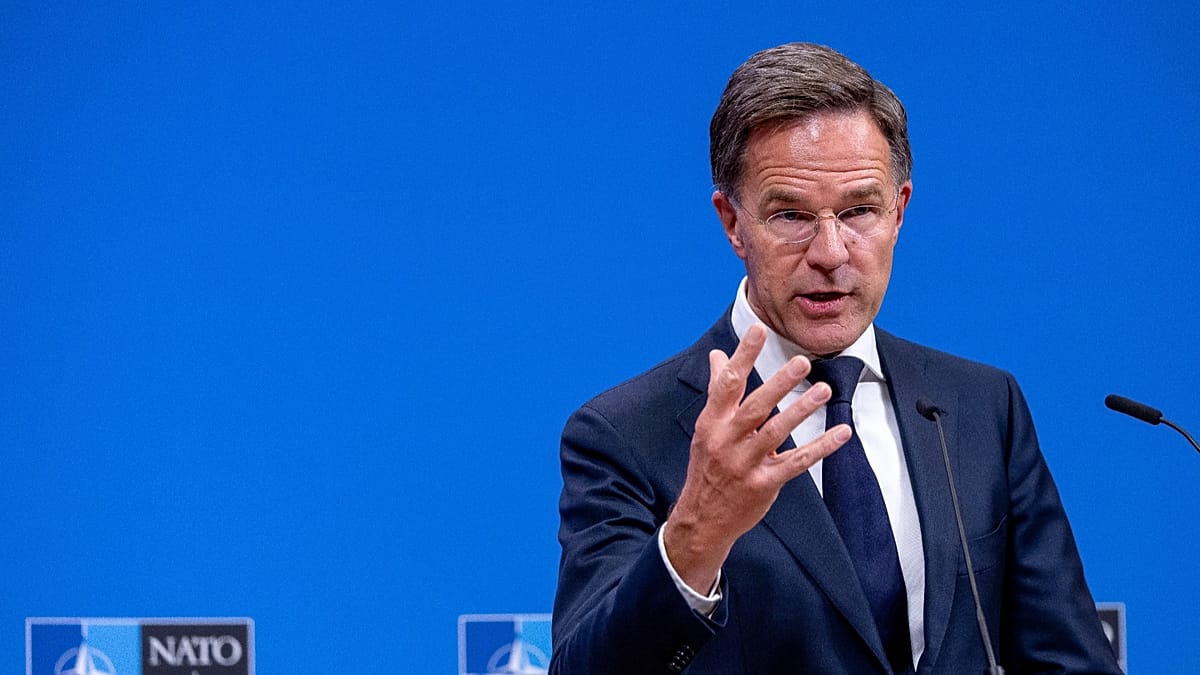
NATO chief Mark Rutte urged “calm” on Tuesday over Russia’s campaign of sabotage in Europe, saying it was failing to undercut support for Ukraine.
His comments come after Estonia became the latest country to officially blame Russia for such an incident, saying Moscow’s “special services” had ordered an arson attack on a defence firm in August.
“Russia continues its reckless campaign of hostile actions against NATO allies. It is trying to weaken our resolve and stop our support for Ukraine. But Russia is failing. It is failing on the battlefield in Ukraine and it is failing to undermine our unity and support for Ukraine,” Rutte told journalists.
European governments say Moscow is stepping up a campaign of sabotage and interference against Ukraine’s backers as the Kremlin’s troops struggle on the front line there, more than four years after their February 2022 invasion.
The Estonian incident came just after the discovery of an explosive-laden drone at an airport in Russia that Berlin pinned on Moscow.
Rutte admitted that Russia’s activities “can have an impact and sometimes they have an impact, clearly.”
But he urged NATO countries to remain “calm, carry on and support Ukraine.”
“We should not be naive… about Russia, but they know we are stronger,” Rutte said.
Speaking alongside the NATO chief, Lithuania’s Prime Minister Mindaugas Sinkevicius said intelligence services had no proof Moscow was imminently prepping for something bigger.
“It’s a must to say if a threat is there for society, but you can’t exaggerate and say something is happening in the upcoming months or weeks,” he said.
“The risk remains, but it’s not fluctuating…not increasing or decreasing.”
Earlier on Tuesday, Estonian Foreign Minister Margus Tsahkna accused Russia of “sabotage” following an arson attack on the premises of defence company, Milrem Robotics, in August.
“We can conclude with certainty that the arson attack…in Tallinn was an act of sabotage ordered by the special services of the Russian Federation,” he wrote in a post on X.
He added that the perpetrators of the attack had been apprehended and “no longer pose a threat” and that Estonia had summoned the Russian ambassador.
“This act of sabotage is part of Russia’s broader campaign across Europe, aimed at intimidating us and weakening our support for Ukraine,” Tsahkna wrote.
Estonia, an EU and NATO member state along the alliance’s eastern flank, has accused Russia of several “hybrid” provocations since the beginning of Moscow’s full-scale invasion of Ukraine in 2022.
Along with its neighbours, Latvia and Lithuania, it has ramped up its investment in defence in the years since and remains a staunch ally of Kyiv.
News of the attack prompted messages of solidarity from across Europe.
Germany’s Foreign Minister Johan Wadephul slammed what he called “Russia’s reckless act of hostility and said Estonia had full solidarity from Berlin.
And Sweden’s Prime Minister Ulf Kristersson called the attack “extremely serious.”
“This pattern of attacks is directed against Europe as a whole. The aim is to weaken our support for Ukraine and to intimidate us. It will not work,” he said in a post on X.
The Kremlin rejected what it called Estonia’s “baseless” accusation that Russia ordered the arson attack in Tallinn.
“Such statements are baseless, ill-considered, have absolutely no relation to reality and lack any form of reasoning. Consequently, we cannot and will not take such statements seriously,” Kremlin spokesman Dmitry Peskov told reporters.
Putin trying to break NATO support for Ukraine, leaders say
Putin, Stringer said, is “looking at a whole number of things” to try to create division between NATO allies because his campaign in Ukraine is going badly.
Estonian Prime Minister Kristen Michal likened the Russian leader to a “rat in the corner,” who is escalating activity in Europe in an attempt to break Western support for Kyiv at a time when Moscow is under pressure.
Putin is trying to undermine NATO’s collective defence pact by testing nations with covert attacks that are hard to attribute, Michal said.
But the Estonian leader said it’s currently “improbable,” that Putin will launch a conventional military attack on Europe because of the threat of a NATO response and because his forces are tied down in Ukraine.
The high level of malign activity from Russia is “here to stay” until Putin changes his military goals, Michal said, adding that the best way to deter him is to “back Ukraine.”