
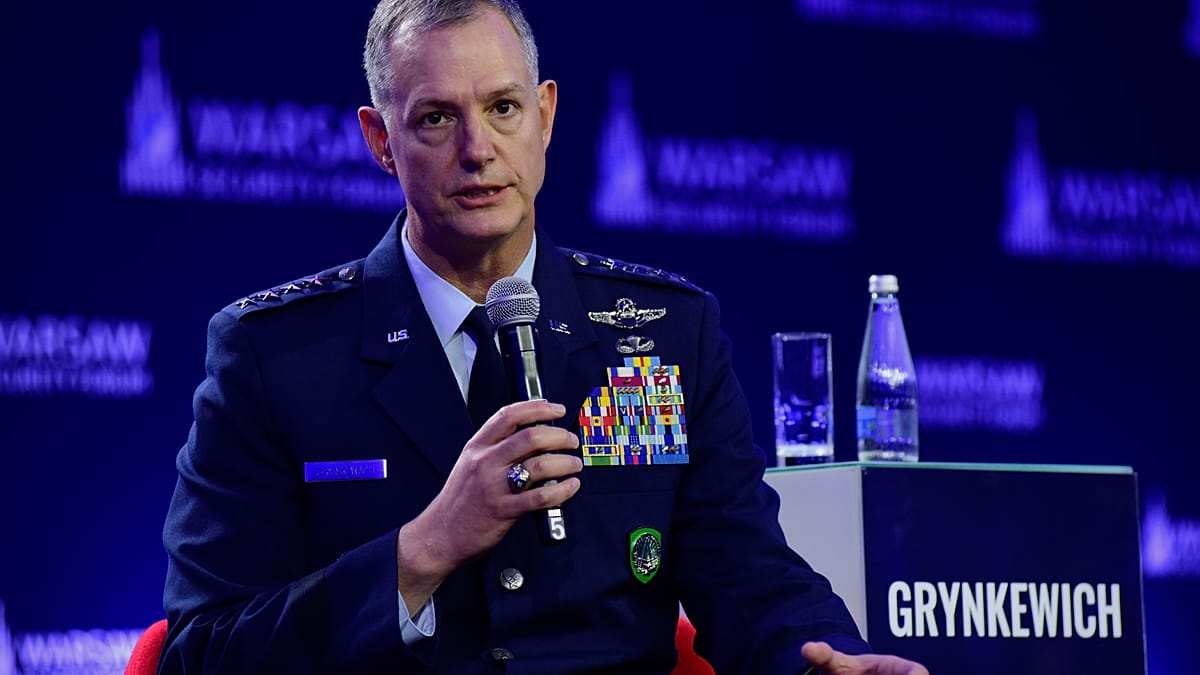
NATO’s Supreme Allied Commander Europe (SACEUR) Alexus Grynkewich has unveiled a new defence strategy aimed at ensuring that any attack on an alliance member proves “utterly futile”, as countries on NATO’s eastern flank face sabotage, arson and drone incursions.
Speaking at the Warsaw Security Forum, Grynkewich said the strategy, known as the ‘Theory of War,’ was designed to deny adversaries the ability to penetrate NATO territory and sustain an attack.
“If attacked, we are ready to fight tonight,” Grynkewich told the audience to loud applause. “We will continue to prepare and rehearse each and every day, so we will be more ready tomorrow, and even more ready the day after that,” he added.
Grynkewich said the strategy was intended both to reassure the one billion people living under the NATO security umbrella, as well as adversaries such as Russia that the alliance was willing to respond to an invasion.
“Enemy formations will be starved of replenishment. Enemy commanders will be unable to control their forces. Enemy forces and support capabilities will be reduced and destroyed,” he said. “We will, in short, ensure any attack, against any Ally, proves utterly futile.”
Endorsed by all 32 NATO members, the plan combines conventional military capabilities, including ground forces, and military hardware, with advanced technologies such as drones, counter-drone systems and artificial intelligence.
It also draws on lessons from modern warfare, particularly the fighting on the ground and in the skies over Ukraine. “We’re learning a tonne from Ukrainian partners,” Grynkewich told the forum.
Three stages of defence: block, blunt and break
The strategy rests on three principles — “block”, “blunt” and “break” — which Grynkewich described as simple but central to NATO’s approach.
“We will block the initial attack. If the attack persists, we will blunt it and prevent any enemy advance. And if required, we will break the enemy’s forces and the operational warfighting system arrayed against us,” he said.
Block: prevent an initial advance
The first phase would focus on stopping hostile forces from seizing allied territory.
NATO ground troops would engage advancing formations, contain their movements and destroy forces attempting to push into alliance territory.
“We will fix the enemy formations and deny the seizure of Alliance territory,” Grynkewich said. “Land-based forces will attack the enemy and destroy his advancing forces,” he added.
Blunt: stop further attacks
If an initial attack continued, NATO would deploy a broader range of capabilities to disrupt and overwhelm advancing forces.
These would include advanced sensors and autonomous systems, which can identify and assess threats with limited or no direct human intervention.
Grynkewich said the strategy would combine capabilities across multiple operational domains to prevent enemy forces from making further advances.
Break: disable the enemy’s ability to fight
The final phase would target not only enemy troops but also the systems that allow them to operate.
These would include command structures, supply networks and other logistical infrastructure, using capabilities such as long-range precision strikes and sensor networks.
The objective would be to disrupt the adversary’s overall military operations and leave its forces unable to sustain an attack.
“The approach also draws on lessons from modern warfare in Ukraine and the Middle East,” Grynkewich said.
NATO insists its strategy is defensive
Grynkewich stressed that NATO’s strategy was intended to protect allied territory rather than pursue territorial ambitions.
“We have no plans, no intentions, and no ambitions beyond the protection of our people and the defence of our territory,” he said.
He described the threat of an imminent attack on the alliance as low but warned that NATO would respond if an adversary chose to strike.
“If someone is foolish enough to attack us, we will fight,” he told the forum.
His remarks come amid growing security concerns among NATO members, particularly those on the eastern flank, where authorities have reported incidents involving sabotage, arson and drone incursions, some involving military-grade explosives.
Grynkewich said the increasingly challenging security environment underscored the need for NATO to demonstrate its readiness to defend allied territory.
US commitment to NATO
Asked whether the strategy remained viable amid concerns among some member states about the United States’ commitment to NATO, Grynkewich pointed to the alliance’s collective defence pledge.
He said Washington had agreed to a statement at the NATO summit in July reaffirming its “ironclad commitment to Article 5”.
Article 5 is the cornerstone of NATO’s collective defence principle, under which an armed attack against one member is considered an attack against all.