
Close Menu
Daily Guardian EuropeDaily Guardian Europe
  • Home
  • Europe
  • World
  • Politics
  • Business
  • Lifestyle
  • Sports
  • Travel
  • Environment
  • Culture
  • Press Release
  • Trending
What's On

Video. ‘Zeptoverse’: CERN scientists uncover evidence of extraordinarily rare particle decay

November 5, 2026

Block 10: new German film brings Auschwitz experiments on women to the screen

November 5, 2026

Video. ‘It would destroy the Democrat Party’: Trump dismisses impeachment threat

November 5, 2026

NASA astronauts cast US election votes from the International Space Station

November 5, 2026

‘Imposter’: Why is the Chucky creator angry with Nicki Minaj?

November 5, 2026
Facebook X (Twitter) Instagram
Web Stories
Facebook X (Twitter) Instagram
Daily Guardian Europe
Newsletter
  • Home
  • Europe
  • World
  • Politics
  • Business
  • Lifestyle
  • Sports
  • Travel
  • Environment
  • Culture
  • Press Release
  • Trending
Daily Guardian EuropeDaily Guardian Europe
Home»Lifestyle
Lifestyle

NASA astronauts cast US election votes from the International Space Station

By staffNovember 5, 20263 Mins Read
NASA astronauts cast US election votes from the International Space Station
Share
Facebook Twitter LinkedIn Pinterest Email
By&nbspClara Nabaa&nbsp&&nbspيورونيوز

Published on
5 November 2026 – 9:34 GMT+1

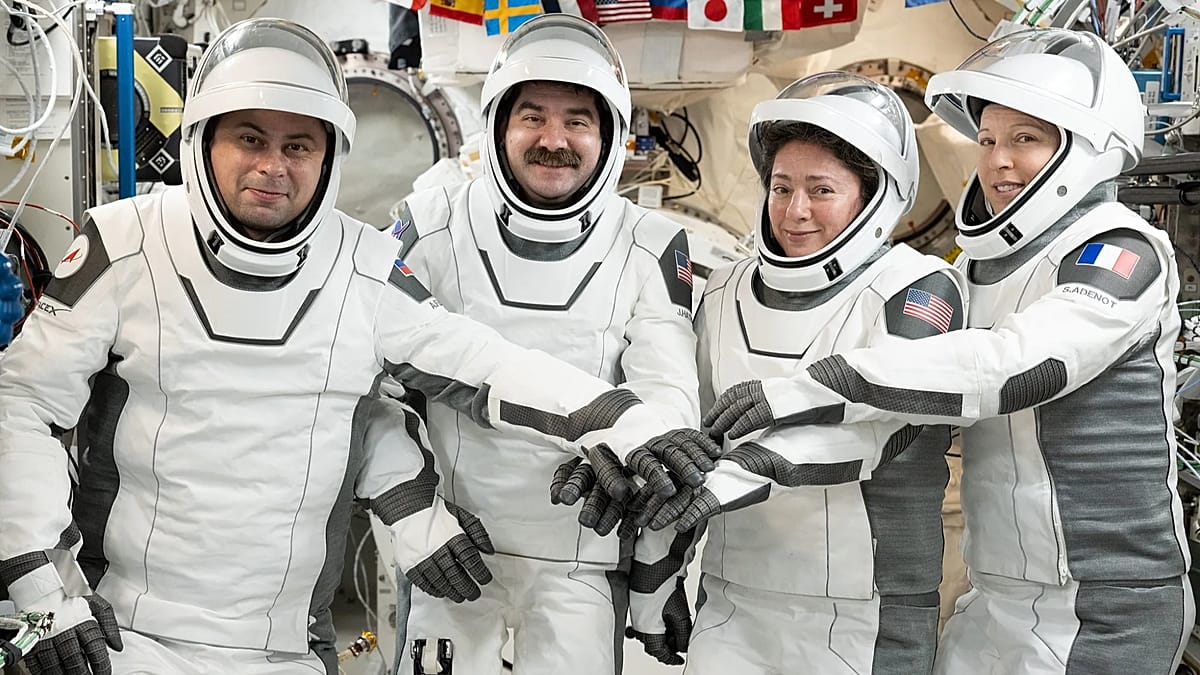
NASA astronaut Anil Menon announced that he and his colleagues Luke Delaney and Jessica Watkins had cast their votes from the space station, stressing that the process took place via a secure electronic system that ensures ballots reach election officials.

In a post on X, Menon wrote that it is indeed possible to vote even from space.

He attached a 29-second video in which he shows an “I voted” sticker and gives a tour of what he described as his own “polling station”, which in reality was his private cabin on the International Space Station. He explained that he had filled out the form on his computer and sent it to Harris County in Texas, where his vote was officially recorded.

Harris County is the usual electoral destination for NASA astronauts because it is home to the Johnson Space Center in Houston, the agency’s main centre for managing human spaceflight missions.

How do votes travel back to Earth?

Despite the distance, the voting process relies on the same infrastructure that NASA uses every day to exchange data and messages with the station through its space communications and navigation programme.

According to the agency, the procedure starts with the astronaut requesting an absentee ballot using the “Federal Post Card Application”, a form also used by US military personnel serving far from home.

Once completed on board, the ballot is transmitted via NASA’s “Tracking and Data Relay Satellite System” to a ground antenna at the agency’s White Sands facility in Las Cruces, New Mexico.

From there, it is transferred to Mission Control at the Johnson Space Center before being forwarded to the relevant county election official to be registered and counted.

NASA stresses that the process is subject to strict security measures to protect the secrecy and integrity of the vote. The ballot is encrypted, and only the astronaut and the authorised election official can see its contents.

A voting tradition that began almost three decades ago

Although voting from beyond planet Earth is highly unusual, the practice itself is not new. It began in 1997, when the Texas legislature passed a law allowing NASA astronauts to vote in US elections while in orbit.

American astronaut David Wolf was the first to do so, casting his vote that same year from the Russian space station Mir, almost three years before the International Space Station welcomed its first permanent crew in November 2000.

The three astronauts who voted this year arrived on two separate missions. Delaney and Watkins launched on 1 October last year as part of SpaceX’s “Crew-13” mission, while Menon arrived in mid-July aboard a Russian Soyuz spacecraft.

They are living alongside four other crew members: Canadian astronaut Joshua Kutryk and Russian cosmonauts Anna Kikina, Pyotr Dubrov and Sergei Teteriatnikov. Kutryk and Teteriatnikov are also part of “Crew-13”, while Dubrov and Kikina arrived with Menon on the Soyuz.

Additional sources • وكالات

Share. Facebook Twitter Pinterest LinkedIn Tumblr Email

Keep Reading

Video. ‘Zeptoverse’: CERN scientists uncover evidence of extraordinarily rare particle decay

Apple begins AI trial in China, powered by Alibaba

‘Sovereign AI agents’ could evade every kill switch and threaten national security, report warns

US midterm elections: Backlash to AI data centres reaches ballot boxes

Supermarket cyberattacks in Europe hit Italy’s Coop stores in Catania and Palermo

Italy holds emergency talks as supermarket fridge attacks spread across Europe

UK likely to face AI-powered cyberattacks on critical infrastructure by 2028, cyber chief warns

InnoWeek 2026 showcases advances in robotics, aviation and clean energy

Which countries in Europe have been hit by supermarket fridge cyber incidents?

Editors Picks

Block 10: new German film brings Auschwitz experiments on women to the screen

November 5, 2026

Video. ‘It would destroy the Democrat Party’: Trump dismisses impeachment threat

November 5, 2026

NASA astronauts cast US election votes from the International Space Station

November 5, 2026

‘Imposter’: Why is the Chucky creator angry with Nicki Minaj?

November 5, 2026

Subscribe to News

Get the latest Europe and world news and updates directly to your inbox.

Latest News

US First Lady Melania Trump to host Ukrainian and Russian officials at White House

November 5, 2026

Le Pen keeps Farage hanging over his Paris rendezvous – POLITICO

November 5, 2026

Live – Europe Today: Trump loses Congress. Will he now be even more unpredictable?

November 5, 2026
Facebook X (Twitter) Pinterest TikTok Instagram
© 2026 Daily Guardian Europe. All Rights Reserved.
  • Privacy Policy
  • Terms
  • Advertise
  • Contact

Type above and press Enter to search. Press Esc to cancel.