Published on
Cyclists are spoilt for choice if they are considering a journey on two wheels around France.
With more than 20,000km of official routes, the country offers a wide range of cycling tourism itineraries that take visitors along stunning coastal and river paths, diverse city routes and nature-filled countryside trails.
One route that’s attracting particular attention right now is La Voie Bleue, a 700km-long journey from the Luxembourg border to Lyon which was crowned as the European Cycle Route of the Year for 2026 at the Fiets en Wandelbeurs cycling and walking fair in Utrecht.
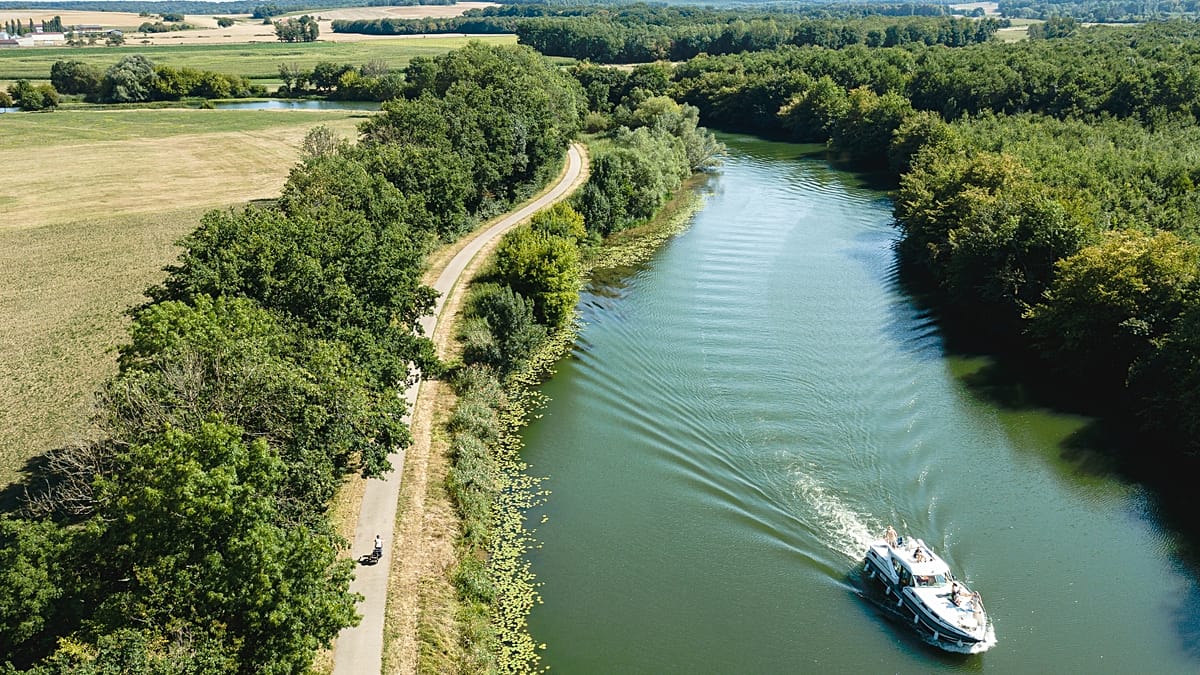
Meaning the ‘blue way’, and launched in June 2020, La Voie Bleue is a waterside route that runs along the Moselle and Saône rivers, following the towpaths of the Canal des Vosges.
Nominated for the 2026 award along with Ode aan het Landschap in the Achterhoek region of the Netherlands and La Vélidéale in France, the “beautiful” La Voie Bleue was awarded the top prize for European cycling for how it “showcases France at its finest”.
The jury said: “La Voie Bleue treats cyclists to a variety of French landscapes and, in Burgundy, to Grand Cru wines. Highlights along the way are the beautiful cities of Metz and Nancy, perfect for exploring by bike. At the end, the charming city of Lyon awaits: the gastronomic capital of France. Peace and tranquillity prevail between the cities. Almost every village has its own story.”
Culture, food and heritage sights
La Voie Bleue begins in the small village of Apach, north of Metz, and follows rivers all the way south. The route traces the Moselle, the Canal des Vosges and the Saône before reaching the confluence with the Rhône in Lyon, offering cyclists a continuous waterside journey through three regions and eight French departments.
One of its defining features is its accessibility. Built largely on former towpaths and greenways, around 80% of the itinerary runs on dedicated, car-free cycle paths. The terrain is almost entirely flat and the route is 100% signposted, making it an ideal introduction to long-distance cycle touring.
Along the way, riders pass through 25 must-see sites, four vineyards – AOC Moselle, AOC Côtes de Touls, AOC Côte Chalonnaise, and Maconnais & Beaujolais – and around 15 charming villages.
Cultural highlights include three UNESCO World Heritage Sites. In Nancy, the elegant Place Stanislas forms part of a UNESCO-listed ensemble of 18th-century architecture, while Vézelay, perched on a Burgundian hilltop, is recognised for its Romanesque basilica and role on the pilgrimage routes to Santiago de Compostela. The journey ends in Lyon, whose historic centre is inscribed for its Renaissance streets, traboules and centuries of mercantile history.
Nature and gastronomy are other popular highlights on the route. The Moselle valley reveals wooded hills and fortified towns, the Canal des Vosges cuts quietly through rural landscapes, and Burgundy’s stretch along the Saône is framed by vineyards and château-dotted countryside. Markets, wine cellars and riverside terraces provide cyclists with the perfect reason to slow down the pace.
La Voie Bleue is also interconnected with Europe’s wider cycling network, linking to EuroVelo 5 in Moselle, EuroVelo 6 in Côte-d’Or and EuroVelo 17 (ViaRhôna) in Lyon, allowing riders to continue towards the Mediterranean or the Atlantic.