



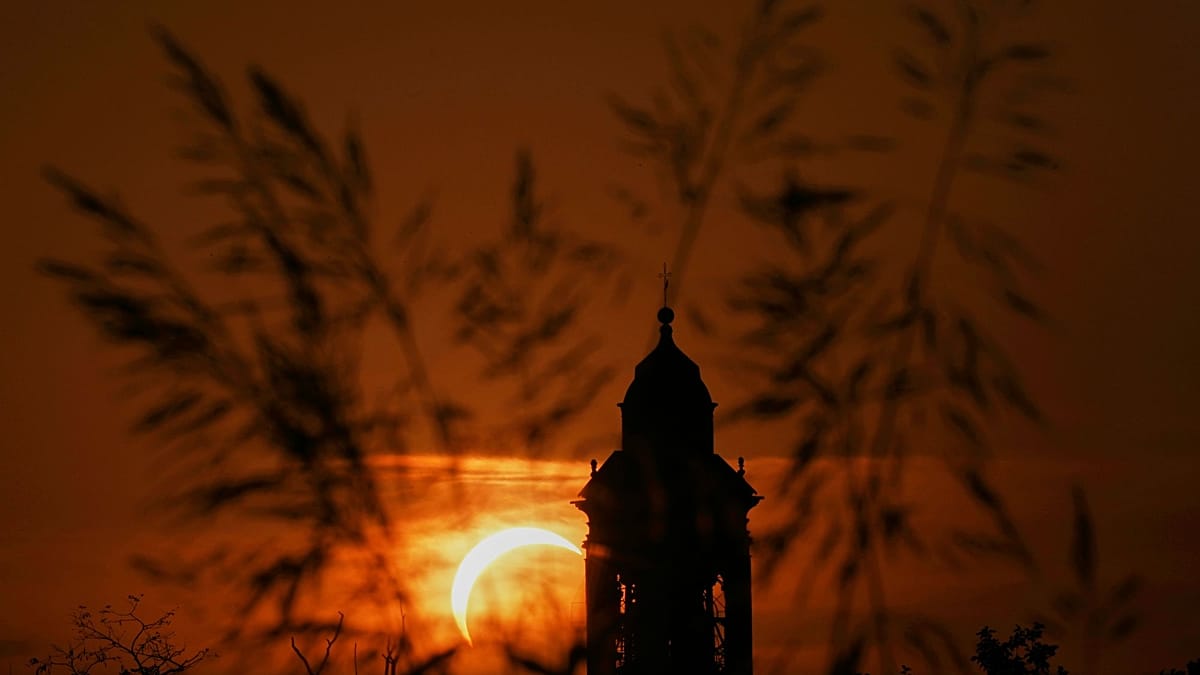
Missed this year’s eclipse and have serious FOMO? Don’t worry, because there’s another one coming up in 2027 – and it’s being described as the ‘eclipse of the century’.
Taking place on 2 August 2027, this eclipse will be the longest on easily accessible land until 2114, with totality lasting six minutes and 23 seconds at the point of the greatest eclipse in Egypt.
For context, yesterday’s eclipse lasted for two minutes and 18 seconds at its maximum point.
You don’t have to travel all the way to Egypt to see it either, as the path of totality will pass through the Strait of Gibraltar before continuing through parts of North Africa and the Middle East.
Where in Europe and beyond to see the 2027 eclipse
It’s another big one for Spain, although the cities in the path of totality are different to this year’s eclipse.
In Marbella, totality will last for three minutes and 21 seconds, while in Cádiz, it will be dark for two minutes and 56 seconds.
Ceuta and Melilla, Spain’s exclaves on the coast of North Africa, will also see the totality for four minutes and 49 seconds, and four minutes and 34 seconds, respectively.
The British Overseas Territory of Gibraltar is another European option, with totality lasting four minutes and 28 seconds.
Lampedusa, one of Italy’s Pelagian Islands, will see totality for two minutes and 56 seconds.
In Morocco, Tangier will see totality for four minutes and 51 seconds. Several cities in Tunisia lie in the path of totality, with the southeastern port city of Sfax descending into darkness for two minutes and 56 seconds.
Given the fact that the greatest eclipse is in Egypt, it’s unsurprising that many umbraphiles (aka eclipse chasers) are headed there for the big day.
In the Siwa Oasis, it will last five minutes and 33 seconds; in Asyut, six minutes and seven seconds; and in Luxor, six minutes and 22 seconds.
In Saudi Arabia, totality will last five minutes and 53 seconds in Jeddah, and five minutes and 10 seconds in Mecca.
If you are planning a trip, I suggest booking a hotel ASAP as many properties are already fully booked, and those that aren’t are seriously pricey.
Worried about the heat in some of these cities? I chatted to Dr. Kelly Korreck, a programme scientist for eclipses at NASA Headquarters, earlier this year, who told Euronews Travel that the temperature could drop as much as 10°C.
Other eclipses to make a note of
An annular solar eclipse – where the moon doesn’t completely cover the sun, leading to a “ring of fire” effect – is coming up on 26 January, 2028.
It will start in South America before passing through Portugal, including Madeira, and cities in Spain including Barcelona, Córdoba, Cádizm and Seville. The maximum coverage is around 84%.
Australia and New Zealand will next see a total solar eclipse on 22 July, 2028. Cities in the path of totality include Sydney, Queenstown and Dunedin.