
By Euronews
Published on
A few days before the latest European Council meeting, Italian Prime Minister Giorgia Meloni set out Rome’s position ahead of the complex negotiations on the next Multiannual Financial Framework (MFF), the European Union’s long-term budget.
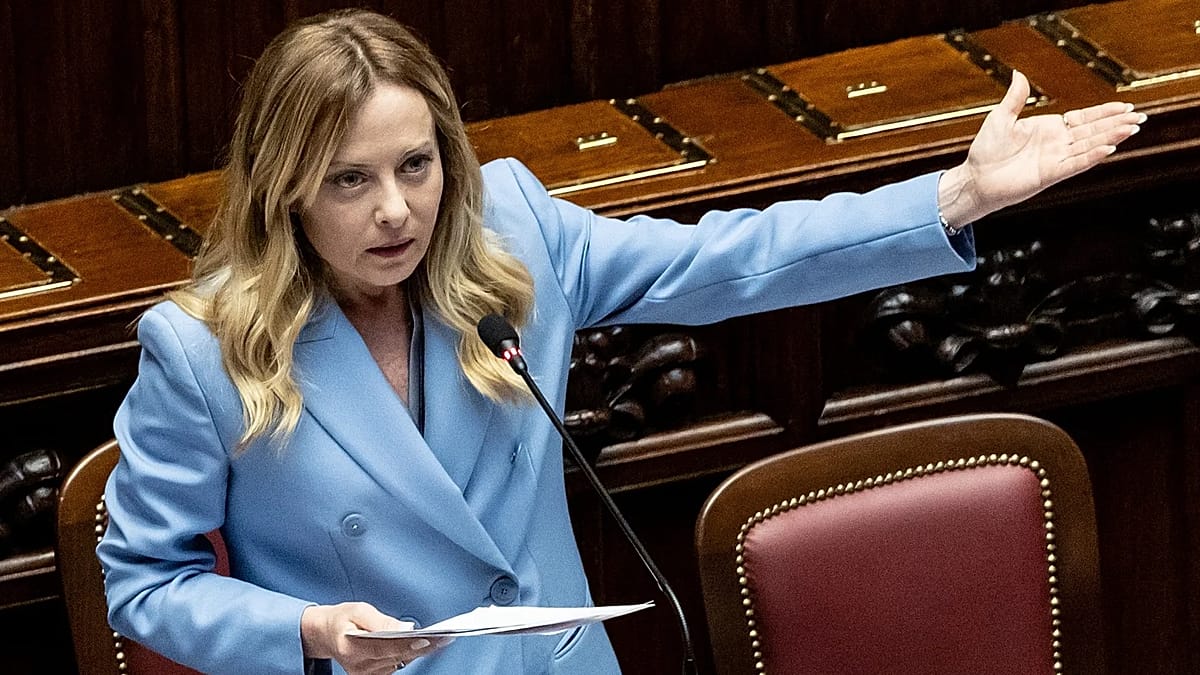
Addressing the Italian Parliament on Thursday, Meloni issued a clear warning on the so-called “rebates”, the annual discounts on national contributions enjoyed by some member states. If the system is not abolished, she said, Italy will demand “the same privilege”.
The figures for the next MFF will be on EU leaders’ table for the first time at next week’s summit.
The talks are expected to be tense, with European capitals waiting for the so-called “negotiating box”, the draft text that will set out the figures and areas of spending.
Rome’s three red lines
In her speech to Italy’s Chamber of Deputies, the prime minister reiterated three points seen as fundamental and non-negotiable for the Italian government:
- Balance between contributions and returns: Italy will not accept a budget that, in exchange for higher contributions paid to Brussels, risks reducing the resources actually available to the country.
- Abolition of rebates: The rebate system, described as “anachronistic” by the prime minister, must be scrapped. Otherwise, Italy – the Union’s third-largest net contributor – “will ask to enjoy the same privilege”.
- Protection of traditional policies: Funding for new priorities must not come at the expense of long-standing areas such as the Common Agricultural Policy (CAP), fisheries or cohesion funds. According to Meloni, the necessary resources should instead be found by cutting EU administration spending, for which the Commission has proposed an increase of more than 20 percent.
“Those who want to finance new priorities by cutting traditional policies will have to look elsewhere,” Meloni said. “We are ready to invest in competitiveness and defence, but this cannot be done at the expense of CAP, fisheries or cohesion.”
Negotiations and alliances in Brussels
The battle over the budget for the next seven years pits opposing camps against each other.
On one side are the so-called “frugal” countries, led by Germany and the Netherlands, together with Sweden, Denmark and Austria, which currently benefit from multi-billion-euro corrections to their contributions and oppose a larger budget because of pressure on national public finances. This bloc is pushing for linear, across-the-board cuts.
On the other side, Italy is aligned with the informal group calling itself the “Friends of Cohesion”, an alliance of 16 countries – including Poland, Spain and Portugal – who together are opposing cuts to the regional budget and calling for the definitive abolition of rebates.
European diplomats expect the Commission’s new draft to include modest, generalised cuts, but not horizontal ones as demanded by the net contributors.
Tensions over rebates are nothing new. Back in December, Rome threatened to block the European Council conclusions if the rebate mechanism – which had resurfaced in a negotiating text from the Danish presidency – was not removed from the talks.
Meloni also made it clear that Italy will not tie itself to artificial deadlines and will sign the agreement only once the best possible compromise has been reached.
Economic security, investment and the Mattei Plan
In her address, the prime minister also focused on economic security, describing it as an integral part of national and European security.
Meloni highlighted the importance of the new European system for screening foreign investments, in order to assess operations that may affect security or create strategic dependencies in essential sectors.
The prime minister stressed that thanks to Italy’s efforts, the final decision on these operations will remain with the individual member states.
To tackle the geopolitical challenges linked to economic dependencies – in particular in the fields of critical raw materials, rare earths and fertilisers for food security – the strategy outlined includes diversifying supplies, expanding the EU’s trade agreements and strengthening industrial value chains with the closest partners.
In this context comes the Mattei Plan, promoted by Italy to develop long-term, mutually beneficial partnerships.
On the negotiating front in recent months, the Italian government claims that progress has already been made the budget talks. Member states may get the option to increase CAP funding, stronger guarantees for regions, greater protection for small and medium-sized enterprises in the Competitiveness Fund and recognition of the principle of technological neutrality in the decarbonisation of industry.
To finance the new priorities, the Italian executive says it is open to considering some of the proposals on “own resources” put forward by the European Parliament, such as taxing profits from cryptocurrencies or introducing a European digital tax.
However, Meloni has drawn a clear red line: the increase in the EU’s budget revenues must in no way be passed on to businesses, citizens or national public finances.
In the coming weeks, particular attention will also be paid to the technical rules governing EU funds’ spending capacity and fairness between member states.