
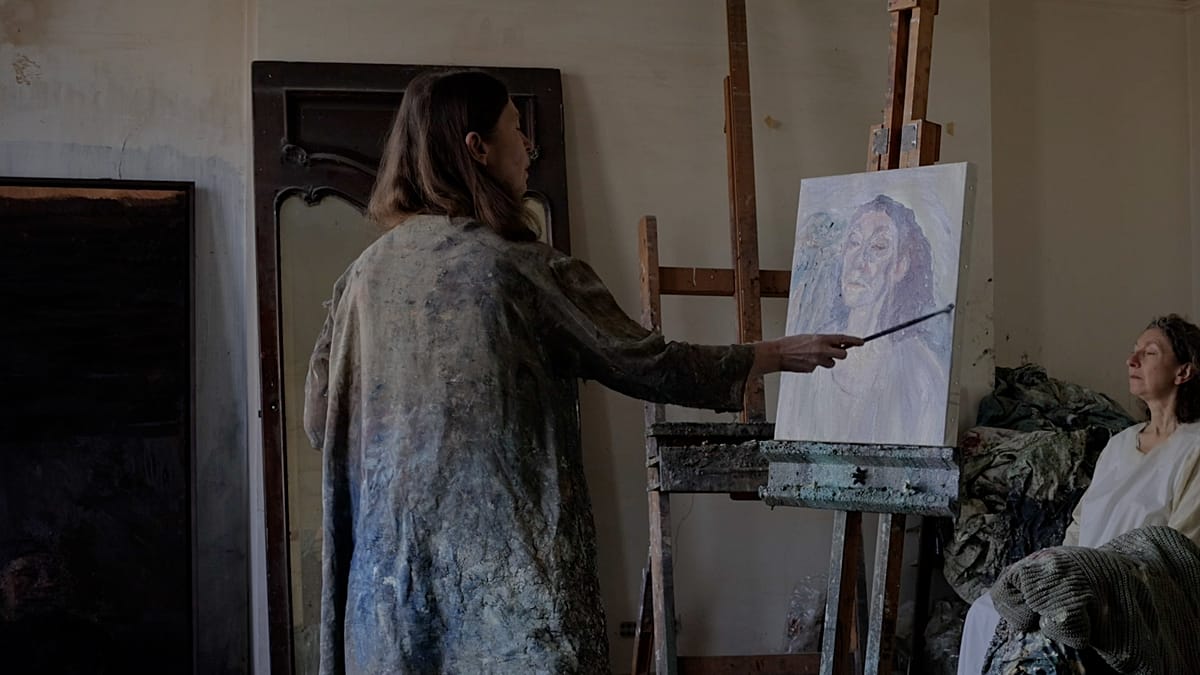
British painter Celia Paul says doesn’t go out very often. She prefers the familiarity of her central London studio. It also doubles as her home and is an essential fortress of solitude for someone who’s constantly looking within herself.
Knowing that made her recent visit to Poland even more special as she’s one of several female artists being featured at the Museum of Modern Art in Warsaw as part of its latest exhibition entitled ‘The Woman Question 1550–2025’.
In March 2025 the New York Review of Books published her essay ‘Painting Myself’, in which she explores the female gaze, identity construction through creativity and how women are perceived and represented in culture and art.
As she was a model and a muse to male artists, Paul says it took courage to start painting herself, so we began our long conversation by asking her about her perspective on her biography, her lover Lucian Freud, and the most important relationships in her life.
Euronews Culture: Who are you? – is it a question you can answer easily?
Celia Paul: Well, I can answer it basically. I can just say I’m Celia Paul. Of course I’m a painter, absolutely. I’ve painted more or less every day of my life since I was 15. Yes, everything else is secondary to that.
Are you your own muse?
Of course. I mean… ‘muse’ is such a… become quite a hackneyed word, but I paint myself as well as other people I know.
Is it difficult to paint yourself and also, maybe, hear criticism?
Well, I never mind about criticism, because I’m… you know, you can’t. But I am self-questioning always, and it took a long time for me to be able to paint myself. I could paint other people I knew well, but couldn’t paint myself until I was much older.
Why?
I think it’s partly the surface of the mirror, you have to be so static in front of the glass. And when you paint other people they’re always slightly in movement and can turn their head away and if you’re looking in the mirror you can’t do that… so there’s a kind of strain. The look in the mirror. But then when I got older I started to reference photographs of me and paintings of me, and in that way I got an outsider view of myself which was easier and somehow more true to how I feel inside.
So how was Celia Paul before she was brave enough to start painting herself and afterwards?
Well, I was a child, so I was different. I was born in India, actually. My parents were missionaries, Christian missionaries. And when we came back to England when I was five, my father became head of an evangelical Christian community in the most beautiful part of England, in the West Country, right by the sea. And I was, in my early adolescence, nature became more and more important to me. And my earliest paintings were of the beauty of nature, not landscapes, but flowers and objects I found and made kind of still lives from. And it was that that got me into the Slade [School of Fine Art] when I was only 16. So I moved from a very remote part of Devon to central London at the age of 16, where I was very much alone. And I shifted from working from nature to working from people because the emphasis was on life drawing, on the nude. And so I started to get interested in painting people.
But my first real breakthrough was painting my mother. She started to sit for me when I was 17 and I realised actually this is my subject matter, my mother is my subjects matter. And she went on sitting for me twice a week for 30 years until she got too old to climb the 80 stairs to my studio.
What did you see in your mother that interested you the most?
I think it’s crucial to paint what means something to the artist. If you don’t have something urgent to express, then there’s no point in painting, and the person who mattered most to me was my mother. I think you can see it in all great portraits if the artist loves the sitter, something different happens. You can see with Rembrandt’s paintings of his mother, for example. And I wanted that kind of intensity.
Do you also put romantic love into your paintings?
More recently I have, but earlier than that I’m one of five sisters, so… I painted them and particularly my younger sister, Kate. But when I painted subjects to do with romantic love, I haven’t worked from life. I’ve worked either from paintings, I’ve been thinking a lot about, there’s a Giorgione painting called ‘La Tempesta’, which is probably one of the most romantic images between a man and a woman. And then photographs I’ve been painting. Between myself when I was young and my lover Lucian Freud, who I met when I was 18 at the Slade School of Art and he was a tutor, he was 55 and I had a very long relationship with him and at the beginning I was very in love with him.
What do you learn about yourself during your painting sessions?
It feels like a crisis every time I pick up a brush and paint, it’s life or death.
So why is it worth it?
Because to try and get some intensity, to try to capture the moment as it’s passing. Time is an extraordinary thing that I’ve always, from the very beginning, had this feeling of, I suppose, life and death. I think it’s to do with growing up in a religious family, this feeling that… This life is not going to be forever.
Do you feel like you are a religious person right now?
But that’s such a difficult question… I prefer the word spiritual. I mean, the only thing that matters to me in art, really, is the spiritual. I’m attracted to stillness in a painting or a work of art. That’s the quality I look for. And beauty.
What do you like the most about your paintings?
I think there has to be a true emotion, which is quite difficult to define, but you can tell when something’s fake. I mean, not to do with whether it’s done by AI, but you can tell if the feeling is false and if perhaps there’s no need for this person to have painted this painting. You can really sense if there is a necessity to a work of art and that’s what I look for.
And what feeling do you see when you look at your paintings from the past?
I always try to spend a lot of time just thinking about where my life is now, what matters to me now. And it changes all the time. Three years ago my husband, Steven Kupfer died, and a lot of my work after that became about grief, because in a space of a few years Lucian Freud died, my mother died and Steven died. And these three people were tremendously important to me. So I started to think about grief a lot in all my work and about the past. And I think I’m gradually shifting away from that and I want to aim towards something more tender, I think, and compassionate.
After some years do you see the grief differently?
I think everyone who’s experienced grief knows that it comes in waves and that actually nothing is ever the same afterwards. But in a strange way, I’ve become very liberated because I’m now completely on my own. And actually it’s tremendously exciting to be on my. I can do what I want when I want. And my work just has been getting stronger and bigger and more daring. I’m just so longing to get back to the studio as I speak to you (smile).
You also told me before our conversation that you don’t go out a lot, you don’t travel a lot. You find your peace at your place, at your studio?
Yes, I’ve worked in the same studio in Bloomsbury, right in front of the British Museum, it has a view onto the forecourts of the British Museum. And I’ve been there since I was 22. Think I could work anywhere else in the same way. It’s the street I live in, my studio is also where I live, it’s one of the noisiest streets in London, but somehow my studio has this extraordinary silence because of all the people who have sat for me in silence, because I always paint in silence. And for the amount of time I’ve spent by myself thinking. I think from a child, I’ve always had this quality of stillness, even when I was very little, a child in the garden in India. Sit for hours just not moving which is quite strange for a child because you see children they’re usually very lively but I wasn’t like that.
Are you inside, also still? Or there is a chaos inside of you?
No, I’m an anxious person, I worry a lot, mainly about my painting. I don’t think I’m a chaotic person, I’m very rigorous thinker and read a lot and my work is quite a lot about ideas.
Let’s take a minute to talk about this exhibition. We are here in Warsaw and it’s very special. It’s all female artists’ pieces of art here. How does it make you feel? Your painting is between all of those amazing artists and that you are also in here?
What strikes me particularly is that each work of art here had to be fought for. A woman artist has to really fight for her freedom in quite a different way to a male artist. There’s still this expectation that a woman should be a carer, a support, whatever, status or vocation and so for each woman who has produced a work of art here she had to fight for her space.
Celia Paul’s paintings are being exhibited at the Museum of Modern Art in Warsaw as part of The Woman in Question 1550-2025which runs until 3 May 2026.