
The sea holds many secrets that are invisible to the naked eye when viewed from the shore: rare species, complex ecosystems and, sadly, loads of litter.
According to the United Nations, each year 52 million tonnes of plastic waste enter the ocean, resulting in an estimated 24 trillion microplastic particles.
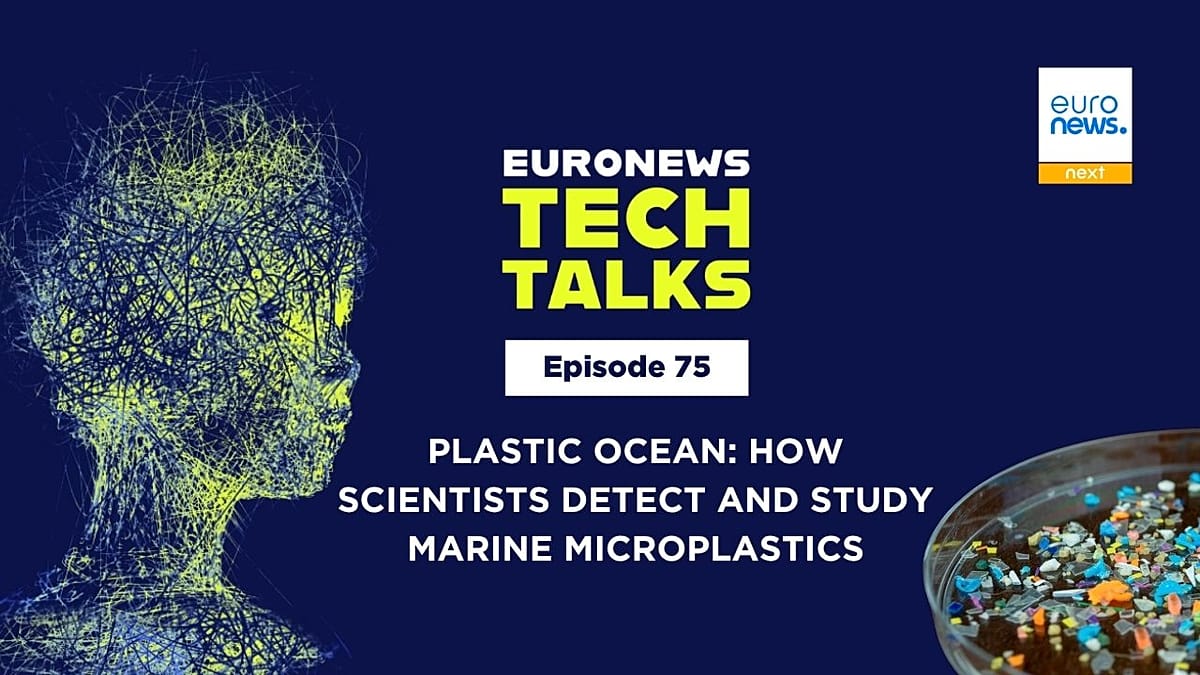
Microplastics, tiny fragments of plastics less than 5 millimetres in diameter, can be found both in the depths and on the surface of the water, disrupting ecosystems in ways scientists are still trying to understand.
But how do microplastics get into the sea? What technologies can be used to identify them? And what impact do they have on marine species?
To answer these and more questions, Euronews Tech Talks visited the Flanders Marine Institute (VLIZ) in Ostend, on the Belgian coast. Here, a research group led by senior researcher Ana Catarino investigates marine microplastics, collecting data directly from the North Sea.
Marine microplastics pollution, climate change and risks
Plastics can enter the ocean in multiple ways: pieces of fishing nets that accidentally detach, litter coming from malfunctioning waste management systems, and so on.
Specifically, microplastics polluting the ocean can be divided into two categories: primary microplastics and secondary microplastics.
The former category comprises elements like nurdles, tiny plastic fragments designed for industrial purposes; while the latter involves particles stemming from the degradation of macro litter due to waves, wind and exposure to sunlight.
The extent of microplastic pollution is, therefore, tied to climate change.
“So if we have more sunny days and higher UV radiation exposure and heat waves and changes of temperature that might, for example, impact the degradation of plastics that are stranded,” Catarino said.
The impact of microplastics on marine species is also closely linked to climate change. On their own, the microplastics ingested by a species may not pose a significant risk.
But if that species is already under stress due to rising sea temperatures, the consequences can be different. “These combined effects, they can be cumulative in the organism,” Catarino explained.
Methods to identify microplastics
Marine microplastics are difficult to identify and quantify due to their small dimensions, irregular shape, and, sometimes, different colours.
Despite these challenges, recognising microplastics is possible, and VLIZ’s postdoctoral researcher Nelle Meyers has worked on a semi-automated method to identify them.
This technique involves collecting a sample from the sea using a net, cleaning the sample of organic materials, and staining it with Nile Red before placing it under a microscope. A fluorescence colouration analysis is then run and its results are passed through two automated programmes that can identify whether a particle is a microplastic or not and what type of microplastic it is.
“We wanted to automate to speed up the whole process,” Meyers said. “We wrote a code so when you upload the picture, the image analysis is done automatically,” she continued.
Thanks to this semi-automated step and the use of a fluorescence microscope, which is relatively common in laboratories, Meyers claimed the technique is cost- and time-effective.
However, the method also presents some limitations, as it lacks information about the chemical composition of the particles and can determine only certain types of polymers.
Microplastics’ impact on marine species
Just as larger plastic debris is ingested by marine species, tiny plastic particles can also be consumed by smaller organisms, like plankton.
“They [microplastics] can also get their stomach, their gut clogged. And then they [small organisms] don’t eat their nutrients, they don’t eat their own food,” Catarino explained.
“And this is worrying because then it brings other issues because these organisms are not able to reproduce and their population will not strive, so it will be affected,” she said.
The specific effects of microplastics depend on multiple factors, including the marine species involved, the type of microplastics, and other stressors to which the species is exposed, such as changes in sea temperature, ocean acidification, and more.
“Sometimes it’s not just one issue or another, it’s the accumulation of all these effects that may be harmful to the organisms,” Catarino told Euronews Next.