

María Corina Machado says she is willing to talk with Delcy Rodríguez after returning to Venezuela.
Venezuelan opposition leader and Nobel Peace Prize laureate María Corina Machado said on Monday that she is ready to meet the country’s interim president following her unexpected return from exile.
Machado landed in Caracas on Sunday after almost a year in exile, where she was greeted by a crowd of supporters in a direct challenge to the US-backed government.
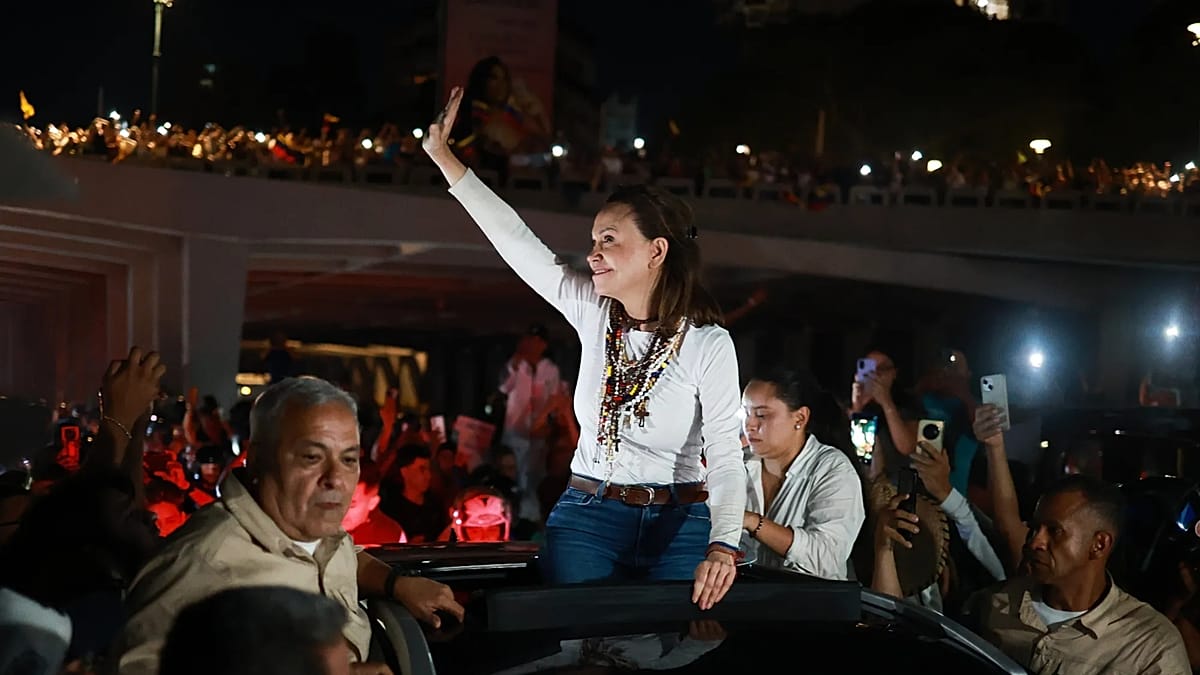
Thousands of people gathered along roads, toll booths and streets in the capital, waving Venezuelan flags and shouting “Freedom!” as a smiling Machado entered Caracas accompanied by a convoy of cars and motorbikes.
Dressed in her usual white T-shirt and jeans, she leaned out through the sunroof of a vehicle to greet the crowd and shake hands with her supporters.
On Monday, Machado reached out to the interim president, Delcy Rodríguez, and signalled her willingness to engage in talks with the former vice-president of her main political rival, Nicolás Maduro, prior to his capture by the United States.
Machado “has said she is willing to sit down not only with Delcy (Rodríguez), but with whoever she needs to sit down with, before the country, with full transparency and with an agenda”, her spokesperson Claudia Macero told local broadcaster Unión Radio.
The European Union welcomed her return: “We trust that the Venezuelan authorities and all political actors will seize this opportunity to move towards an inclusive dialogue, led by Venezuelans themselves, that leads to free and fair elections,” said the EU foreign affairs spokesperson, Anouar El Anouni.
Finally back home
Machado’s return once again places the most influential figure in Venezuela’s opposition at the heart of the country’s turbulent politics.
“María, if you come back, my daughter has to come back too!” a supporter shouted on Sunday, referring to one of the millions of Venezuelans who have left the country to escape repression and a stagnant economy.
Machado slipped out of Venezuela clandestinely last December to receive the Nobel Peace Prize, after spending almost a year in hiding.
Since then, the 59-year-old leader had tried to return to the country at least seven times without success, according to party sources. She is now coming back to a very different Venezuela.
Nine months ago, Maduro was captured in an extraordinary US military operation and imprisoned in the United States. Yet, to the disappointment of the democratic opposition, his vice-president, Delcy Rodríguez, took over as interim president with Washington’s backing.
From her exile in Panama, Machado had been forced to follow from afar the US-backed talks on political transition, in which she did not take part. The interim government has promised to hold elections, although it has not yet set a date.
Machado has repeatedly praised US President Donald Trump for ordering the risky military operation, and even gave him the medal from her Nobel Prize.
Trump, for his part, has repeatedly voiced his satisfaction with Rodríguez, who is meeting key US demands, especially regarding access to Venezuela’s oil.
On Sunday, Trump said he had been unaware of Machado’s return, but added: “I think she is a very nice woman. She gave me her Nobel Prize, so what else can I say?” “We are doing very well in Venezuela,” he said.
Huge oil reserves
Last week, thousands of people demonstrated in Caracas and other cities to demand Machado’s return and the holding of elections.
Many leaders of her party, Vente Venezuela, have also recently returned from exile, to which they were driven by the post-election crackdown that left 28 people dead and more than 2,400 detained, including dozens of Machado’s associates.
Her party is calling for elections to be held in 2027 and for Machado to be allowed to stand as a candidate, something she was barred from doing in the last presidential election.
Venezuela has the world’s largest proven oil reserves. Yet current output, at one million barrels a day, is far below the three million it was pumping decades ago, after years of corruption and mismanagement.
Rodríguez has granted Washington access to a significant share of the country’s crude reserves and has signed agreements with foreign companies to explore, produce and export oil and gas.