
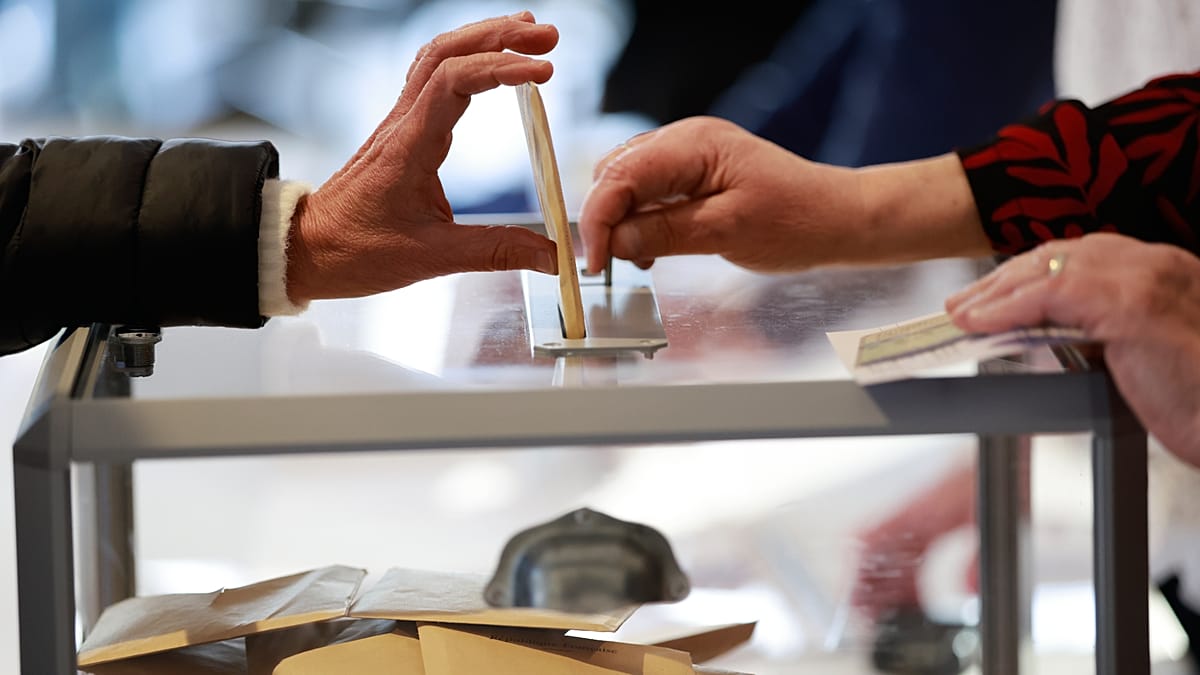
France held the first round of its 2026 municipal elections on Sunday, with nearly 48.7 million voters called to the polls across around 35,000 villages, towns and city boroughs.
The vote was also marked by a high abstention rate. Analysts point to several possible reasons, including growing distrust in politics and broader democratic fatigue among voters.
Around two-thirds of French villages, towns and smaller municipalities are expected to elect their mayor in the first round, often often due to there only being one candidate listed, or limited competition.
The picture is far more uncertain in France’s largest cities, where the vote remains highly competitive.
France uses a two-round electoral system for local elections. If no candidate wins an outright majority in the first round, a run-off vote is held the following Sunday.
Only candidates that receive at least 10% of the vote are allowed to stay in the race, although those with more than 5% can merge with others before the second round.
That system often leads to intense negotiations and alliance formations between the two rounds.
In Paris, Socialist candidate Emmanuel Grégoire is projected gain the most votes by some distance ahead of conservative Rachida Dati. Two other candidates, Sophia Chikirou of the hard-left party France Unbowed and centrist candidate Pierre-Yves Bournazel, could also qualify for the run-off.
Far-right candidate Sarah Knafo, polling at just under 10%, also hopes to pass the threshold and secure a place in the second round.
The mayoral race is especially tight in Marseille and Lyon, two other major cities where a second round run-off is expected to take place.
Surprises in several cities
In Le Havre, former prime minister Édouard Philippe — widely considered under pressure in his local stronghold — ended the evening comfortably ahead of his rivals with 43% of the vote.
In Lyon, incumbent Green mayor Grégory Doucet was expected to face a strong challenge from conservative businessman Jean-Michel Aulas, but early projections showed there was little between them.
Another key takeaway from the first round is the performance of parties on the political extremes.
The far-right National Rally (RN) has consolidated its local presence. Several of its mayors were re-elected in the first round. The party is also leading in several southern cities such as Nîmes and Toulon.
Meanwhile, the hard-left France Unbowed, which previously had limited local representation, recorded significant gains. The party also performed strongly in the northern cities of Roubaix and Lille.
Both RN and LFI are therefore expected to increase their representation in municipal councils after this election.
The Socialist Party, meanwhile, recorded strong performances in several urban centres, while the conservative Republicans (LR) reported similar successes in other parts of France.
Several national political figures also appear well-positioned locally. Éric Ciotti, leader of the right-wing UDR party, which is allied with the far-right, finished well ahead of his rival Christian Estrosi in Nice.
Second-round negotiations begin
With many major races still undecided, attention now turns to the negotiations ahead of the second round, scheduled for next Sunday.
Political parties have 48 hours to negotiate alliances and submit their final candidate lists to local authorities, with the deadline set for Tuesday at 6 pm.
Several leaders have already set out their positions.
Jordan Bardella, leader of the National Rally, called for cooperation with what he described as “sincere right-wing lists” against candidates backed by the left.
Socialist leader Olivier Faure ruled out any national alliance between the Socialist Party and France Unbowed.
Yet Manuel Bompard, the national coordinator for France Unbowed, called for the creation of an “anti-fascist front” in whichever elections the far-right stands a chance of winning.
Meanwhile, Gabriel Attal, the general secretary of President Emmanuel Macron’s party Renaissance, said it would support neither the far-right nor the radical left.
In Lyon, France Unbowed candidate Anaïs Belouassa-Cherifi could emerge as a kingmaker. She has said she is ready to hold discussions with incumbent mayor Grégory Doucet ahead of the second round.
With alliances still to be negotiated, the second round of voting next Sunday could significantly reshape France’s local political landscape and offer early signals regarding the political direction the country might take in its presidential election next year.