
Estonia, the Russia-bordering NATO member, has a relatively small army — but as one of the world’s digital leaders, it is looking to make up for that with technology.
Its defence industry is now building a wide range of cutting-edge military equipment, battle-tested in Ukraine and ready to scale up: low-cost, jamming-resistant drones, portable launch systems and sensors that spot threats in the sky.
Euronews Next was invited to an undisclosed location near Tallinn to see a demonstration of these Estonian-made systems.
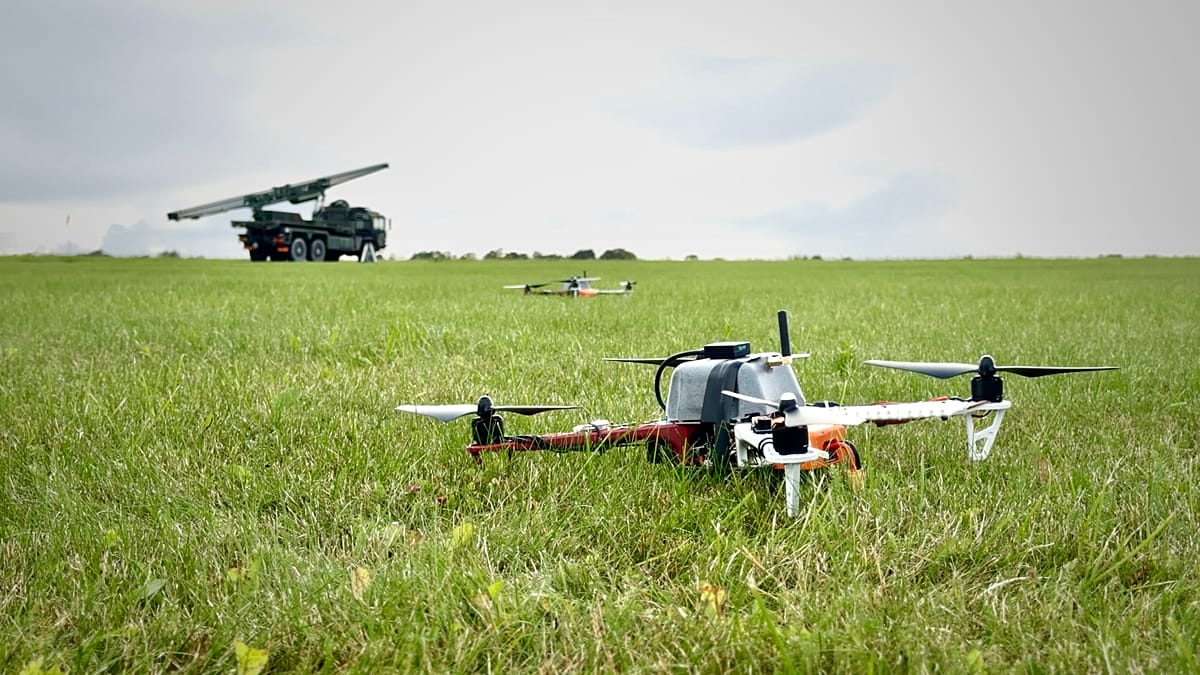
KrattWorks showed how a single operator can now control a swarm of drones, each capable of carrying deadly explosives, at the same time. The company’s core idea is to make each soldier count for more.
“The Estonian army is about 40,000 strong, but the adversary is quite a lot bigger. So we need to multiply our soldier [count],” Karmo Saar, Head of Sales at KrattWorks, told Euronews Next.
In Ukraine, he explained, one operator can already control seven of their drones.
The machines can also fly without a constant link to their operator. “The systems we develop in Estonia are fully autonomous,” Saar said. “If they are being jammed and the connection is lost, they have all the computing power on board and they finish the mission themselves.”
Estonia’s defence industry is almost entirely private. Many firms supply Ukraine — while improving their products based on feedback from the battlefield.
Threod Systems, which makes surveillance drones, says that feedback has improved its designs.
“If you lose the GPS, what will the aircraft do? Previously it mostly crashed somewhere,” Margus Allas, Test Engineer at Threod Systems, told Euronews Next.
“Nowadays, our product is that safe that it comes home — you can take it over and land safely. So that was a key feature that came from Ukraine.”
Allas said Ukrainian users also pushed the company to test in harsher conditions. “In real life we want to use the aircraft in bad weather,” he told Euronews Next.
Some operators are exhausted and have gone days without sleep, he added, so the software has to be simple to use.
Cheap, local and scalable
That experience has pushed Estonian firms towards flexible, lightweight and affordable solutions.
One example is a pneumatic drone catapult, also produced by Threod and widely used in Ukraine. The “Cata B” can be set up in minutes and needs only diesel fuel to launch drones.
Detection matters as much as the drones themselves. Rantelon, a radio-frequency technology company, showed a passive drone detector.
It emits no signals and only listens, so an enemy cannot easily locate it. “The advantage of being passive is that your enemy can’t tell where your systems are,” Kaspar Põder, Sales Project Manager at Rantelon, told Euronews Next.
The device can track several drones at once, across different radio bands, and covers military as well as civilian models.
Põder said uses range from border protection to critical infrastructure and large public events. “Drones are here to stay, and the market is growing,” he told Euronews Next.
Electric Wings Group showed a 10-inch FPV drone designed to carry a munition to its target. The drone uses radio frequencies and is “not jamming proof,” Jordan Vähesoo, Sales Manager at Electric Wings Group, told Euronews Next.
But jammers are expensive and not everywhere, he said: “If one [drone] breaks down or gets jammed, you just open a new one from the box and you go again.”
The company can produce about 10,000 units a year now and says it can scale up from there.
The frames, propellers and motors are made in Estonia, and the batteries are assembled there. “I think it’s important that every country has its own manufacturer. A lot of components right now are still coming through China,” Vähesoo told Euronews Next.
Chinese parts are cheaper, he said, but European tenders increasingly ask for European electronics. “I would like to see that switch,” he added.
The state is backing the push. Estonia wants to become a global hub for testing and building drones. The government aims to triple defence industry revenue to €1 billion between 2023 and 2030.
An adapting army
The armed forces are changing too. Hugo Urbla, Director of Operations at the Estonian Defence Forces’ Force Transformation Command, told Euronews Next that Ukraine has shown how cheaply damage can now be done.
“A bang has become cheaper, because it costs [just] a few euros to fly something now,” he said.
The Force Transformation Command organises cooperation between the armed forces, industry, research institutions and international partners.
“Things that are produced by Estonian companies, be it for dual use or for only military purposes, are being actively tested by the Defence Forces on major exercises but also on a day-to-day basis,” Urbla said.
“This does not mean that these systems are off-the-shelf ready. A technological system will always need direct feedback from soldiers who are using it. Only this way can the system actually become one that is worth something to a soldier.”
But drones will not replace conventional forces, he added.
“The armour and manoeuvre units will have a place in the next war,” Urbla told Euronews Next. “We know what the current war looks like, but we do not know what the next war will look like.”