
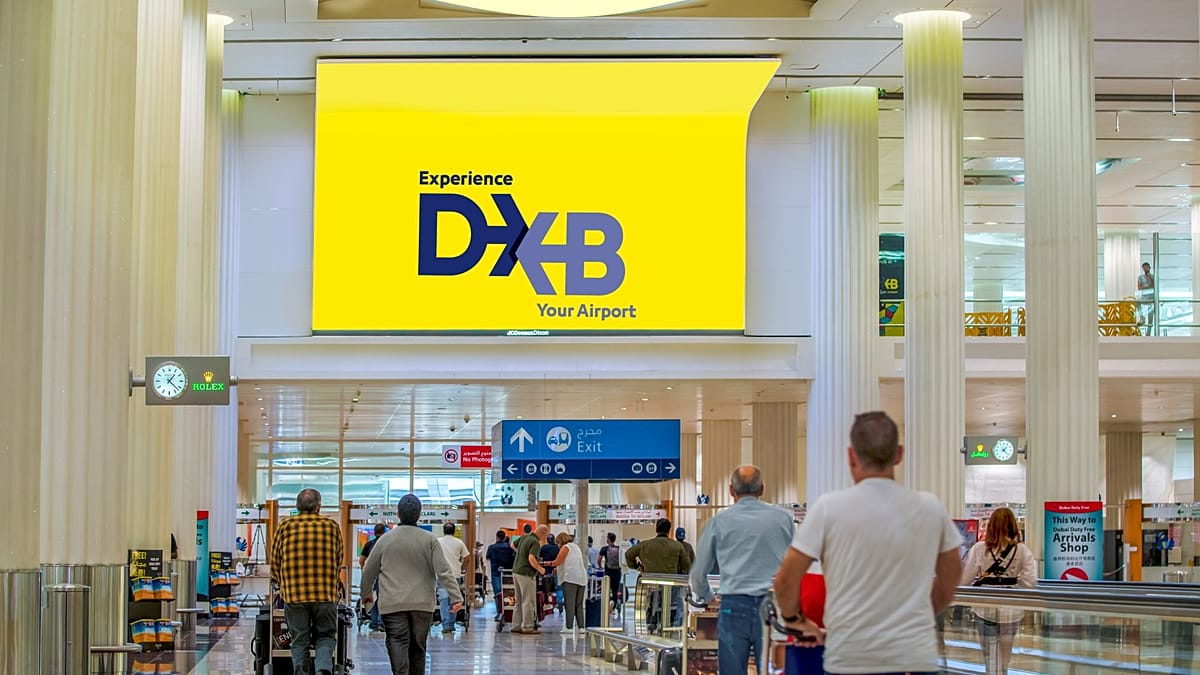
While airport codes used to be something you’d only see on your boarding pass and luggage tags, nowadays, the three letters are absolutely everywhere. You can rep your home city with phone cases, décor, t-shirts… I’ve even seen airport code shoelaces.
But have you ever stopped to wonder how those three letters were chosen, or why we need them in the first place?
With airport codes hitting the headlines as Palm Beach International Airport changes to DJT following its renaming after current president Donald J. Trump, we thought it was time for a deep dive…
What is an airport code, and what is it used for?
An airport code is a unique three-letter geocode that corresponds to a single airport around the globe.
The geocodes are assigned by the International Air Transport Association (IATA), and there are around 11,300 in the IATA Airline Coding Directory. These codes aren’t just assigned to airports, either – they can also be used for heliports, rail stations and bus stations.
Introduced in the 1930s, airport codes were originally just two letters but became three in the 1940s as the number of airports grew.
“These universal codes are essential to the functioning of the aviation and travel industries, ensuring that systems involved in reservations, scheduling, ticketing, cargo documentation, and other operations speak the same language,” the IATA notes on its website.
How are airport codes chosen?
Around 40 to 50 codes are newly assigned annually.
The standard procedure is to use the first three letters of the location’s name, but if that is already taken, the airport will need to choose an unassigned combination that preferably starts with the first letter of the location’s name.
For example, Amsterdam Airport Schiphol’s IATA airport code is AMS, Frankfurt International Airport’s is FRA, and Dublin Airport’s is DUB, while Dubai International Airport is DXB, because DUB was already taken.
It worked out in Dubai’s favour, though, as the airport is commonly known by its code, much like JFK in New York or LAX.
Some airport codes instead come from the airport’s name, as is the case with Paris Charles de Gaulle Airport (CDG) or Stockholm Arlanda Airport (ARN).
Exceptions to the rule
Notable exceptions to the rule include Canadian airports, where the code for most major airports starts with Y.
This is because when deciding the three-letter codes, it was decided to use the two letter code from before alongside a Y at the front if the area had a weather station.
That’s how we’ve ended up with codes like YOW for Ottawa and YVR for Vancouver.
Why do airport codes change?
While the IATA notes that airport codes “are considered permanent and are almost never changed”, over the past 12 months, some 750 changes have been made.
Some examples of airports that have changed code include Don Mueang International Airport, which was originally known as Bangkok International Airport and had the code BKK. Its code is now DMK, while Suvarnabhumi Airport, the busier airport serving the Thai capital which opened in 2006, is now BKK.
John F. Kennedy International Airport was originally known as Idlewild Airport, and had the code IDL. It adopted the code JFK when it was renamed after the late president in 1963.
You can browse all of the world’s airport codes on the IATA website.