
Close Menu
Daily Guardian EuropeDaily Guardian Europe
  • Home
  • Europe
  • World
  • Politics
  • Business
  • Lifestyle
  • Sports
  • Travel
  • Environment
  • Culture
  • Press Release
  • Trending
What's On

Reaching ‘The Peak’: Coca-Cola’s Olympic celebrations in Milan set for record numbers

February 18, 2026

‘Keep your mouth shut’ on nukes – POLITICO

February 18, 2026

pourquoi un départ anticipé de Lagarde ferait les affaires de Macron – POLITICO

February 18, 2026

‘A dangerous trend’: Olympic skiers voice concern over receding glaciers

February 18, 2026

Margaret Hodge in the running to lead Ofcom – POLITICO

February 18, 2026
Facebook X (Twitter) Instagram
Web Stories
Facebook X (Twitter) Instagram
Daily Guardian Europe
Newsletter
  • Home
  • Europe
  • World
  • Politics
  • Business
  • Lifestyle
  • Sports
  • Travel
  • Environment
  • Culture
  • Press Release
  • Trending
Daily Guardian EuropeDaily Guardian Europe
Home»Culture
Culture

Lava up: New mineral study reveals buried ‘dirt’ about bath time in ancient Pompeii

By staffJanuary 15, 20263 Mins Read
Lava up: New mineral study reveals buried ‘dirt’ about bath time in ancient Pompeii
Share
Facebook Twitter LinkedIn Pinterest Email

Published on
15/01/2026 – 8:36 GMT+1

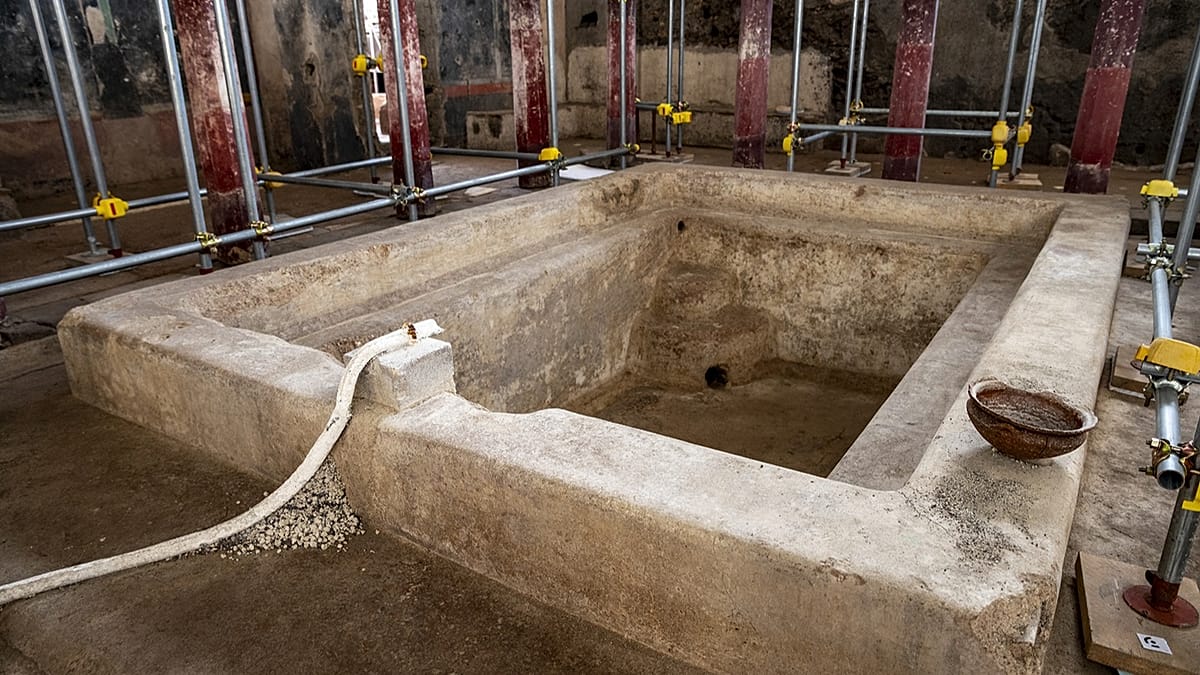
Bath time in ancient Pompeii has been revealed as not the wholesome and clean experience as some might have thought.

A new study on newly found minerals buried deep under lava, in 79 AD from the eruption of Mount Vesuvius, indicate that water in communal areas was unlikely to have been changed regularly.

Combined research by scientists from Germany’s University of Mainz suggests the city’s bathing culture was influenced by Greeks and then the Samnites, thousands of years before the Roman invasion.

Their findings, buried under ash, come from the discovery of calcium carbonate deposits, a mineral which reveals the composition of communal water and the presence of human contamination.

Water works

Through geochemical historical analysis the team was able to reconstruct the chronology of the city’s water system.

This unearthed evidence that illustrates how Pompeii was influenced by the Greeks and then the Samnites way before the Romans ruled the roost.

The Samnites are described by the British Museum as a warlike mountain people, who, in Italy put up the fiercest resistance to the Romans.

Researchers say the city’s entire water system including the Samnite wells, public baths and the aqueduct the Romans built were preserved by the lava which destroyed Pompeii.

Cees Passchier is Professor of Tectonophysics and Structural Geology at the University of Mainz and a co-author of the study on the baths which is published in PNA (Proceedings of the National Academy of Sciences).

“The water in the early stages of the baths was apparently not very clean. It’s not surprising because the water was supplied by a water lifting machine, so you must imagine there was probably a slave running in a kind of a hamster wheel lifting up water buckets and supplying the baths with water,” says Passchier.

The great innovation came in the wealthy Augustan Period from from 27 BC to 14 CE when Passchier says communal bathing experienced a boon as every city wanted an aqueduct.

“People could not afford to build long, long distance aqueducts, they also didn’t have the knowledge of it to build them and it’s only the starting Greek time, the Greeks started to build longer and larger aqueducts, but it was the Romans, really, with their talent for organizing things, who managed to set up really large aqueducts supplying cities.

It all came to an end in Pompeii, however, before the height of the Roman era according to Passchier.

“The Central Baths of Pompeii were under construction when the volcano erupted and they were never put in use, so there were a pretty large number of public baths in Pompeii, and they were increasing in size in the course of time because Pompeii was unfortunately destroyed even before the peak of Roman imperial civilization.”

Video editor • Yolaine De Kerchove Dexaerde

Additional sources • AP

Share. Facebook Twitter Pinterest LinkedIn Tumblr Email

Keep Reading

Reaching ‘The Peak’: Coca-Cola’s Olympic celebrations in Milan set for record numbers

Survey says more Americans believe Bad Bunny ‘better represents’ US than Donald Trump

Sign of the times: ‘Cry, Wedding and Blood’ brings Lorca to life at Spain’s National Drama Centre

Everyone’s a winner: Sony World Photography Awards 2026 Open Competition

Eurovision fans rage online over cancellation of 70th anniversary live tour

Rev. Jesse Jackson, civil rights icon and two-time US presidential candidate, dies aged 84

‘Godfather’ and ‘Apocalypse Now’ actor Robert Duvall dead at 95

Dana Eden, co-creator of hit spy show ‘Tehran’, found dead in Athens hotel room

Slumdog millionaire: Meet the Global Teacher Prize winner using slum walls to spread learning

Editors Picks

‘Keep your mouth shut’ on nukes – POLITICO

February 18, 2026

pourquoi un départ anticipé de Lagarde ferait les affaires de Macron – POLITICO

February 18, 2026

‘A dangerous trend’: Olympic skiers voice concern over receding glaciers

February 18, 2026

Margaret Hodge in the running to lead Ofcom – POLITICO

February 18, 2026

Subscribe to News

Get the latest Europe and world news and updates directly to your inbox.

Latest News

Video. Heavy snowfall blankets Bucharest, transport services disrupted

February 18, 2026

Satellites as instruments of space defence |Euronews Tech Talks

February 18, 2026

Bulgaria to hold snap election in April – POLITICO

February 18, 2026
Facebook X (Twitter) Pinterest TikTok Instagram
© 2026 Daily Guardian Europe. All Rights Reserved.
  • Privacy Policy
  • Terms
  • Advertise
  • Contact

Type above and press Enter to search. Press Esc to cancel.