
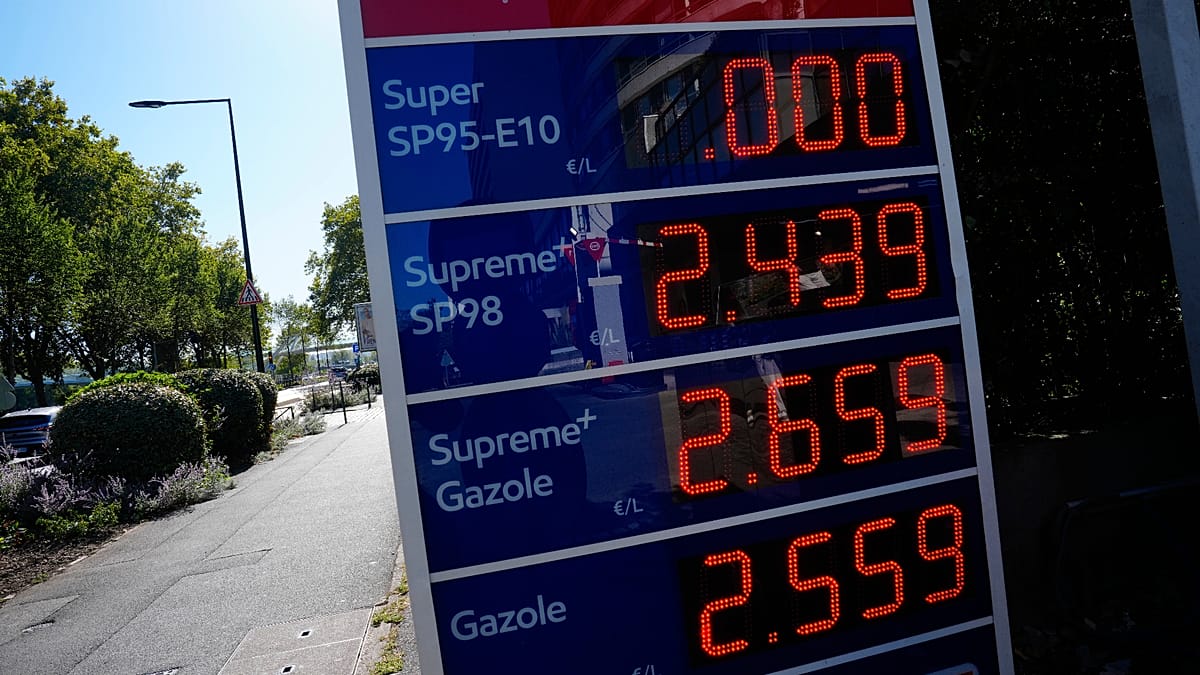
Fuel prices surged again over the $100 mark on Tuesday amid the ongoing global supply crisis sparked by strikes in the straits of Hormuz and Bab-el-Mandeb.
Negotiations between Iran and the US hit another deadlock in August, prompting hostilities to resume, with the latest wave of Iranian attacks slashing daily cargo passage in Hormuz to fewer than 20 vessels a day.
On top of that, the attacks by Iran-backed Houthi rebels in Yemen are also disrupting trade around Bab-el-Mandeb, which used to be a crucial safety valve between Yemen, Eritrea and Djibouti.
With all these vital trade routes under attack, the crisis has been described as “the largest physical supply disruption in the history of global energy markets.”
How does it affect the petrol and diesel pumps?
As of Tuesday, the highest petrol price in Europe was reported in the Netherlands, at €2.43/L on average, followed by Denmark at €2.35/L and Finland at €2.32/L, according to live tracker fuel-prices.eu/live.
French (€2.23/L) and Greek consumers are also feeling the pinch (€2.20/L).
However, diesel drivers are being hit even harder. Prices in France reached €2.40/L on Tuesday, while in Italy they stood at €2.36/L.
Denmark is at the top of the list, with diesel there costing €2.52/L.
For comparison, that’s almost a one-euro difference compared to North Macedonia’s €1.70/L and Andorra’s €1.72/L.
What do prices mean in real purchasing power?
The economic picture changes when adjusting fuel prices to purchasing power standards (PPS), a common reference currency unitthat removes differences in price levels to compare economic data across countries.
To make this comparison, we measured the cost of a 50L tank, calculated it against each country’s GDP per capita and adjusted it for differences in purchasing power. The higher the percentage, the higher the cost of filling up relative to the country’s purchasing power.
The Balkans are clearly taking the biggest hit, with Bosnia and Herzegovina topping the list, according to a Europe in Motion estimate on a 50L refuel.
In the EU, Greece is where fuel prices are squeezing people’s wallets the most, for both petrol and diesel.
The oil supply disruption is also putting pressure on refineries.
The International Energy Agency (IEA) notedthat global refinery production in July 2026 was nearly five million barrels a day down from July 2025, creating a bottleneck effect in the refined oil market.
With crude oil supplies from the Gulf disrupted, refineries have had to look for alternative sources of crude or pay more to secure supplies
However, crude grades are not always interchangeable, and replacing established supply routes can be costly.
At the same time, disruptions are also hitting supplies of already-refined products such as diesel and jet fuel, pushing refining margins higher and adding further pressure on fuel prices.
Direct drone attacks on major refineries in Saudi Arabia, Kuwait and Bahrain have worsened the situation further, with production halted or reduced.
End of the tunnel? Diesel refinery margin peak expected in October
The war in Ukraine, with refineries hit on Russian territory, is an additional shock, according to the IEA. Not so much because of Russian oil imports to Europe, which have been severely curtailed, but because other major buyers, such as Turkey and Brazil, are being forced to look elsewhere for supplies of diesel, in particular.
European Central Bank experts interviewed by Euronews Business say that, based on refined diesel futures from London Stock Exchange Group, they expect the refining margin for diesel to peak in October, while “petrol margins peaked in August.”