
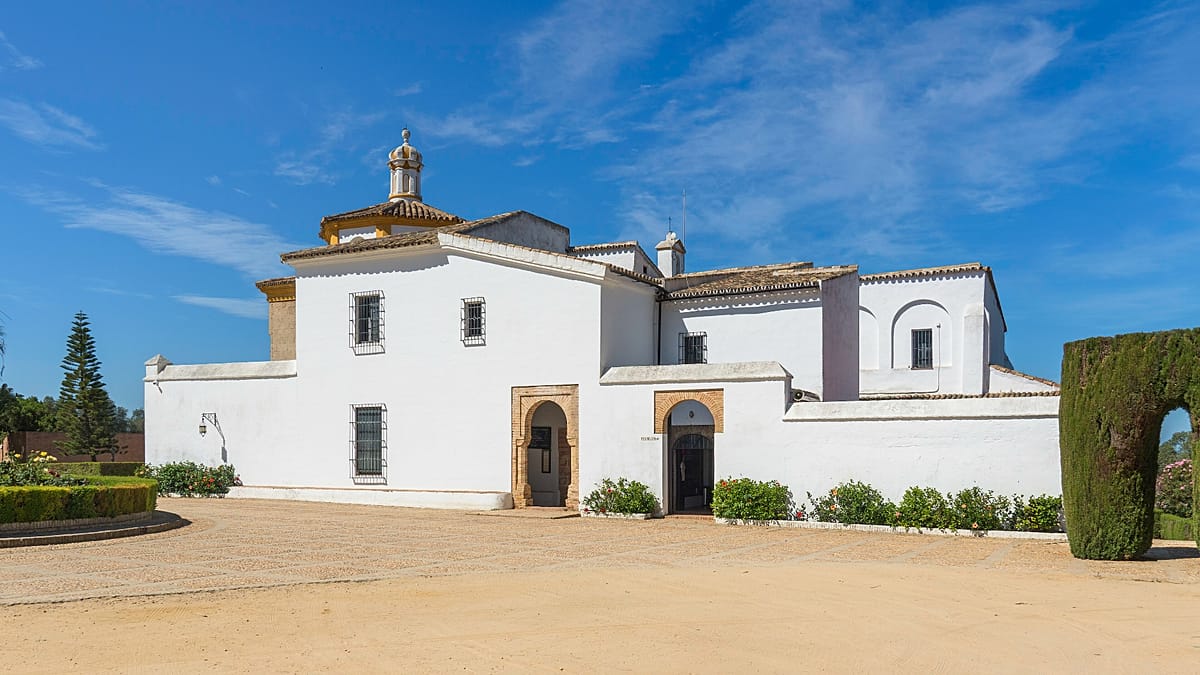
In a small hillock in Huelva, at the point where the Tinto River meets the Odiel before they reach the Atlantic, stands one of the most decisive sites in world history: the monastery of Santa María de La Rábida. Without its walls, its friars and the faith invested there, it is likely that Christopher Columbus’s enterprise would never have set sail from the nearby shores of Palos de la Frontera bound for the New World.
The Franciscan presence on the site dates back to the early 13th century, when the first friars settled in this primitive hermitage on the Huelva estuary. For decades, La Rábida was a place of retreat and prayer, far from the bustle, until fate, and the persistence of a navigator, turned it into the epicentre of one of the most momentous episodes ever experienced: the encounter between two worlds that until then knew nothing of each other.
Today, we can tread the same soil on which the navigator walked and pass through the doorway that sealed his destiny. There, in La Rábida, the friars welcome visitors just as they welcomed Christopher Columbus more than 500 years ago.
The refuge of a navigator down on his luck
By the time Columbus reached these lands, he had spent years trying to persuade a European crown to trust his project: a westward trade route to the Indies which, unbeknown to him, would lead him to a continent unknown to Europeans. Before stopping in Huelva, the navigator had sought support in Portugal, France and Italy, without success. He had also tried to strike an agreement with Castile and Aragon, but the monarchs were then focused on the campaign in Granada to reconquer the last Muslim stronghold in the Iberian Peninsula after more than 770 years of Reconquista.
It was in the convent of La Rábida that he found more than accommodation: he found allies willing to believe in him and support him before Queen Isabella I of Castile, the great champion of Columbus’s project and defender of the Indigenous peoples who inhabited the newly discovered lands. She herself demanded that they be treated as Castilian citizens, free subjects, protected from all abuse or enslavement. Even at her death she did not forget these new Castilian subjects: the will of Isabella of Castile is considered a key legal milestone that anticipated the modern concept of human rights, by establishing the protection and freedom of Indigenous Americans.
The Franciscan friars, especially Friar Juan Pérez, who had been the queen’s confessor, listened to Columbus’s plan and decided to intercede at the court of the Catholic Monarchs. Thanks to that mediation, the pioneering navigator finally obtained an audience that would lead to the support of Isabella I of Castile, the visionary monarch who agreed to fund the expedition that would change the course of history.
The Virgin who ‘witnessed’ the start of the journey
Within the walls of this hermitage, the image of Santa María de La Rábida, also known as Our Lady of Miracles, is still preserved today. According to tradition, it was before this statue that Columbus himself prayed moments before setting off into the unknown, on a voyage many considered madness and which would ultimately redraw the map of the world.
Visiting today the chapel where this image is kept is, in a way, to stand at the very spot where the journey was conceived: a place where silence can be heard, a vantage point that bore direct witness to a decision that would shape the destiny of two continents.
The Pinzón brothers, the key to setting sail for the New World
Winning over the Crown was not enough: Columbus needed a crew willing to embark on a voyage into the unknown that many sailors of the time saw as a journey with no return. That is where one of the most influential seafaring families in Palos de la Frontera came in: the Pinzón brothers.
Martín Alonso Pinzón, an experienced mariner and a respected figure in the town, put his reputation at the service of the project and helped to recruit much of the crew, overcoming the reluctance of those who distrusted the navigator’s plan. His involvement was so crucial that he ended up commanding the caravel La Pinta, while his brother Vicente Yáñez Pinzón took command of La Niña. The third brother, Francisco Martín Pinzón, sailed as master (second-in-command) on La Pinta, completing a family presence that proved decisive on the three ships of the expedition, alongside the nao Santa María, captained by Columbus himself.
Without the human and nautical backing of the Pinzón family, the project would hardly have set sail from the port of Palos on that 3 August 1492.
Today, replicas of these three vessels can be visited at the Muelle de las Carabelas. There, the three ships offer a glimpse into the exploratory past of what was once Castile.
A legacy of light and shade
The discovery of America, driven from this small monastery in Huelva, brought about the greatest cultural, economic and biological exchange in modern history. From that encounter, foods now considered essential arrived in Europe, such as the potato – crucial, centuries later, for example during the Irish famine – the tomato, sugar cane and coveted cocoa. At the same time, that feat was marked by episodes of violence and subjugation towards Indigenous peoples, a reality that today is analysed with a critical gaze, but one that is difficult to project onto the 15th century.
La Rábida is not just a religious building: it is the symbolic starting point of a complex historical process, capable of explaining both the flowering of a new relationship between cultures and the shadows that this very process cast.
Today, the Franciscan Convent of Santa María de La Rábida has become a major tourist and cultural landmark for those who wish to retrace the steps leading up to the discovery of America. Its rooms preserve documents, models and objects that recreate convent life in the 15th century, as well as the atmosphere in which Columbus worked out the final details of his expedition.
To stroll through its cloister under the sky lit by the Moon that inspired the navigator to venture beyond the seas, to contemplate the image of Our Lady of Miracles or to gaze out over the same landscape from which the caravels departed, is to travel directly back to the origins of modern history. It is a place of pilgrimage not only religious but also historical, for anyone who wants to understand how a small monastery in Huelva ended up changing the course of the world.