
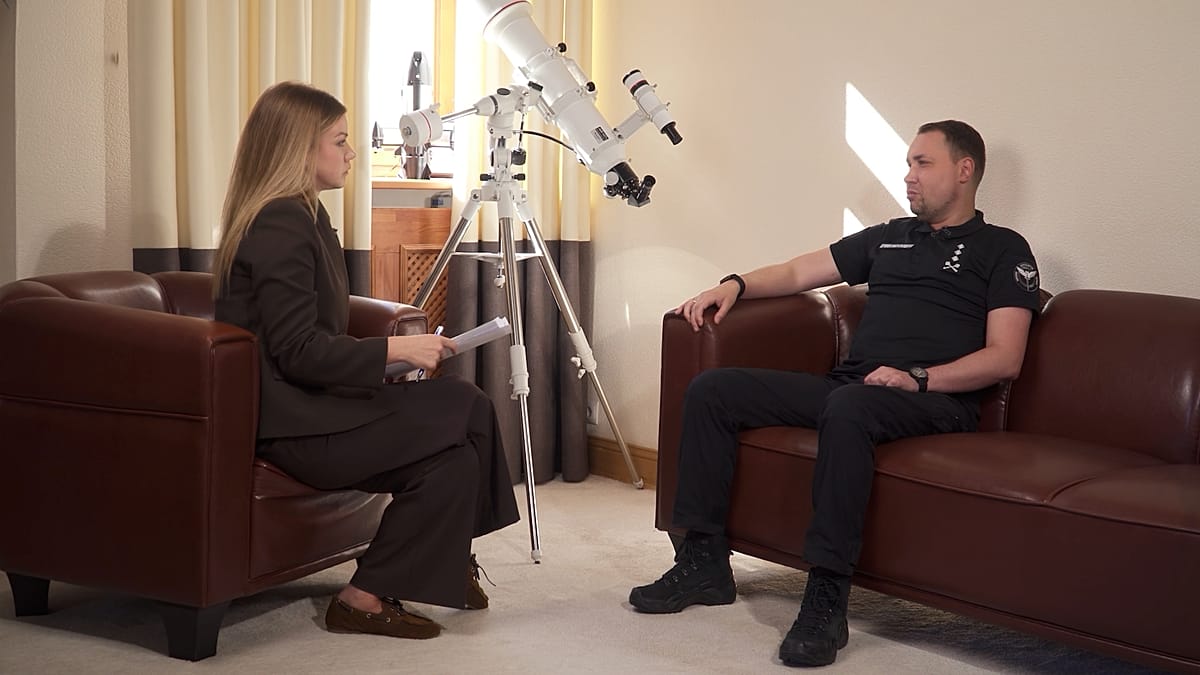
Russia’s intensifying aerial attacks on Ukraine are aimed at exhausting and intimidating the civilian population, Kyrylo Budanov, head of the Office of the President of Ukraine, told Euronews in an exclusive interview.
“Civilians are being killed – women, children, elderly people, veterans of the Second World War,” Budanov said. “It is all truly terrible, especially when children are killed.”
Budanov described Russia’s approach as “classic terrorism”, saying its purpose was not only to inflict damage but to frighten the population.
Asked whether Moscow believed sustained attacks could exhaust Ukrainians and ultimately increase pressure on the government to make concessions, his answer was unequivocal: “Yes, they do believe that.”
But Budanov rejected the suggestion that Russia was adapting faster than Ukraine as Moscow deploys faster jet-powered drones, changes flight routes and carries out complex combined attacks.
“I don’t believe that Russia, in principle, is adapting faster than we are,” he said.
Instead, he said Ukraine was working to develop and deploy technological solutions to reduce the impact of Russia’s attacks, adding that protecting the civilian population the “number one task” in this effort.
Race to scale up new drone interceptors
One of those solutions is a new generation of Ukrainian interceptors designed to counter Russia’s faster jet-powered drones.
Budanov said the technology had moved beyond conventional testing and was already undergoing experimental use in combat.
“The issue is scaling up this technology,” he said.
“There are still engineering improvements to be made. They intercept Russian jet-powered drones in most cases, but there is still work to do. And then there is the question of mass production.”
Budanov said he believed Ukraine could reach the necessary scale before the most difficult period: the coming winter.
His confidence, he said, was based on having personally seen both the technology and its production.
“I have seen these developments, and I have seen the production,” Budanov said. “I am watching how the technological cycle is developing. They will make it in time.”
Deeper defence cooperation with Europe
Ukraine’s new defence technologies could also become part of deeper industrial partnerships with European countries.
Several countries have already signed cooperation agreements with Kyiv under Ukraine’s so-called Drone Deal framework.
Asked whether Ukraine’s latest technology for intercepting jet-powered drones could eventually form part of those agreements, Budanov said: “Anyone who has made such agreements with us has the right, so to speak, to continue negotiations on specific products.”
But he stressed that Ukraine’s own requirements would come first.
“We will be able to meet the demand of other countries when, first and foremost, we have met our own country’s needs for such products,” he said.
Budanov said future defence-industrial cooperation with European partners could take different forms, including joint ventures and, in some cases, production facilities abroad with Ukrainian engineers and shared ownership.
Such production could make sense where it offered advantages and where Ukraine remained the priority customer, he said. But some critical technologies, he argued, should remain inside the country.
Asked what Ukraine could bring to European defence partnerships that its partners could not develop as quickly themselves, Budanov pointed to two advantages: “The speed of implementing innovation, the speed of scaling production — in other words, mass production.”
‘Very dangerous’ for Europe without the US
Looking beyond defence-industrial cooperation, Budanov said it was still too early to define Ukraine’s place in Europe’s future security architecture because the framework itself had yet to take shape.
“What will the future security architecture of Europe actually be?” he said. “There is no answer to that question at the moment, but everyone is working on it.”
Once it was defined and formally agreed, he said, the role of each participating country would become clearer.
Asked whether such a system could work without the United States, Budanov was more explicit.
“I think those who will be developing this doctrine have to take absolutely different options into account,” he said. “But it seems to me that this is a bad option. A very bad one, very dangerous for Europe.”
Ukraine’s financing needs and economic future
Budanov also addressed Ukraine’s immediate financial requirements, saying Kyiv could already see how the greater part of its needs could be covered.
“We can see where the greater part can definitely be covered,” he said, pointing to ongoing negotiations between Ukraine, the International Monetary Fund and the European Commission.
He said Ukraine’s financial requirements would continue to change as the war evolved.
“Look at what is happening now with Russian missile and drone strikes,” he said. “Obviously, more is needed somewhere, but on the other hand, less is needed in other areas. All of this balances out.”
But Budanov drew a distinction between Ukraine’s immediate need to finance the war and the broader question of what its economy should eventually look like.
Longer term, he said he favoured a liberal, free economy with limited state intervention, alongside predictable tax policy and domestic stability.
“But right now, we have to survive,” Budanov said. “That is our main task – to survive here and now.”
He said the defence sector would require a different approach, particularly when it came to military-technical cooperation and arms exports.
“In any civilised country in the world, weapons are not simply sold left and right,” he said. “And Ukraine will not be an exception. There should simply be strict, transparent and understandable conditions for everyone.”
For now, he said, Ukrainian defence exports remained limited because of the country’s own wartime requirements.
Asked what success for Ukraine would look like years from now — economically, in attracting investment and bringing Ukrainians back home — Budanov offered a brief answer:
“A place in the world rankings that is not the one we have now.”