

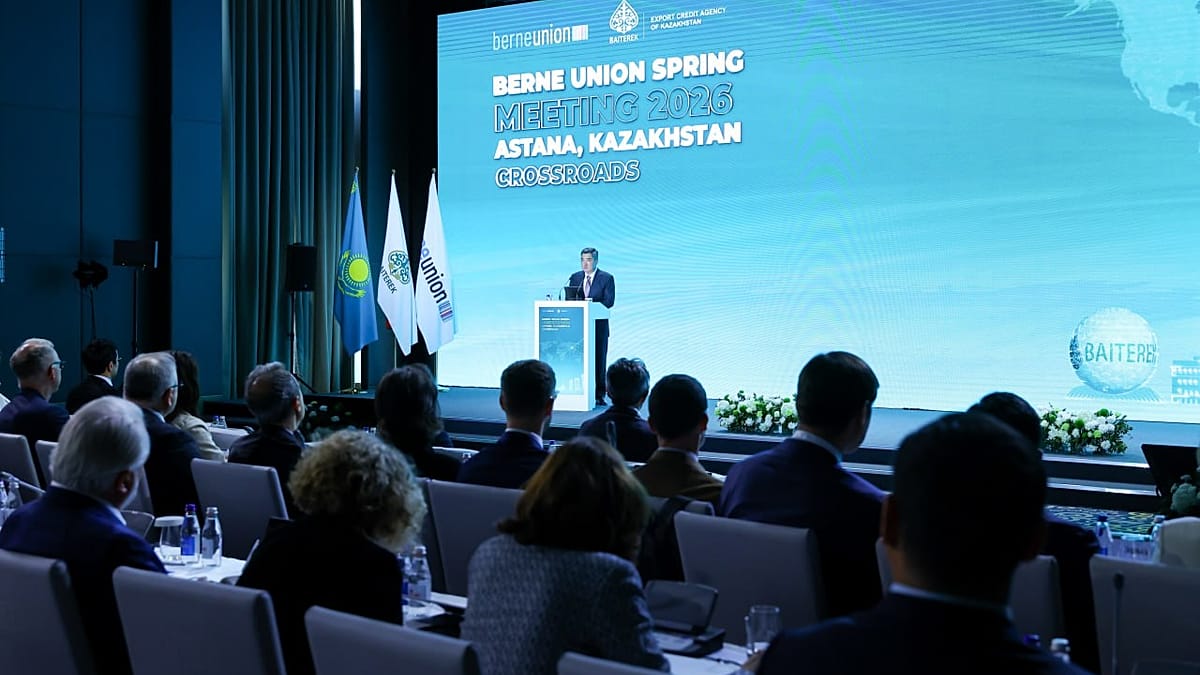
The push comes as geopolitical instability, including the war in the Middle East, is redirecting parts of the global export credit and investment insurance industry towards regions seen as carrying lower traditional war risk, including Central Asia.
More than 70 of the world’s largest export credit and investment insurers gathered in Astana for the first-ever regional meeting of the Berne Union.
Investment drive and ‘Golden Visa’
Kazakhstan credits the growing attractiveness of its investment climate to what Prime Minister Olzhas Bektenov described as the “structural transformation” of the region’s largest economy.
He invited Berne Union members to “take full advantage” of investment opportunities in Kazakhstan.
Foreign direct investment increased by 14.4% to almost €18 billion, while investment in fixed capital rose by 13%, reaching a record €37 billion, said Bektenov.
The country has also introduced a “Golden Visa” regime for investors and highly skilled professionals aimed at attracting foreign talent and capital.
Export finance interest grows
The gathering presents new opportunities for the Development Bank of Kazakhstan, which finances large-scale infrastructure and industrial projects.
“ECAs help reduce risks and attract investors,” said Marat Yelibayev, Chairman of the bank’s management board.
Export credit agencies provide insurance and guarantees protecting investors against political and economic risks associated with international projects.
Kazakhstan’s export credit agency has already opened offices in key overseas markets, offering targeted support to domestic exporters while responding to international investors’ needs.
The state-owned Baiterek National Managing Holding, which oversees the country’s development institutions, says diversification beyond raw materials remains a priority.
“Our focus is on creating the conditions necessary for sustainable business development and long-term growth,” said Rustam Karagoishin, Chairman of the Board.
OECD alignment boosts credibility
Kazakhstan’s growing integration into global trade finance networks is also being driven by closer alignment with OECD export finance standards, according to Silvia Gavornikova, head of the export credits and competition division at the Organisation for Economic Co-operation and Development.
The OECD framework supports around €51 billion in international trade annually through officially supported export credit arrangements.
“Kazakhstan’s ECA is showing very strong initiative to comply with international norms,” Gavornikova said, citing transparency, risk assessment, environmental standards and responsible state support for exports.
Greater compliance with OECD standards could make Kazakhstan a more reliable partner for international banks, insurers and export credit agencies seeking cross-border cooperation.
Critical minerals attract attention
Beyond non-resource exports, the Berne Union expects investment into Kazakhstan’s commodity sectors to increase in the coming years, particularly in critical minerals.
Berne Union President Yuichiro Akita said the growing appetite for insuring critical mineral investments makes this “a good time” to attract investors to Kazakhstan.
That comes as companies linked to the sons of Donald Trump seek US-backed financing for tungsten mining projects in Kazakhstan as part of Washington’s efforts to reduce dependence on China for strategic minerals.
“The geopolitical situation is really challenging,” Akita said.
“But Kazakhstan has the resources the world now needs. From an investment perspective, we want to work with Kazakh partners because the world needs partners.”
Trade ambitions and the Middle Corridor
Bektenov said the country’s new Trade Policy Concept will help raise non-resource exports to nearly €45 billion by 2030.
Kazakhstan’s foreign trade turnover currently stands at around €124 billion, with exports spanning nearly 4,000 product categories shipped to 127 countries.
The country is also expanding its network of free trade agreements. Existing arrangements with Vietnam, Serbia and Iran were joined last year by new agreements with the United Arab Emirates, Mongolia and Indonesia.
A key part of the strategy is the Trans-Caspian International Transport Route, the multimodal trade corridor linking China and Southeast Asia to Europe through Kazakhstan, the Caspian Sea, Azerbaijan, Georgia and Turkey.
Several major infrastructure projects along the route are expected to increase trade volumes and strengthen transcontinental logistics links.
“Now the job is to share this pipeline with ECAs and commercial banks so they can step in and decide whether they want to provide instruments for these projects,” said Timur Onzhanov, Deputy Chairman of the Management Board at Baiterek.
The Astana meeting concluded with strategic agreements between Kazakhstan’s export credit agency and major international export-import banks.
The agreements focus on mutual reinsurance of export risks, co-financing investment projects, and promoting Kazakhstan’s non-resource exports in the markets of the Middle East and Europe.