
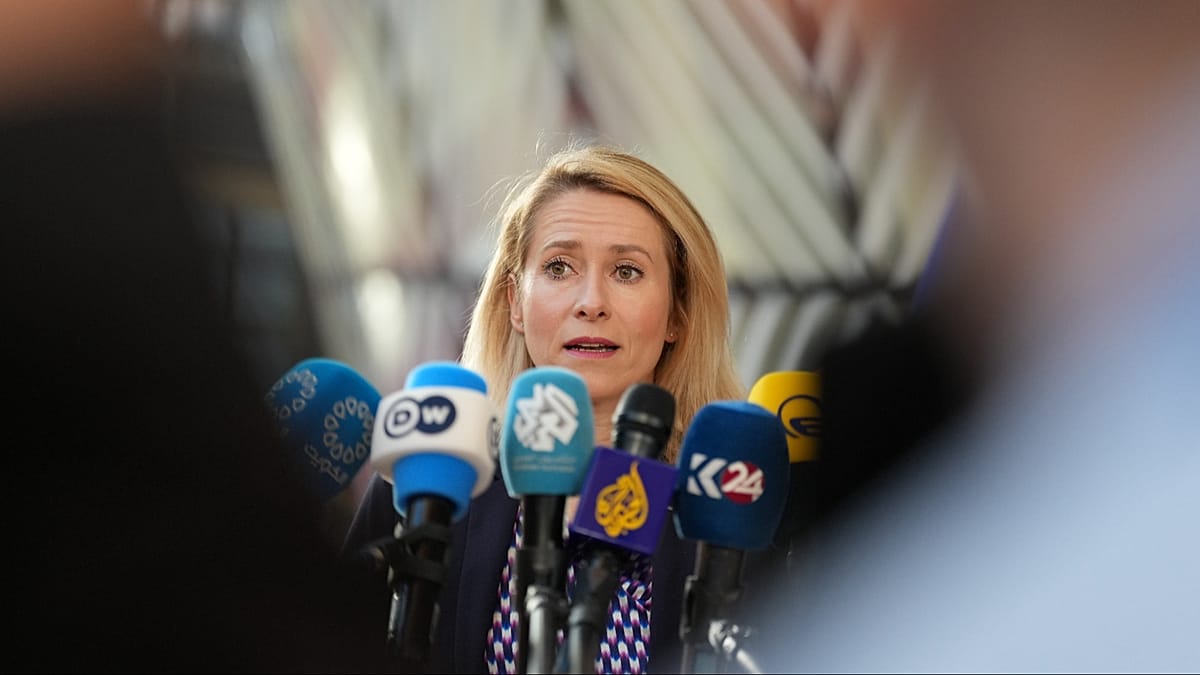
Kaja Kallas, the EU’s chief diplomat, said on Monday that she would propose changing the mandate of the bloc’s naval mission, as pressure on Europe grows to help secure access to the Strait of Hormuz and prevent major disruptions to global oil supplies.
“We will discuss with the member states whether it is possible to really change the mandate of this mission,” Kallas told reporters ahead of a meeting of EU foreign affairs ministers in Brussels. “It is in our interest to keep the Strait of Hormuz open,” she added.
Ministers are gathering in Brussels today to discuss how Europe should respond to the impact of the war with Iran, which has triggered what analysts describe as the largest disruption to global oil supplies in history and sent oil prices above $100 a barrel.
The discussions will focus particularly on the EU’s Aspides operation, which was established in February 2024 as a defensive operation following repeated attacks by the Iran-aligned Houthis on international shipping.
Its mandate is to “protect vessels,” safeguard freedom of navigation and “monitor the maritime situation in the Strait of Hormuz and surrounding waters, including the Red Sea, Gulf of Aden, Arabian Sea, Gulf of Oman and the Persian Gulf,” according to the Council.
However, officials say the mandate may need to be revised to deal with a much bigger crisis along the Strait of Hormuz — which carries about one fifth of the world’s oil.
Kallas’s remarks also came a day after US president Donald Trump increased pressure on Europe to help protect the Strait of Hormuz, warning that NATO faces a “very bad” future if its members fail to come to Washington’s aid.
Still, any change to the mandate of the EU’s Aspides mission is unlikely to command unanimous support among European countries.
A European diplomat told Euronews the goal of the meeting is to establish capabilities and coordinate under the EU umbrella but did not foresee a large European coalition would emerge to escort ships out of the Strait of Hormuz in line with Trump’s request.
Neither the US nor Israel consulted with European allies before launching an attack against Iran on February 28. The Trump administration has often lashed at the Europeans for not spending enough on defence, calling them weak and even decaying. But the difficulties to get oil moving have led the US to rally allies in an international coalition.
Still, Trump’s appeal has produced little results.
On Sunday, Johann Wadephul said talks about expanding the remit of Aspides are under discussion at the European level but ruled out German participation. He also called on the United States and Israel to clarify their objectives in the conflict with Iran.
On Monday, Luxembourg’s foreign minister Xavier Bettel echoed some of Germany’s reservations and stressed that the EU is not directly involved in the war.
“We need to decide if we are going to be part or not. With satellites, with communications, we are very happy to be useful but don’t ask with troops and machines,” he told reporters ahead of the Foreign affairs Council.