
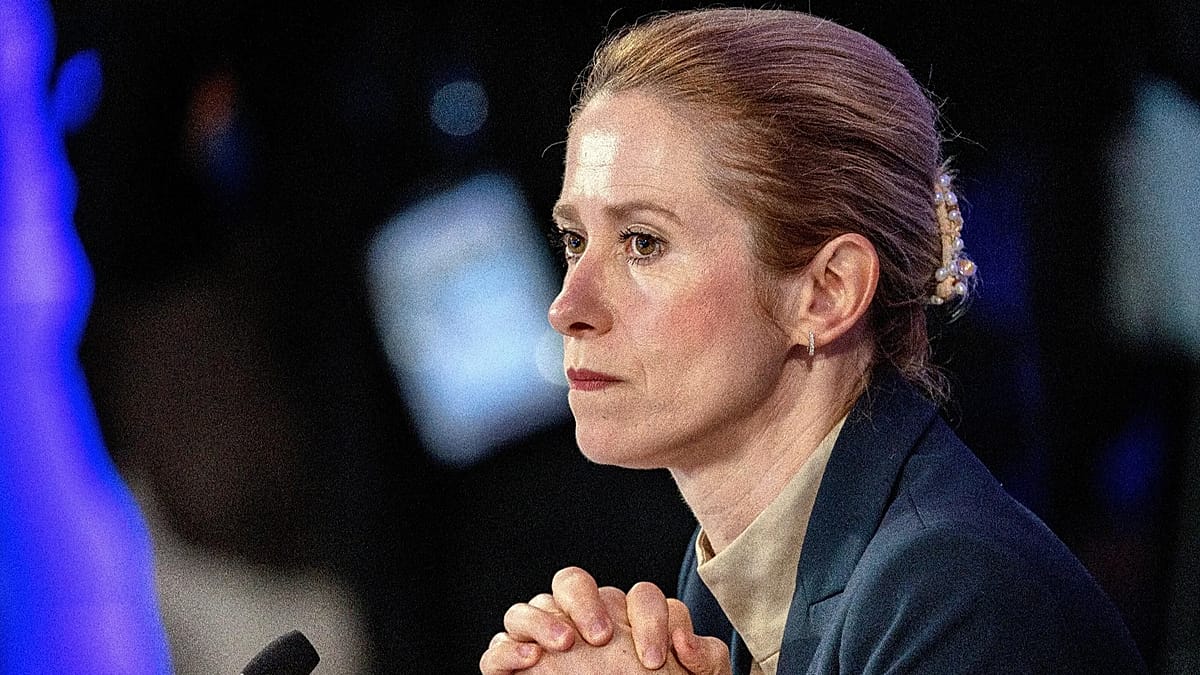
The European Union’s foreign policy chief, Kaja Kallas, suffered another political defeat when member states torpedoed her latest initiative to set up an expert group on European defence, at a time when her diplomatic service is under growing pressure to reform.
On Sunday, the European External Action Service (EEAS) cancelled, at the last minute, the launch of a new high-level group tasked with producing a report on how to boost the EU’s defence capabilities by identifying strategic investment gaps.
Kallas, the EU High Representative for Foreign Affairs and Security Policy, had announced the initiative just days earlier, saying it aimed “to have some of the brightest minds on security and defence come together and really provide out-of-the-box solutions.”
“We have decided not to proceed with the initiative,” an EU official told Euronews, asking not to be named. “Some member states felt this was not the right path to pursue at this moment.”
The episode underscores how Kallas at times attempts to push forward without the necessary political support, even as backing from member states – especially smaller ones – is her best bet to keep the EEAS relevant.
Diplomatic misstep
Italy led the charge against the initiative with a firm no, after the group included a representative seen as a major political opponent of Defence Minister Guido Crosetto.
According to the Italian press agency ANSA, the person in question was Roberta Pinotti, who previously served as defence minister under the centre-left governments of Matteo Renzi and Paolo Gentiloni – both of the opposite political colour to the current Italian executive.
France and several other countries also objected to the expert group, stressing it had not been discussed at ministerial level and had caught most European governments by surprise.
The pressure was such that it forced the EEAS to cancel the initiative.
For the EEAS, the expert, advisory nature of the initiative meant not all countries needed to be represented, and that former political and military officials were the obvious choices.
Still, the initiative drew opposition on multiple fronts: from the countries that were represented, over the names chosen; and from the countries left out, who resented not having a seat at the table.
Three EU officials, who asked not to be named due to the sensitivity of the topic, described the initiative as a “mismanagement,” “unfortunate” and “a f***-up” respectively – reflecting widespread frustration over how things had unfolded.
Sense of urgency
For the diplomatic service, the EU needs to speed up its defence preparedness or risk being caught flat-footed, but some member states appear to be dragging their feet rather than proposing new ideas.
The intent had been to create a sense of urgency, accelerating efforts to fill Europe’s defence capacity gaps and set a clear direction ahead of the Munich Security Conference in February, as the US government prepares its troop review by year’s end.
“Everyone agrees about the urgency of the topic, but the whole choreography was just a bit unfortunate,” an EU diplomat said.
At the same time, the EEAS is frequently criticised for not being efficient enough, which runs counter to the argument that European capitals need to be constantly consulted, even to appoint experts for an advisory body.
“As a former prime minister, she is underestimating how much member states want to be consulted on foreign policy matters,” a second diplomat said, noting that the episode shows how some countries are hypersensitive about the procedure.
Ironically, such lack of consultation with her constituency comes at a time when Kallas’s role is being increasingly challenged by Brussels and other key European capitals.
Pressure to reform
The EU foreign policy chief has repeatedly clashed with Commission President Ursula von der Leyen over who steers the bloc’s foreign policy. Von der Leyen has pursued what she dubbed a “geopolitical Commission” and periodically tested her own footing on international affairs, with relations with Israel emerging as a key flashpoint.
This personal and institutional clash has increasingly intersected with recurring calls to reform EU foreign policy-making, with the latest Franco-German proposal considering placing the EEAS under the Commission’s remit, albeit with a bolstered portfolio.
Following an informal meeting of EU foreign ministers in Ireland last week, Kallas pushed back against the proposal, saying there was broad support for the current institutional setup, even if all agreed it could be better implemented.
“The problem that was mentioned by many member states is that, if we then move everything to the Commission, then especially the small member states lose control of the foreign policy,” Kallas said.
“The member states were clear that they don’t want to lose the steering wheel of the foreign policy.”
Small countries’ scepticism
Streamlining the bloc’s external action and centralising it under the Commission would mean only the largest member states could meaningfully shape decisions made in Brussels.
Kallas’ role was precisely designed with this duality in mind, serving simultaneously as a Vice-President of the Commission and as EU High Representative following the political direction of the member states, thus giving every country a seat at the table.
Yet while small member states are the ones currently shielding Kallas’ institutional role from being absorbed into an all-powerful Commission, her latest blunder has managed to draw the ire of precisely that constituency.
“The member states want to see the EEAS as a service for them, not as an institution with its own mind that takes initiatives that were not previously discussed,” a third EU diplomat from a small country sceptical of the reform told Euronews on condition of anonymity.
It was not the first time Kallas had appeared to press forward without the necessary political backing from member states. Last year, she pitched a €40 billion military support package for Ukraine that was rejected by EU leaders.
A row of incidents
Kallas is no stranger to diplomatic faux pas. In May, she said the US had evacuated its embassy in Kyiv amid warnings of an imminent Russian attack, only for the claim to be disputed by Washington. That same month, she also triggered a backlash after appearing to compare China to a disease.
In June, Israeli Foreign Minister Gideon Sa’ar cut off all contact with her, after media reports that she had privately compared Israel to apartheid-era South Africa – a move that drew mixed reactions from EU leaders.
The High Representative has also raised eyebrows over her insistence on using frozen Russian assets to fund Ukraine, and over her strained relations with the US administration.
However, as large member states and a Commission increasingly centralised are calling into question the current institutional setup, any further stumbling that could alienate support from the member states might prove fatal for Kallas and her institution.
“There is overall dissatisfaction with how VP Kallas is handling issues like that,” a fourth EU diplomat said.