
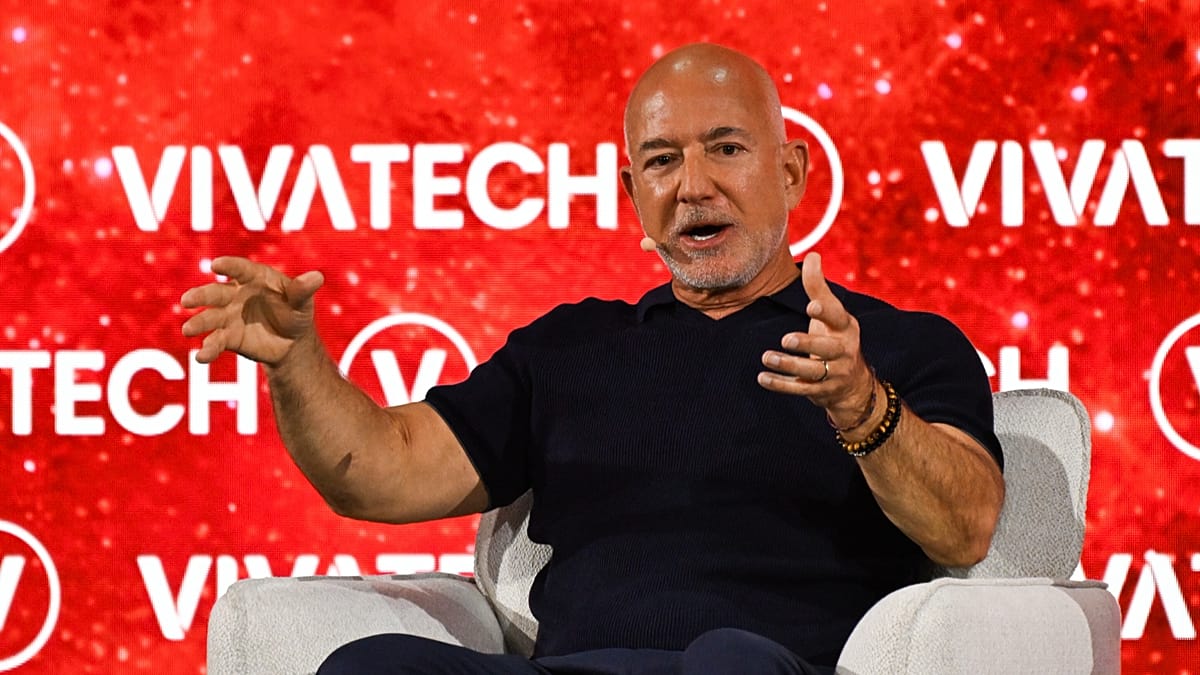
Jeff Bezos took the stage at VivaTech in Paris on Wednesday to make the case that humanity must move to the moon and eventually beyond, not just for the sake of exploration but to save the planet from the effects of technology and industry.
Speaking alongside Blue Origin chief executive Dave Limp in a session moderated by former NASA astronaut Mike Massimino, the Amazon founder and Blue Origin executive chairman argued that shifting heavy industry off Earth is the only scenario in which economic growth and environmental preservation can coexist.
“[Our] garden planet can be returned to its pre-industrial revolution state,” Bezos said.
“This is the only way in which the world is worse today than it was 500 years ago … We can actually have both,” he continued, emphasizing that the quality of life has improved for the entirety of humanity but that the planet suffered as a result.
His message was unambiguous on sequencing, namely that the moon comes before Mars, and skipping that step would be a mistake.
The moon’s proximity, which is reachable in three and a half days, makes it accessible at any time rather than once every two years like Mars, and its shallow gravity makes it an essential staging post, he argued.
“When you skip steps, it actually doesn’t make you faster,” Bezos said. “It’s a kind of a gift. It’s so near Earth.”
Materials lifted from the lunar surface require 28 times less energy per kilogram than those launched from Earth, he noted. That figure makes the moon not just a destination but a potential supplier for deeper space missions.
He was pointed about the Apollo programme too: the original moon landings were pulled forward in time by geopolitics and the race with the Soviet Union, achieved by spending up to 4.5% of the US federal budget and ultimately unsustainable.
What Blue Origin is attempting now, he argued, is categorically different — not a sprint driven by rivalry but a permanent settlement driven by necessity.
“The idea that we’ve been to the moon before — it’s the permanence of it, of staying there,” he said. “Now is the right time. To really get into it and go to stay.”
The economic logic of the moon, in Bezos’s telling, is as compelling as the environmental one.
Lunar water ice, detectable from orbit and soon to be examined up close, could be converted into liquid oxygen — one of the key propellants for deep space travel — and launched into orbit at a fraction of the cost of lifting it from Earth.
The moon’s surface, bombarded for four and a half billion years by meteorites, holds virtually every mineral needed to build infrastructure in space.
The longer vision he sketched was sweeping: large space habitats of the kind first proposed by physicist Gerard O’Neill in the 1970s, in which thousands or even millions of people live and work in orbit, compute infrastructure built in space, solar energy generated beyond the atmosphere, and chips manufactured off-world with answers beamed back to Earth.
Mars and further destinations would follow but only once the lunar foundation is in place.
“We will build colonies on Mars and so on,” he said. “The moon is an important first step.”
Bezos also used the appearance to address Prometheus, his artificial intelligence venture co-founded last year, which he described as a tool to compress the engineering cycle — potentially cutting a ten-year development programme to five years, then two, then one.
Unlike large language models trained on text, he said, Prometheus is built on engineering-specific data suited to designing physical objects, with the goal of dramatically accelerating the pace of invention.
He closed on characteristic optimism. Civilisational wealth, he argued, has always been driven by invention, from the plough 6,000 years ago to the steam engine, and the current moment is the most target-rich environment in human history.
“Every young person right now should be so excited,” he said. “It’s never been a better time to be an entrepreneur.”