



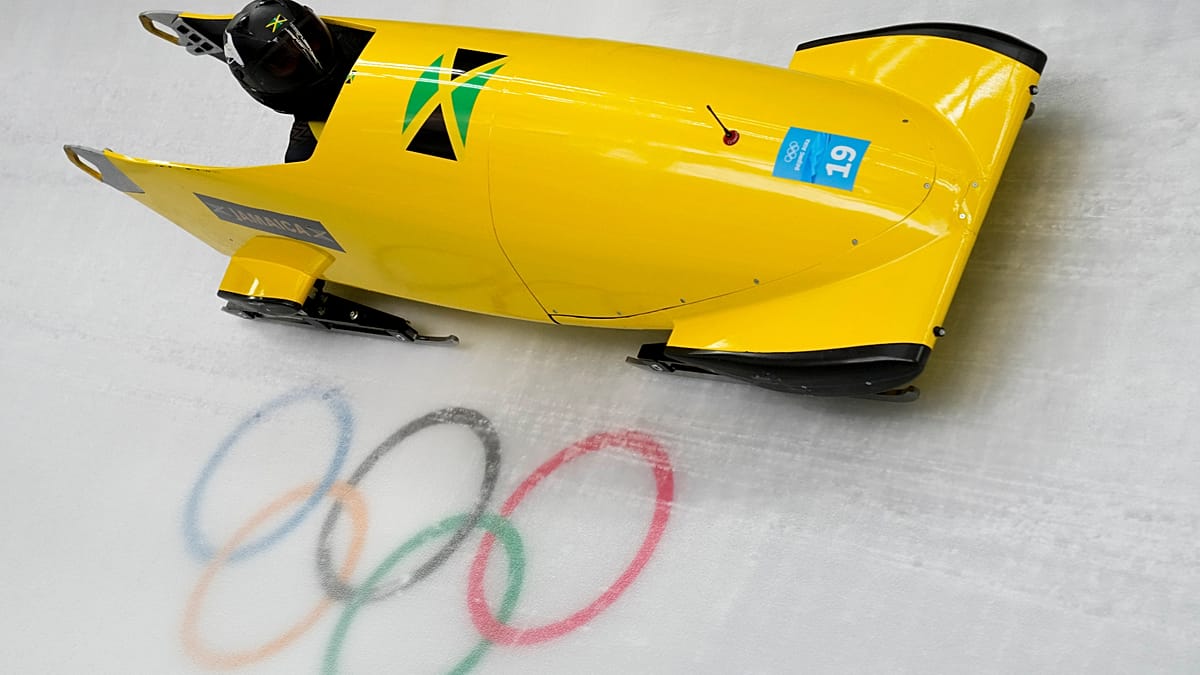
Nearly four decades on from Jamaica’s debut at the 1988 Calgary Olympics that inspired the cult film Cool Runnings, the Caribbean country’s bobsledders are now preparing for their tenth Winter Games in Italy.
At the Milano Cortina 2026 Winter Olympics, Jamaica will compete in both the women’s and men’s bobsleigh events between 15 and 22 February.
In the women’s monobob, the green, black, and yellow flag will be worn by Mica Moore — a former Great Britain athlete who has switched allegiance.
In the men’s competition, Jamaica will field two crews. The four-man bobsleigh team will feature Shane Pitter, Andrae Dacres, Junior Harris and Tyquendo Tracey.
In the two-man event, Pitter will serve as driver, with the brakeman to be selected from Joel Fearon, Junior Harris or Nimroy Turgott.
They will be continuing the legacy of their compatriots who made history in Calgary in 1988.
Unlikely venture
The story begins with the crew that made history: driver Dudley Stokes, brakeman Michael White, and push athletes Devon Harris and Chris Stokes — the quartet with which Jamaica debuted in the four-man bobsleigh.
Some of the athletes were picked after a selection process among competitors preparing for the 1988 Seoul Olympics, while others were drawn from the ranks of Jamaica’s army.
Behind the unlikely venture stood George Fitch, then a commercial attaché at the US Embassy in Kingston and still regarded as the architect of “tropical” bobsleigh.
As unconventional as the idea of Jamaica entering a winter sport were the athletes themselves. White was a sprinter on the army team, Harris competed in the 800 metres, and Dudley Stokes began his career as a helicopter pilot.
Although the four-man crew did not qualify for the fourth run, Jamaica’s debut in the Winter Olympics — and the personal stories of the athletes involved — had already left a lasting mark, even inspiring the Disney film Cool Runnings. The movie is largely fictionalised but is still the most recognizable part of the Jamaica bobsled story.
Those athletes’ example has also encouraged other warm-weather nations, such as Mexico, Puerto Rico and Brazil, to establish their own bobsleigh teams.
Started with a street cart race
Although the team now trains in the United States, in Evanston, Wyoming, its earliest experiments took place in Jamaica itself, where athletes practised explosive starts using improvised street carts in place of sleds.
It was while watching a traditional downhill cart race that Fitch and his fellow entrepreneur William Maloney first conceived the idea of forming a Jamaican bobsleigh team, convinced that the island’s greatest sporting asset — its world-class sprinting speed — could be adapted to winter competition.
Initial training sessions, conducted under American coach Pat Brown in the United States and Austria, were challenging and often discouraging.
Yet the determination shown by the athletes attracted the attention of the international federation, which ultimately approved Jamaica’s participation in Calgary in 1998.
Shortly before the competition, the team suffered a setback when crew member Allen Caswell was forced to withdraw because of injury.
He was replaced by Stokes, a fellow sprinter who had travelled to Calgary primarily to support his brother Dudley, the team’s driver.
The sporting results are well known. The two-man sled of Dudley Stokes and Michael White finished 30th, while the four-man crew’s campaign ended in dramatic fashion with a crash during the penultimate heat — an incident that, despite disappointment on the track, helped cement the team’s enduring place in Olympic history.
Jamaica’s best-ever result remains a 14th-place finish in the men’s two-man bobsleigh at the Lillehammer 1994 Games.
In recent years, however, the evolution of the sport — particularly the introduction of the women’s monobob — has opened up new opportunities, enabling the programme to develop a more structured, long-term approach.