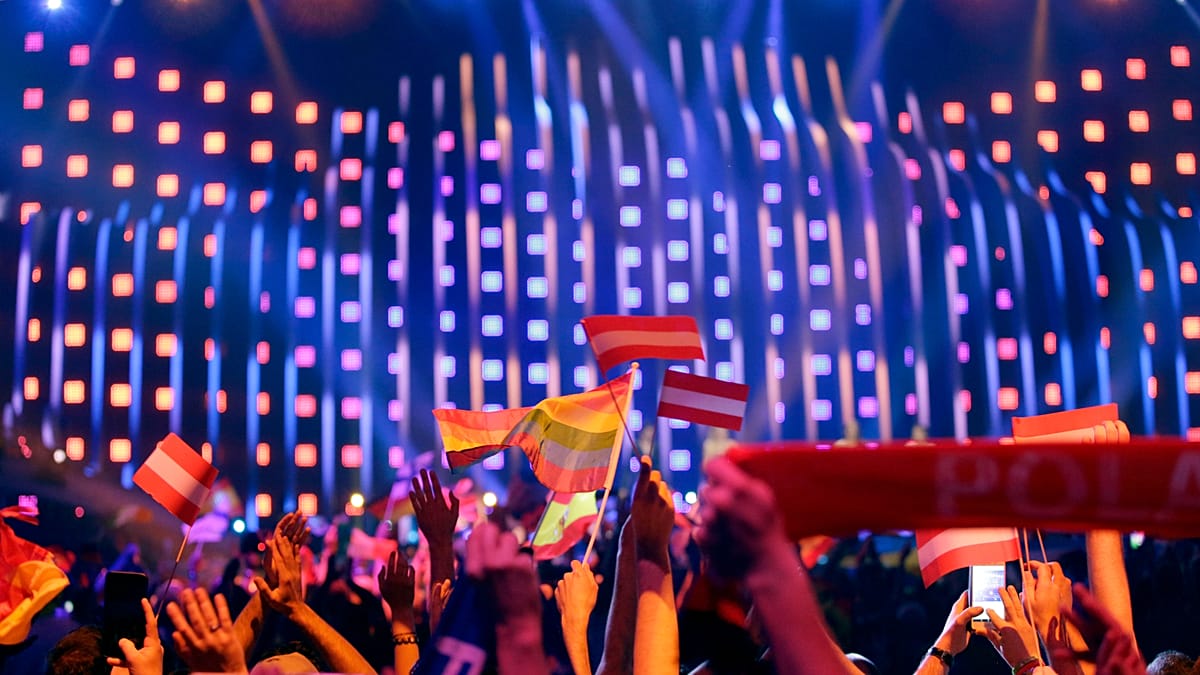
The Eurovision Song Contest takes place in May, but for true fans, the Eurovision season starts much earlier.
“For us Eurofans, Eurovision starts in September,” João Vargas (source in Portuguese) tells Euronews, since it’s in September that the songs from the different countries start to come out. Then come the national finals: “We have Albania, which starts in December, so for us it starts there. And it’s interesting to follow basically 30, 40 national finals, Saturday after Saturday, from December until May,” he tells Euronews.
The term “Eurofan” isn’t in the dictionary, but it can be almost a full-time job. These peopleclosely follow the national finals in different countries such as the Festival da Canção in Portugal, Melodifestivalen in Sweden or Benidorm Fest in Spain, analysing songs, performances and results in great detail.
The dedication of those who follow the process of selecting the songs that go on to the annual international competition is unquestionable: “February, March, it’s total madness! There are Saturdays when we have a screen divided into five or six squares with the national finals for each country,” emphasises Francisco Rodrigues. (source in Portuguese)
The community stands out for the content it publishes online, mainly on social media, including personal rankings, vocal and staging analyses, voting predictions and statistical comparisons between editions. Those who explain it to us know their stuff. João and Francisco are dedicated Eurofans and share a fascination with the contest, which has been running for 70 years.
As well as being fans, they are creators of content dedicated to the festival: reactions, analyses, sharing opinions, anything goes to convey the passion that unites them with a community.
“I think we tried, we started talking to each other without realising that we were creating this tribe, without realising that this community was being formed,” explains Helena Almeida (source in Portuguese), who is also a member of the Eurovisivos fan community, and of this group of friends.
“There’s a sense of belonging here that we’ve created and that we respect,” says the content creator.
“A place that brings people together”
Theconnection and experience created between each fan and the festival is unique. Euronews spoke to six Eurofans and content creators. They all recount a different story and a unique moment that connected them with the international event.
Fábio Alexandre explains how he found his connection, which began with his family. “I remember being very young and watching Eurovision with my grandparents. That’s where the bug was born,” he recalls.
“We always got together to watch the Song Contest and Eurovision. I have memories of 2004, 2005, but 2006 was the year that marked me the most, because it was the year when there was a bit of a generational clash, because my grandfather was very shocked by who won, which was a rock band, Lordi, who were little monsters with kind of scary faces and I loved it, I found it fascinating. It’s such a different space: me loving it and my grandfather hating it,” says Alexandre, revealing how Eurovision is a space for sharing and belonging.
**”**There’s room for everyone,there’s room to be different, there’s opportunity for everyone.I think all this gives us hope and makes us want to know more about the artists, to see and experience this show,” he says. “The motto United by Music is not in vain.”
Eurovision appears as a free space for sharing, at least that’s how it’s characterised by all those involved. Whether online or in an arena, Eurovision for these people is much more than a musical contest. Some define it as a family.
“I think if I had to summarise this whole journey, Eurovision ends up being home and ends up being a place that brings people together. People who can become part of our lives, who are our family or who can become our family,” says Jorge Durões, who is also a devoted Eurofan and has been following the festival since the 90s.
“This world ended up opening up even more in 1998, with the victory of Dana, the first transsexual to win,” he confesses. “For a 13-year-old boy at the time, who was also here trying to find out who he was, coming into contact for the first time with an element of a community I didn’t yet know I was part of, the LGBT community, began to open horizons,” adds Durões.
“That’s when I felt, for the first time, that Eurovision was a safe place, a place of home, a place where we all have our place, of sharing, of diversity**,** but above all a place where we can assert ourselves and be who we are.”
“Everyone said it would never happen and it did”
Portugal has 55 participations in the international event and one victory. Salvador Sobral, with the song ‘Amar pelos Dois’, won in 2017 and still holds the record for the highest score ever, with a total of 758 points, the highest total recorded since the current voting system was implemented in 2016. That said, it’s not hard to see why it’s easy to name the Portuguese victory as the most memorable moment of the contest.
“I grew up hearing everyone around me say it would never happen, and it did,” explains Helena.
“I remember commenting with people, because you see, we fans follow the movements, we follow the comments of other fans, we see the bets online, and we started to see that we had a chance, we started to believe. And I remember commenting on it to the people around me, and everyone thinking that I was completely misguided, that it would never happen, and then it did!” she recalls.
“It was total hysteria! We couldn’t believe it, because waiting 70 years to win Eurovision, and winning like that, winning in Portuguese, was a fantastic thrill,” explained João Vargas. “I remember watching Eurovision and saying: ‘we’re really going to win, my God, what do you mean? This is really real’,” said Filipe Cruz (source in Portuguese), also a dedicated Eurofan.
For those who, like these fans, follow the national final and Eurovision, there is a clear difference between before and after.
“We usually ended up in the semi-finals, and when we went to the final, the rankings weren’t great either,” explains Filipe Cruz. “Since then, we’ve had some pretty good rankings, some top 10 or close to top 10.”
“Music isn’t fireworks, music is feelings,” was a striking and even controversial phrase uttered by Salvador Sobral at the moment of his victory. Few expected a ballad in Portuguese to win at a festival characterised by expressive rhythms, elaborate choreography, lights, fire and everything a delegation can think of and pay for on stage. In the opinion of these fans, the Portuguese singer’s victory has paved the way for less likely but more authentic styles for the artists who perform them.
“I think it also had an influence abroad because, at first glance, nobody would have thought that a song like Salvador’s could win, and the fact that he won made the artists who came along in the following years, many of them more genuine,” says Helena. “I feel that since Salvador won, doors have been opened for other artists who want to go to Eurovision with a song that is less festive, more introspective, more ballad-like, even with a touch of jazz, which are styles you don’t find there as much, to do so.”
“Initially, no-one took much notice of the Napa song. The (Eurovision) fans were a bit turned off and then it actually became one of the most listened to Eurovision songs this year, which is an interesting phenomenon,” explains Filipe. “A phenomenon that was kind of unexpected. Then other artists might think that maybe the Song Contest is a good platform for them to grow.”
For these fans, watching the events live is almost obligatory, at least when it’s possible to do so. After Salvador’s victory, and as the contest rules state, Portugal organised the event in 2018. It was the first opportunity for many to watch the event live.
“When I walked in and saw that gigantic stage, which took up the whole room, the whole Meo Arena, I started crying, completely! I can’t explain it,” confesses Francisco Rodrigues. “I remember saying: it’s done, I can go, I’m happy, my dream is realised!”.
Controversy surrounds Eurovision Song Contest
In 70 years of Eurovision, the contest has experienced more than its fair share of ups and downs. This year, the contest is in the midst of a new controversy over Israel’s participation due to the conflict in the Gaza Strip.
The European Broadcasting Union (EBU), which is organises the event, decided in December 2025 to keep the country in the event which is being held in Vienna, Austria.
As a result, several countries have announced that they will not take part in 2026 as a sign of protest, including Spain, one of the so-called Big Five, which will not send a representative and will not broadcast the contest. Ireland, the Netherlands, Slovenia and Iceland have also announced their withdrawal from the competition.
Portugal, through RTP, has opted to take part in the 2026 edition, despite the position of most of the artists taking part in the Festival da Canção, whose first semi-final took place on 21 February, who have chosen to boycott the international contest. Several have released a joint statement in which they say that if they win the national final, they will not represent Portugal at Eurovision in Vienna as a form of protest.
“I think interest has waned dramatically**.** Knowing that 14 of the 16 participants don’t want to go to Eurovision, I think it makes perfect sense for them to think: ‘we’ll see who wins’, because in fact, the interest in competition has been lost here,” explains Fábio Alexandre.
“It’s an atypical festival, strange, because we’re used to seeing those songs competing to represent us abroad and, in this case, we know that there are 16 here, but there aren’t that many that can really go to Vienna,” said Francisco Rodrigues. “I think everyone here is free to make their own decision. It’s not because they say yes, that they’re going to Eurovision, that they’re in favour of what’s happening in Palestine. So this is a very delicate issue and one that, I think, affects the health of the contest itself. And that, of course, makes me apprehensive,” he emphasised.
Even for those who follow both the national finals and the main event in May, the situation has had an impact and caused disinterest.
“I think we’re all sharing a bit of that lack of interest, even if it’s not unconsciously. I also realise it myself, even the semi-finals of the other countries that we know are going to take part in Eurovision, when the songs come out, I don’t go and watch them straight away, which was something I used to do,” explains Jorge Durões. “Whether we like it or not, the whole structure of the Eurovision year has been affected. This is unconsciously impacting the fans and I think many of us are just waiting to see what will happen in Vienna in May.”
To justify the Israeli presence, the EBU points out that it is allowed on the basis of the principle that the contest is an event between public broadcasters, not between governments. The organisation argues that Eurovision is a competition between member broadcasters, in Israel’s case the public broadcaster Kan, and not a direct representation of the political positions of the respective states, stressing that the contest is an “apolitical” event whose aim is to promote music and cultural diversity.
“I’m not one of those people who says this is an apolitical event because politics is everywhere. Politics defines everything around us, so I don’t think we can pretend it doesn’t. From the moment the teams that take part carry the flag of their country, they are representing it, and the event always ends up having a political representation here,” explains Helena Almeida.
“Given what’s going on, there are those who argue that certain countries shouldn’t take part. I’m in favour of that too. If we paralleled what happened with the expulsion of Russia, I think other countries could be expelled. Even so, I realise it’s difficult, things aren’t black and white,” he said.
“For me, it’s all about respecting everyone’s opinion. I have my position,” says João Vargas, who explains how he blocked the issue of Israeli participation from his content. “I don’t publish about Israel, I don’t talk about Israel,” he explains. “It’s my position as a Eurofan, but I respect those who do it,” he adds.
Nobody knows what will happen to the festival in the event of an Israeli victory, a scenario that came very close last year. The Festival has since changed the rules regarding voting and the promotion of songs, following the controversy caused by Israel’s result and allegations of “interference” by the Israeli government.
“I believe that the Festival da Canção in Portugal will continue to evolve and this year is the beginning of a renewal of the format. And I believe that this will also happen at Eurovision, that it will continue to evolve, that the rules will continue to be worked out in-house, where the revolutions are actually made, and that Eurovision will continue to thrive and continue to evolve and grow and be a safe space for us,” says Jorge Durões. “I don’t believe that after 70 years the brand, the concept, the Eurovision space will be called into question. The end of Eurovision has often been prophesied and it hasn’t ended.”
Last year’s Eurovision Song Contest achieved audience and engagement records. According to information from the EBU, the grand final, held in Basel, Switzerland, reached 166 million viewers in 37 markets, which, according to the broadcaster, represents an increase of three million viewers on the previous year.
In Portugal, the Festival da Canção presents the second semi-final on Saturday and the grand final on 7 March.
The Eurovision final will take place on 16 May in the Austrian capital, Vienna.