
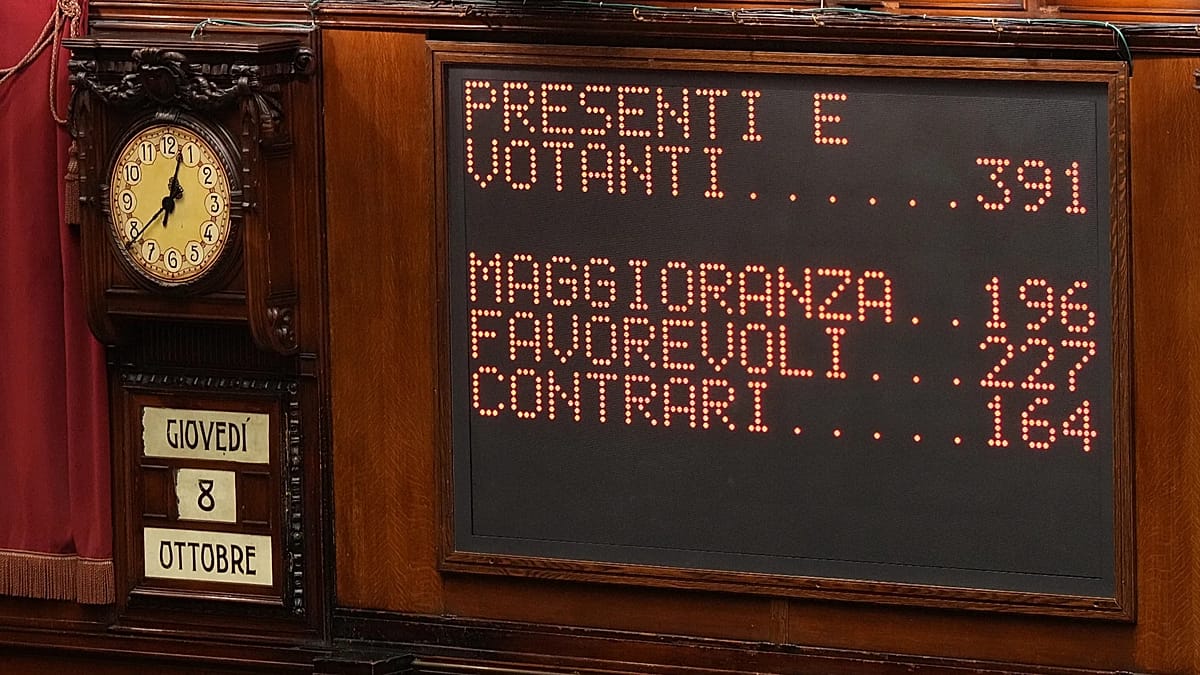
Italy’s Chamber of Deputies approved a new electoral law on Thursday, clearing the way for its use in the next general election, due in 2027.
The legislation, backed by Prime Minister Giorgia Meloni’s government and formally known as the Stabilicum, – dubbed the Melonellum by opposition parties, – passed by 227 votes to 164 in a secret ballot.
The vote effectively marks the unofficial start of the election campaign. While the current legislature runs until September 2027, speculation about an early election is already circulating in the corridors of parliament, though as we explain below, a vote before 14 April remains unlikely.
The immediate political battle now shifts to alliances. Meloni has so far ruled out joining forces with National Future, the party of MEP Roberto Vannacci, while the opposition has yet to agree on a common leader. Significant divisions remain within the centre-left, particularly over the war in Ukraine, where Democratic Party secretary Elly Schlein and Five Star Movement leader Giuseppe Conte remain at odds.
Meloni moved quickly to claim the vote as a show of unity.
“To those who hoped to see the centre-right split, today we answer with facts: we are united, solid and determined to carry forward the commitments made to citizens,” she wrote on social media.
During the sitting, opposition MPs protested, brandishing placards reading: “Rigged law”, “No to the fix” and “With Meloni diesel at 3 euros”.
“Seats first. That is your slogan. We will vote firmly against this electoral law, which has been designed not for voters but to protect those already elected. With our progressive alliance we will be able to win under any electoral law and change Italians’ lives,” said Elly Schlein in her explanation of vote.
Five Star Movement leader Conte also used exceptionally harsh words, arguing that the law has been written to ensure victory for the current ruling coalition.
He concluded: “There is only one further detail missing to guarantee your future control of Parliament: specifying that the majority bonus goes to a prime minister with light-coloured eyes”.
How the new Italian electoral law was approved
The governing majority held firm in the secret ballot. This was the third parliamentary reading, after the amendments passed by the Senate, which introduced preference voting with blocked list leaders and increased the number of signatures required from parties not represented in Parliament in order to stand in elections.
On Wednesday the Chamber had approved the third confidence motion tabled by the government on the first three articles of the law. Thursday saw the final, most delicate, vote. If this last vote had gone against the government, the text would have been rejected, but the cabinet would not formally have been obliged to resign.
The most significant changes are contained in the first two articles, which were approved through a confidence vote. They introduce preference voting alongside blocked list leaders and set out the rules for electing both the Chamber and the Senate under the new system.
The signature threshold for parties without parliamentary representation has also been raised, from 1,500 to 6,000, and the rules on gender representation have been amended.
A third article addresses single-member constituencies in the province of Bolzano, while article 8 introduces one of the most anticipated changes: the right to vote for people living away from their registered place of residence.
The confidence vote is a mechanism that allows governments to fast-track legislation and limit debate and filibustering by the opposition. Under this procedure, MPs vote on the government’s text as presented, without the ability to propose amendments.
The government stakes its survival on the outcome, if the Chamber votes it down, the administration automatically falls.
The issue of first-term MPs’ pensions
Faced with the threat of a government crisis, it was widely expected that most MPs would back the reform.
There is one date that Italian political scientists are all trying to pinpoint precisely: the moment when the current legislature reaches 4 years, 6 months and one day of its total five-year term.
On that date, first-term MPs become entitled to a parliamentary pension (around 1,500 euros, payable only from the age of 65).
For the current government, that threshold falls on 14 April 2027, and Italian political history shows that it is very unlikely that an election will be called before then.
There is nonetheless concern that the Constitutional Court could overturn the reform, which would complicate the government’s plans and expose the right to fierce criticism during the campaign.
The opposition has identified three potentially unconstitutional elements: the majority bonus in the Senate, the requirement for parties without an established ballot logo to gather 300,000 signatures, and the absence of any requirement that at least 40 percent of lead candidates be women.
According to critics, the law potentially leaves Italy in political deadlock.