
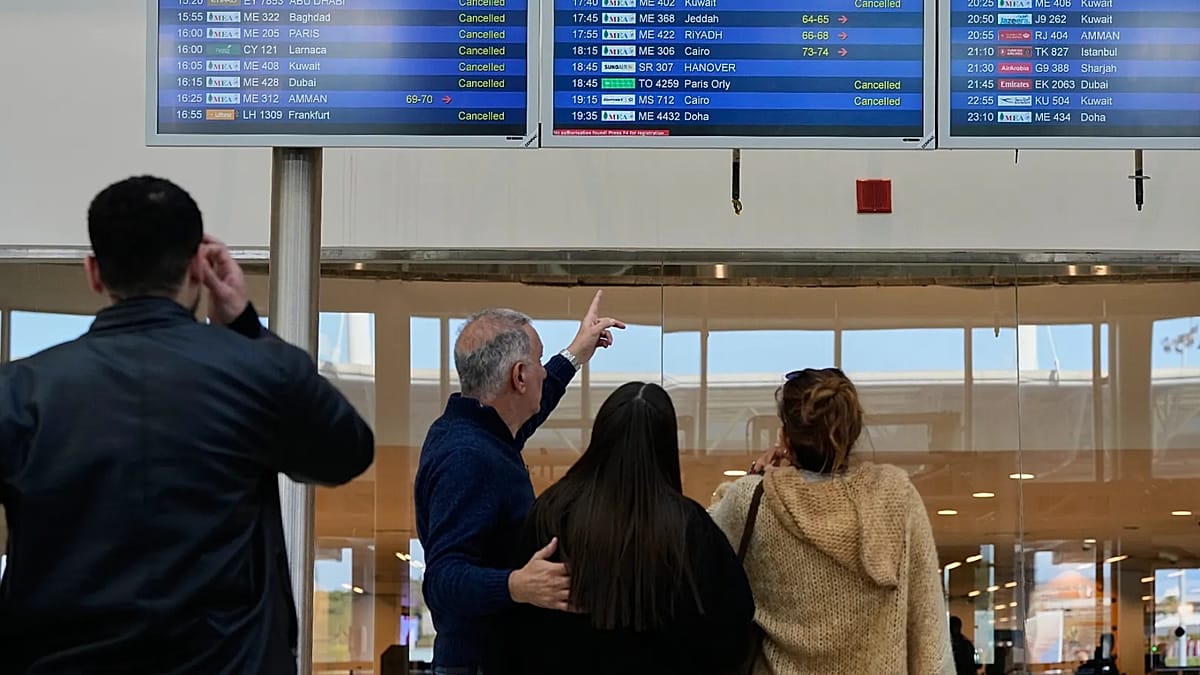
The Middle East’s commercial aviation sector remains grounded for a third day with airspace closed and operations suspended at major airports following the joint US-Israeli strikes on Iran and retaliatory attacks.
As of Monday 2 March, Bahrain, Iran, Iraq, Israel, Jordan, Kuwait, Qatar, Saudi Arabia, Syria and the United Arab Emirates (UAE) were among the nations that announced at least partial closures of their skies. This has forced widespread flight suspensions, cancellations and diversions, leaving tens of thousands of passengers stranded around the world.
The conflict has led to the closure of key hub airports in Dubai, Abu Dhabi and Doha, and Flightradar24 reported that more than 3,400 flights were cancelled on Sunday across seven airports in the region: Dubai International, Hamad International Airport in Doha, Zayed International Airport in Abu Dhabi, Sharjah International Airport, Kuwait International Airport, Bahrain International Airport, and Dubai World Central – Al Maktoum International.
‘No one really knows what’s going on’
It is unclear how long the disruption to flight operations could last – which leaves passengers in travel limbo.
Jonathan Escott and his fiance had arrived at the airport in Newcastle, England, on Saturday only to find out that his direct flight to Dubai on Emirates was cancelled, leaving everyone on the flight stuck there. Escott left to go back to where he was staying with family, about an hour from the airport, but has no idea when he may be able to travel.
“No one knows,” Escott said. “No one really knows what’s going on with the conflict, really. Not Emirates, Emirates don’t have a clue. No one has a clue.”
Incidents at regional aviation hubs
In retaliation to the strikes by the US and Israel, Iran launched a series of attacks on Israel and Gulf nations that host US military bases – Bahrain, Kuwait, Qatar and the UAE.
The three major airlines in the Gulf – Emirates, Etihad and Qatar Airways – typically have about 90,000 passengers per day crossing through those hubs and even more travellers headed to destinations in the Middle East, according to aviation analytics company Cirium.
Two airports in the UAE reported incidents as the government there condemned what it called a “blatant attack involving Iranian ballistic missiles” on Saturday.
Officials at Dubai International Airport – the largest in the UAE and one of the busiest in the world – said four people were injured, while Zayed International Airport in Abu Dhabi said that one person was killed and seven others were injured in a drone strike. Strikes were also reported at Kuwait International Airport.
Though Iran did not publicly claim responsibility, the scope of retaliatory strikes that Gulf nations attributed to Iran extended beyond the American bases that it previously said it would target.
“For travellers, there’s no way to sugarcoat this,” says Henry Harteveldt, an airline industry analyst and president of Atmosphere Research Group. “You should prepare for delays or cancellations for the next few days as these attacks evolve and hopefully end.”
Operations remain suspended
Airports across the Middle East remained closed on Monday as the conflict moved into its third day. The situation is changing quickly and airlines urged passengers to check their flight status online before heading to the airport.
Dubai Airports confirmed that all flight operations at Dubai International and Dubai World Central – Al Maktoum International were suspended until further notice. Due to the multiple regional airspace closures, Emirates has temporarily suspended all operations to and from Dubai, up until 3 pm local time (12 pm CET) on Tuesday 3 March.
All aircraft movements at Hamad International Airport in Doha have been suspended due to the temporary closure of the Qatari airspace. The country’s flag carrier, Qatar Airways, will resume operations once the Qatar Civil Aviation Authority announces the safe reopening of Qatari airspace. The airline said a further update will be provided on Tuesday by 9 am local time (7 am CET).
Etihad Airways said that all flights to and from Zayed International Airport in Abu Dhabi are suspended until 2 pm local time (11 am CET) on Monday 2 March.
At least 145 planes that were en route to cities like Tel Aviv and Dubai early Saturday were diverted to airports in cities like Athens, Istanbul or Rome, according to FlightAware. Others turned around and returned to where they took off from. One plane spent nearly 15 hours in the air after leaving Philadelphia and getting all the way to Spain before turning around and returning to where it started.
Numerous airlines cancelled international flights to Dubai through the weekend, as India’s civil aviation agency designated much of the Middle East – including skies above Jordan, Saudi Arabia and Lebanon – as a high-security risk zone at all altitudes.
On Sunday, FlightRadar24’s live map showed the main east-west air corridor over Iraq – typically one of the busiest aviation “superhighways” linking Asia and Europe – almost completely empty. The route, which usually carries a constant stream of long-haul flights crossing between the two continents, appears devoid of traffic, underscoring the disruption currently affecting airspace across parts of the Middle East.
Which international airlines are affected?
Oman Air has said that flights to and from Amman, Dubai, Bahrain, Doha, Dammam, and Kuwait have been cancelled for 2 March. Other flights are operating as scheduled but delays are to be expected.
Saudia has also cancelled flights to and from Amman, Kuwait, Dubai, Abu Dhabi, Doha, Bahrain, Moscow and Peshawar until 11:59 pm local time (9:59 pm CET) on 2 March.
Low-cost carrier Wizz Air has suspended all flights to and from Israel, Dubai, Abu Dhabi, Amman and Saudi Arabia up to and including 7 March.
Turkish Airlines has cancelled flights to and from Bahrain, Dammam and Riyadh (Saudi Arabia), Iran, Iraq, Jordan, Kuwait, Lebanon, Oman, Qatar, Syria and the UAE.
Air France has cancelled its scheduled flights to and from Tel Aviv, Beirut, Dubai and Riyadh until 3 March.
Dutch airline KLM is currently not flying through the airspace of Iran, Iraq, and Israel, nor over several countries in the Gulf region. Flights to, from, or via destinations in the region are cancelled or adjusted. KLM’s Tel Aviv flights are suspended for the remainder of its winter season operations; flights to and from Dubai are suspended until 5 March; and flights to and from Damman and Riyadh are also suspended until 5 March.
British Airways is not flying to Tel Aviv and Bahrain until 4 March, while a number of flights to the Middle East have also been cancelled. The airline said if passengers are due to fly between London Heathrow and Abu Dhabi, Amman, Bahrain, Doha, Dubai or Tel Aviv up to and including 15 March, they can change their flight free of charge to travel on or before 29 March. Customers travelling up to and including 8 March may also request a full refund.
Lufthansa Group airlines – which includes Lufthansa, SWISS International Air Lines, Austrian Airlines, Brussels Airlines, ITA Airways, and Eurowings – has suspended flights to Tel Aviv, Beirut, Amman, Erbil, Dammam, and Tehran until 8 March. In addition, Lufthansa Group airlines also suspend flights to and from Dubai until 4 March.
Finnair has suspended daily flights to Dubai and Doha until 6 March, while Norwegian is suspending its flights to and from Dubai up until and including 4 March. “We will then assess if it’s possible to resume flights,” said the budget carrier.
Delta Air Lines has cancelled flights from New York to Tel Aviv until 8 March, while American Airlines’s Doha-Philadelphia flights are “temporarily suspended”. Air Canada has cancelled flights from Canada to Israel until 8 March and to Dubai until 3 March.
Air India has extended the suspension of all flights to and from the UAE, Saudi Arabia, Israel, and Qatar until 11:59 pm local time (7:29 pm CET) on 2 March 2026.
Garuda Indonesia, Indonesia’s flag carrier, temporarily suspended flights to and from Doha “until further notice”, the company said in a statement on Sunday.
Are passengers entitled to compensation?
Airlines that are crossing the Middle East and Gulf will have to reroute flights around the conflict with many flights headed south over Saudi Arabia. That will add hours to those flights and consume additional fuel, adding to the costs airlines will have to absorb. So ticket prices could quickly start to increase if the conflict lingers.
Responding to the flight cancellations, Ella Jo Rhodes, a travel expert at UK consumer champion Which?, said on Saturday: “In light of the ongoing situation in the Middle East, many airlines are taking precautionary steps to amend their schedules, including cancelling flights in the region. Given the extraordinary circumstances, passengers on delayed or cancelled flights will not be entitled to compensation.
“However, if you are flying with a UK or EU airline, or are departing a UK or EU airport with any carrier, your airline should provide assistance during your delay. Depending on the length of your delay, assistance may include food and drink and, where necessary, overnight accommodation. If your journey is cancelled, you are entitled to a full refund.”