
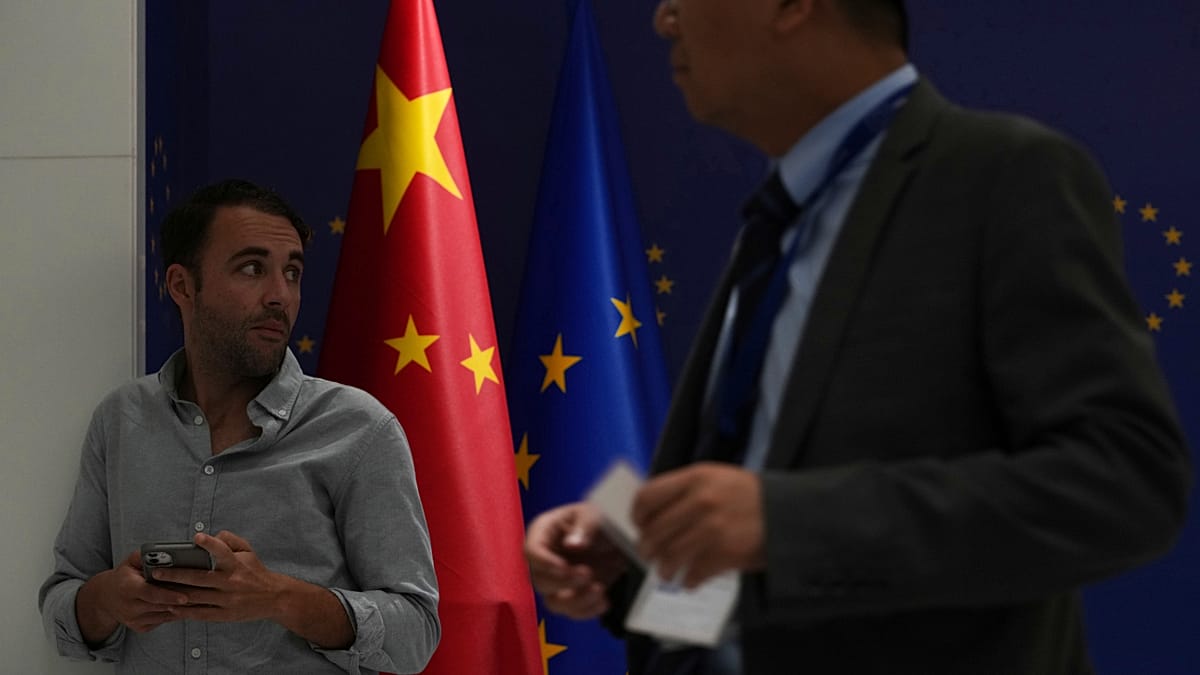
Tensions between China and the EU have intensified in recent months, prompting the European Commission to convene most of its commissioners for a strategic rethink during an “orientation debate” on Friday.
“China is a critical partner, and engagement and dialogue will continue,” the commission said in a readout following the debate. “At the same time the current state of the trade and investment relationship is not sustainable.”
Calling the relationship “not sustainable” may understate the depth of the rupture.
Relations have steadily deteriorated since European Commission President Ursula von der Leyen branded Beijing a “systemic rival” in a landmark 2023 speech. But tensions surged to a new level once EU policymakers finally settled their differences over the EU-US trade deal that had consumed Brussels for months, freeing the bloc to sharpen its focus on China.
Last year, according to the commission, the bloc registered a record-high €359.9 billion trade deficit with Beijing, fuelling growing calls in Brussels to better protect the EU market from cheap Chinese imports that threaten entire sectors — metals, chemicals and the car industry among them.
“We are seeing a panic attack in the last few weeks on China,” an EU official told Euronews, speaking on condition of anonymity to speak candidly. The official added that the China issue had been “overlooked for too long.”
A total of 200,000 European jobs were lost in EU industry — particularly in the energy-intensive and automotive sectors — since 2024, with a further 600,000 job losses projected this decade in carmaking alone.
On Friday, the commission readout specified that its “overarching approach remains de-risking, not decoupling,” signalling that the bloc is still pursuing targeted efforts to reduce its dependence on China rather than sever economic ties altogether. Yet the risk of a full-scale trade war has never felt so real.
Here are five key points on how the situation has escalated to this point — and where it may be headed next :
1. Fines and regulatory pressure
During the previous legislative term, the EU passed legislation that drew Beijing’s anger — notably measures to screen foreign direct investment. And it has stepped up its fight against so-called dumping, whereby public subsidies are used to undercut competitors through exports sold below market prices in China.
The European Commission has grown increasingly assertive in countering China’s subsidy-driven approach, including by imposing duties on imports of battery electric vehicles. Several product-specific investigations are also ongoing.
Earlier this week, the Commission fined Chinese e-commerce giant Temu €200 million for selling unsafe products and opened a full-scale investigation into JD.com’s acquisition of e-commerce retailer MediaMarkt.
EU lawmakers and governments are also discussing the Industrial Accelerator Act, a legislative proposal that would impose strict conditions on investments in batteries, electric vehicles, solar panels and critical raw materials from countries controlling 40% of the global market share in a given sector.
A separate proposal — a revamped Cybersecurity Act — could push out Chinese equipment suppliers such as Huawei and ZTE from critical infrastructure.
2. A more systemic approach
To counter Chinese overcapacities, the EU agreed in April to double tariffs on steel imports that exceed EU quotas. The measure is a so-called “safeguard” — a tool backed by some of the EU’s largest economies, including France, Italy, Spain, the Netherlands and Lithuania, which called for it to be extended to sectors beyond metals.
In a non-paper, those countries argued that safeguards were more “agile” than other EU instruments targeting cheap export products. The paper also calls for economic security to be factored into assessments of the EU’s interests when deciding on trade defence measures.
The European industry is also ramping up pressure to crack down on Chinese cheap imports calling on the Commission to use trade defence measures “more flexibly, faster, and preventively.”
A major wake-up call for EU policymakers has been the recent case of Nexperia, a Dutch-based chipmaker acquired by Chinese giant Wingtech, which was caught in the crossfire of US-China trade tensions, causing significant disruption in the automotive sector.
The Commission is now set to require sectors such as the car industry to diversify chip suppliers in certain cases, taking supply-chain risks into account in procurement decisions.
Despite these various initiatives, EU policymakers have grown wary that the current rules are too slow-moving for a fast-moving adversary. After duties were imposed on electric vehicle batteries, China’s focus simply shifted to hybrid vehicles.
Brussels is now moving towards a more systemic approach, treating trade defence as a toolbox to rebalance relations with China. One potential addition is a so-called overcapacity instrument to cap imports in specific sectors.
3. China’s threats of retaliation
In recent weeks, China has repeatedly threatened retaliation if the EU presses ahead with closing its market to Chinese goods.
Both the “Made in Europe” legislation and the Cybersecurity Act have drawn Beijing’s ire, prompting intensified lobbying of Brussels and EU member states, with warnings that implementation will trigger a response.
The Europeans are walking a tightrope, acutely aware that their decisions could spark a trade war. After the EU imposed tariffs on Chinese electric vehicles in 2024, Beijing imposed tariffs on EU pork, brandy and dairy products.
“International trade is a two-way street. There’s no forced trade. The China-EU trade relations are win-win in nature. China does not aim for trade surplus,” Chinese Foreign Ministry spokesperson Mao Ning said at a press briefing on Thursday.
“The EU needs to put trade ties with China in perspective and honour its commitment to free trade. China will closely follow the EU’s moves and take all measures necessary to safeguard legitimate rights and interests,” Ning added.
Some argue it is already too late for the Europeans, who depend on China for key components of their supply chains — components Beijing can weaponize at will.
In 2025, China blocked exports of rare earths, which are vital for EU green technology and defence, as well as chips essential to the European car industry. Beijing can also leverage operating licences for EU companies and restrict access to its market at any time.
4. European divisions
Europe is far from united on China.
Germany, despite a troubling trade deficit with Beijing, has been slow to shift away from its cooperative approach, which prioritises securing market access for German companies in China.
Berlin did not endorse last weekend’s non-paper backed by other major EU economies. Instead, German Economy Minister Katherina Reiche repeated this week that Germany’s overriding priority is to avoid jeopardising exports to China.
Yet the economic cost of dependence on Beijing might be forcing Berlin to reconsider its stance. The German government is reportedly weighing a tougher line that would mark a significant shift in its China policy.
For years, the German industry had a relationship with the Chinese market that critics described as toxic — one that blocked any meaningful attempt to rebalance the trade deficit out of fear of losing commercial access to the vast Asian market.
Spain has emerged as the other major EU country reluctant to act against China. With relatively cheap energy costs, Spain has become attractive to foreign investors, of which Beijing accounts for a growing share.
Its position caused embarrassment for Madrid this week, after it initially appeared to support the France-led non-paper before retreating and claiming it had merely participated in discussions.
“There has been no specific political support for any ‘non-paper’,” Spanish trade minister Carlos Cuerpo said, adding that the EU should “engage” with Chinese authorities through “dialogue.”
5. What happens now?
Brussels’ reassessment of its China stance has been long in the making, rooted in decades of deepening economic dependence. But the latest acceleration was also prompted by a shift in US posture, most visibly the recent visit to Beijing by President Donald Trump.
The Commission’s orientation debate on Friday was just a first step in what could become a broader repositioning. Where that leads — given internal divisions and the threat of retaliation — remains deeply uncertain.
The conclusions of that exercise are expected to feed into a discussion on economic security at the next European Council meeting on 18-19 June. China has appeared on EU leaders’ agenda several times in recent years, only to be pushed aside by more pressing crises.
While Brussels considers adding new instruments to its policy toolbox, political will remains the key determining factor. Nowhere is that gap more stark than in the EU’s handling of the anti-coercion instrument, also known as the “trade bazooka,” which was designed to push back against economic pressure and unfair trade restrictions.
“The anti-coercive instrument was never used, even though we have been coerced quite a lot,” the EU official said. “We need tools that we are actually willing to use.”