
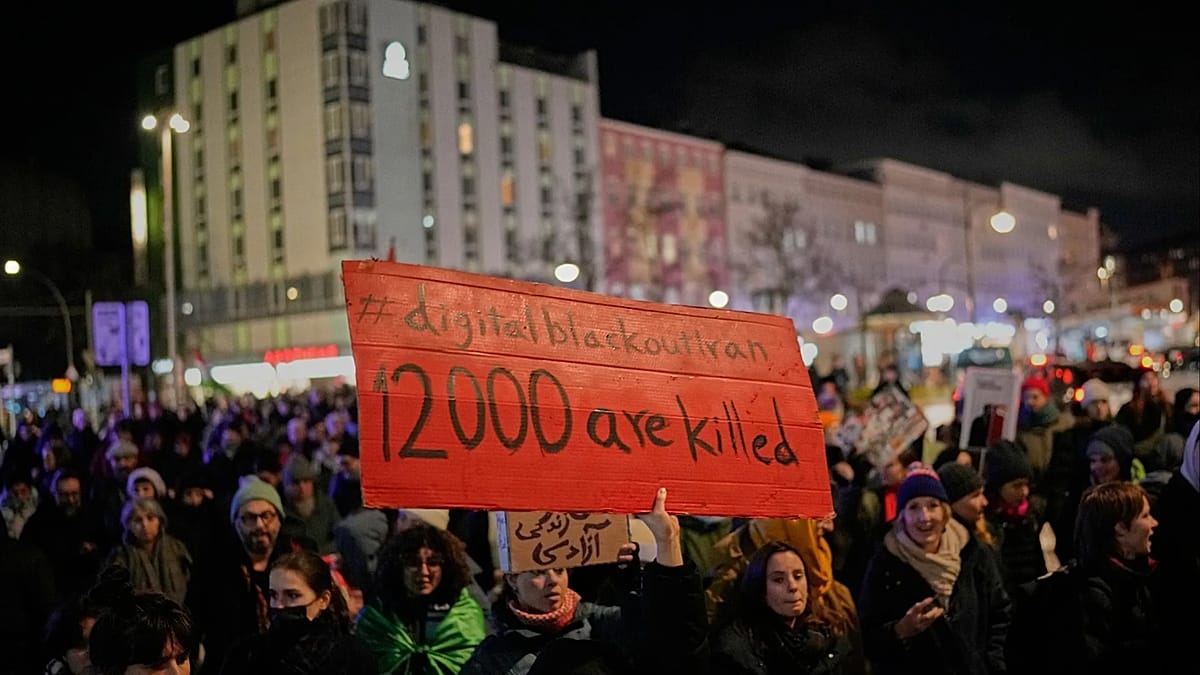
The nationwide protests that have rocked Iran in recent weeks have also sent shockwaves through the Iranian diaspora around the world.
Alongside growing economic hardship in the Islamic Republic, widespread anger over corruption within the regime has fuelled the unrest, which started in late December.
Authorities have responded with brutal force and a “digital blackout,” shutting down internet access in an effort to suppress dissent.
In an interview with Euronews, German-Iranian artist and doctor Maryam said that “you first have to grasp what is happening in Iran and how the protests have grown exponentially”, adding that their scale was not immediately apparent.
“You live with tension, fear and hope all at once,” said the artist, who is known in the music industry under her stage name Maryam.fyi.
“Every time a new wave of protests breaks out, you ask yourself: is this the moment, is this the day the regime will finally fall, or will they manage to crush everything again? Is this the last time this fight for freedom will be waged, and can it be won this time?”
According to a report compiled by doctors in Iran and cited by The Times, at least 16,500 people were killed in what the newspaper described as a “genocide in digital darkness”.
On Monday, the US-based Human Rights Activists News Agency said it had verified at least 4,029 deaths, with another 9,049 cases under review. Euronews cannot independently verify the figures.
Eyewitness reports have described extreme violence and thousands of dead and injured.
Iran expert Ali Fathollah-Nejad described the events as a “massacre of historic proportions” on German public broadcaster ZDF on Monday morning.
“Even for someone who has worked on this region for more than twenty years, I have never witnessed anything like this in such a short period of time. We are now hearing eyewitness accounts that describe scenes beyond comprehension,” he said.
A so-called “phased restoration” of internet access has reportedly been promised, yet many Iranians are still cut off from the outside world by a blackout that started on 8 Jan.
For relatives abroad, the uncertainty over the fate of family members, friends and others back home is agonising. Maryam said that the uncertainty felt “oppressive” and “depressing”. Due to her public profile and regular media appearances, she now has very few contacts left in Iran as she is unwilling to risk putting anyone in danger.
Even so, she sees how many of her friends cannot reach their families, or have learned that relatives were killed during the protests.
“It’s just awful, the things you hear,” Maryam added.
‘Complete abuse of all kinds of principles’
Activists estimate that several thousand protesters were severely injured during the demonstrations. As in the 2022 protests, reports again highlight a troubling rise in head and eye injuries.
According to an analysis by The Conversation, such injuries represent a form of political repression rooted in a long cultural tradition, in which blinding symbolises disempowerment and the stripping of legitimacy.
Today, the aim is not only to punish individuals, but also to prevent them from seeing, documenting and exposing state violence, argues Firouzeh Nahavandi, a Belgian sociologist of Iranian origin.
“The regime deliberately shoots at life-threatening parts of the body and even makes sure, for example, that blood is sprayed to spread fear and terror,” Maryam said.
Yet many of the injured are said to have avoided hospitals out of fear, amid growing reports that protesters are being arrested directly at medical wards.
“This is, of course, a complete abuse of all the principles behind such a profession,” said Maryam, who is also a doctor.
She recalled accounts of injured people being examined to determine how they were hurt, and turned away if they had sustained gunshot wounds.
“It was assumed they were protesters and, as ‘terrorists’, deemed legitimate targets,” she said.
‘Help is on its way’
After the unrest started, US President Donald Trump said he would help demonstrators if the regime began killing or executing them.
“Help is on the way,” he said last week, urging Iranians to keep protesting.
Trump said that the US military wouldn’t intervene after he was assured that no executions would take place for the time being.
Maryam said she never believed military intervention was the right approach.
Instead, support should focus on restoring internet and mobile phone access “so that people can organise themselves”.
“Right now, all these people who are willing to risk their lives for freedom and for a revolution are cut off from the internet and unable to organise,” she told Euronews.
“That’s what makes the situation so dire. People are being flooded with propaganda and fear, which keeps the regime in power, while they themselves are unable to coordinate.”
Last week, German Chancellor Friedrich Merz also said he believed the Iranian regime is “effectively finished”, and that regime change is imminent.
Yet Maryam said she is is sceptical of Merz’s expressions of solidarity.
“The German government had the chance to support the people three years ago, and even before that, but it didn’t take it. Instead, it continued doing business with Iran,” she stressed. “It’s hardly news that the Iranian people are oppressed by an Islamist regime.”
“Germany was still one of Iran’s strongest trading partners in recent years. Statements like this feel deeply hypocritical to me,” she added. In her view, asylum procedures for Iranians could be made much easier, deportations could be halted, or the Iranian ambassador to Berlin could be expelled.
“So much could be done, but it isn’t happening. That’s why, until there are concrete actions, I see this as little more than lip service.”
A nationwide ban on deportations to Iran was in place in Germany until the end of 2023, before being lifted in January 2024. Since then, deportations have depended on individual asylum or residence decisions.
Figures from the Federal Office for Migration show that around 5,817 Iranians applied for asylum in 2024. Of those, 2,249 were granted protection status, while 3,880 applications were rejected.
Despite the ongoing internet blackout, images and videos of the protests continue to emerge: bloodied bodies, body bags lying in the streets, and security forces patrolling neighbourhoods.
According to reports from Bayerischer Rundfunk, a regional public service broadcaster in Germany, the protests have subsided, but armed militias are still present on the streets.
Prices for everyday goods have reportedly continued to rise, leaving little sign of economic relief for the population.
“The Iranian diaspora and German politicians must put aside their differences and unite to do everything possible for the freedom of the Iranian people,” Maryam said.
“This is a moral obligation. And our society should be out on the streets in the largest possible numbers, in solidarity, to demand an end to these atrocities,” she added.