



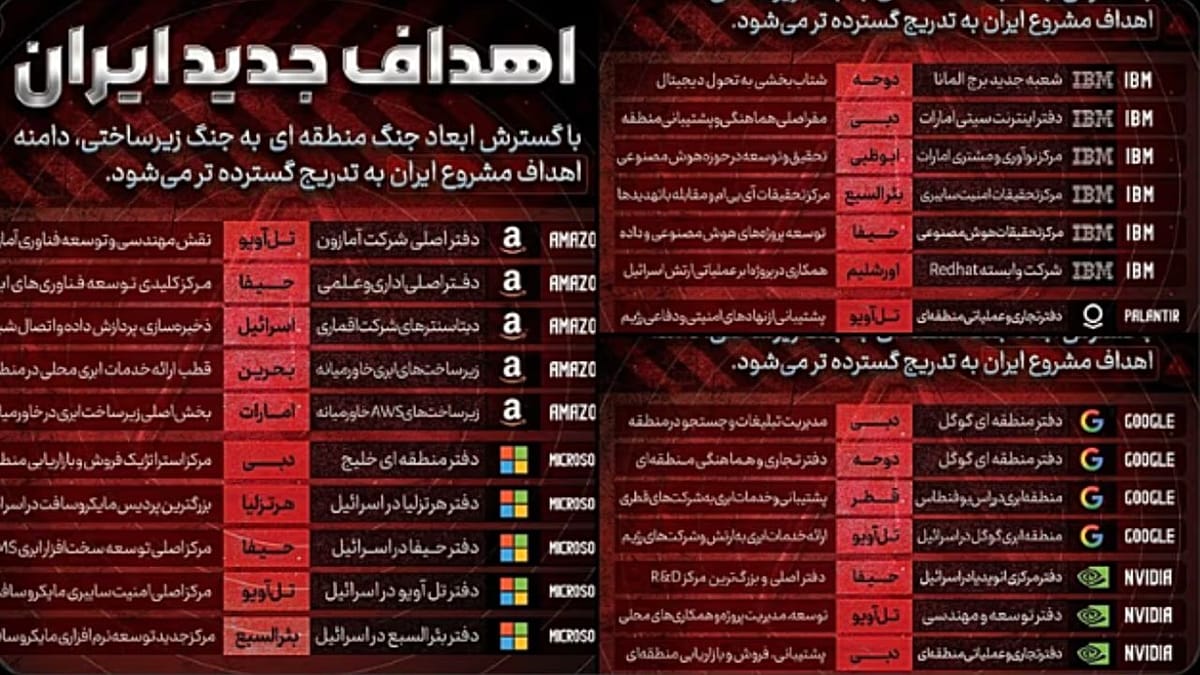





A spokesperson for Microsoft declined to comment. Spokespeople for the other companies listed did not immediately respond to a request for comment.
In a statement in response to the new threats from the IRGC, a White House official told POLITICO, “The United States Military is and was prepared to curtail any attacks by Iran, as evidenced by the 90 percent drop in ballistic missile and drone attacks by the terrorist regime.”
The IRGC similarly threatened a handful of companies with infrastructure in Israel and the Gulf earlier this month, all of which are named in Tuesday’s statement. Those companies, including Google, Microsoft, Palantir, IBM, Nvidia and Oracle, were listed as new targets given their technology has been used for military applications.
Fighting in the Middle East has highlighted the risks of President Donald Trump’s push to expand American tech infrastructure in the region. Iranian drone strikes knocked out power to Amazon Web Services cloud computing facilities based in the United Arab Emirates and Bahrain on March 3. And experts warned it wouldn’t be an isolated attack.
“I think it’s highly unlikely that it will be the last time, as data centers become more and more important for a broad range of critical infrastructure,” Sam Winter-Levy, a fellow in the Technology and International Affairs Program at the Carnegie Endowment for International Peace, told POLITICO earlier this month in response to the AWS incident.
The continued warnings from Iran pose a significant threat to U.S. tech companies and raise questions about how the facilities will be protected in the event of an attack.
“We can’t think about this AI infrastructure as purely a commercial asset anymore, and to some extent, it’s national security infrastructure,” Hamza Chaudhry, lead of AI and national security at the Future of Life Institute, told POLITICO earlier this month.


