
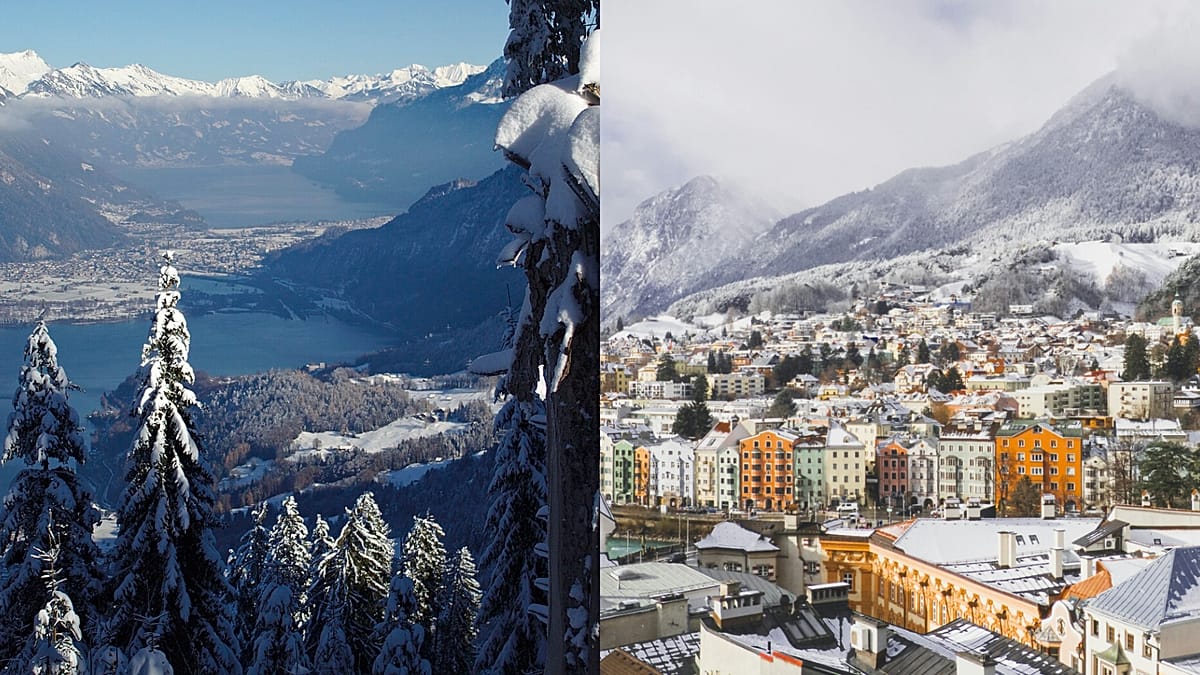
Winter in Europe means time for outdoor adventures – often on the slopes. Few destinations offer quite the same combination of skiing, snowboarding, chilly winter hikes and other activities like in the continent’s Alpine resorts.
In central Switzerland, between Lake Thun and Lake Brienz, Interlaken sits in the heart of the Bernese Oberland region of the Swiss Alps. Despite the lower temperatures, the year-round resort surprisingly offers accessible hikes and kayak routes during the colder season.
While around 370 kilometres to the east, Innsbruck makes an equally strong claim for holidaymakers’ attention. The capital of Austria’s Tyrol state, it’s also regarded as the “capital of the Alps”, though Grenoble in France is another contender for that title.
So, with the winter upon us, where will you choose for your next adventure getaway?
Both Interlaken and Innsbruck share an Alpine setting and a serious appetite for outdoor pursuits, but each offers adventure travellers surprisingly different experiences – and not just skiing.
Interlaken, Switzerland
Interlaken is replete with lakes, mountain villages and the Bernese Alps with glaciers.
The winter landscape, especially the snowparks, broad pistes and vast downhill runs, can be explored with a pair of skis. And the Interlaken Holiday Region has five areas dedicated to skiing and snowboarding: Beatenberg-Niederhorn, Brienz-Axalp, Diemtigtal, Habkern, and Aeschi-Aeschiried.
The latter two are especially popular during very snowy winters. In Habkern, a single ski lift connects to its four pistes – each of varying difficulty. While in Aeschi-Aeschiried, skiing and snowboarding activities overlook Lake Thun and the Niesen peak.
Another way to enjoy the region’s panoramas is on two wheels through Interlaken’s trails – even during the winter.
The town’s bike-friendly infrastructure makes leisurely rides a breeze. Although snow and ice can make outdoor cycling a challenge in winter, cyclists need not fret. “Winterlaken” by Yellow Velo offers an easygoing two-hour e-bike tour guided by a professional to Interlaken’s old town, 13th-century castle ruins and the traditional town of Bönigen.
Another way to make tracks in the Interlaken snow is through the town’s extensive network of hiking routes – the region features 220 kilometres of winter trails. Come rain or snow, the trails are maintained to still be hikable during the winter. The circular Aeschi hike is always in view of the Niesen, Switzerland’s highest pyramid-shaped peak.
On neighbouring Lake Brienz, just east of Interlaken, it’s also possible to kayak and surf ski across its turquoise waters during winter. Surrounded by snowy peaks and equipped with a dry warm suit, lake-cruisers can go on a half-day tour through the calm waters in the heart of the Bernese Oberland.
Interlaken’s accommodation offerings range from properties perched thousands of metres above sea level, wellness hotels, as well as various camp sites where visitors can spend their nights in camper cans, caravans, mobile homes, tents or bungalows.
Within Switzerland, the region receives train connections every 30 minutes to and from major towns like Bern, Zürich, Geneva and Basel. It is also part of the country’s national road network, making car travel easy, too.
While Interlaken doesn’t have its own airport, the nearest is around 50 kilometres away in Bern or 135 kilometres away in Zürich.
Innsbruck, Austria
Winter in Innsbruck means speedy toboggan runs amid mountain landscapes, groomed slopes and ski tours through snow-covered Alpine valleys.
Taking its name from the River Inn, the Austrian city is home to Tyrol’s highest toboggan run. Situated in the Kühtai ski resort, and at an altitude of 2,127 metres above sea level, this 2,020m-long route takes roughly 45 minutes to ascend before the swift descent starts. When the sun goes down, the tobogganing doesn’t have to end as the run is floodlit well into the night.
Innsbruck is also home to the Bergisel Ski Jump, a 50m-high sports facility and landmark designed by Iraqi-British architect Zaha Hadid as part of a remodelling project.
While popular among ski-jump enthusiasts, visitors can also go to take in the sights from the viewing terrace, and also take in the scenery while dining at Bergisel Sky, a floor-to-ceiling glass-windowed restaurant.
For the skilled skier, almost 40 cross-country trails offer yet another way to explore the Innsbruck landscape. At the cross-country ski centre in Rinn, the Panoramaloipe trail winds through fields towards Judenstein, which is 900 metres above sea level. The free to ski trail also includes a diagonal and skating track.
After working up an appetite, skiers and tobogganers can head to the Graf Ferdinand Haus for a place to indulge in the “hot stone” dining concept and unwind over meat or cheese fondue (perhaps both?) or Graf Ferdinand’s spare ribs. The mountain hut is open from December to April and also features a sun terrace – ideal for views of the surrounding mountains.
The region also offers an array of unique places to stay – from farmers renting out apartments for visitors to experience Tyrolean country life up close to mountain lodgings at various altitudes with spectacular views.
Unlike its Swiss counterpart, Innsbruck has its own airport, served by around 50 airlines. Lufthansa, Icelandair, British Airways, easyJet and Finnair are among the carriers operating flights to and from the city.
While on ground, Innsbruck has a dedicated coach terminal. Austrian, German, Italian and Swiss coaches, as well as trains, are also connected to the city’s main train station. Train connections from Vienna run 20 times a day, twice daily from Venice and once daily from Frankfurt.