


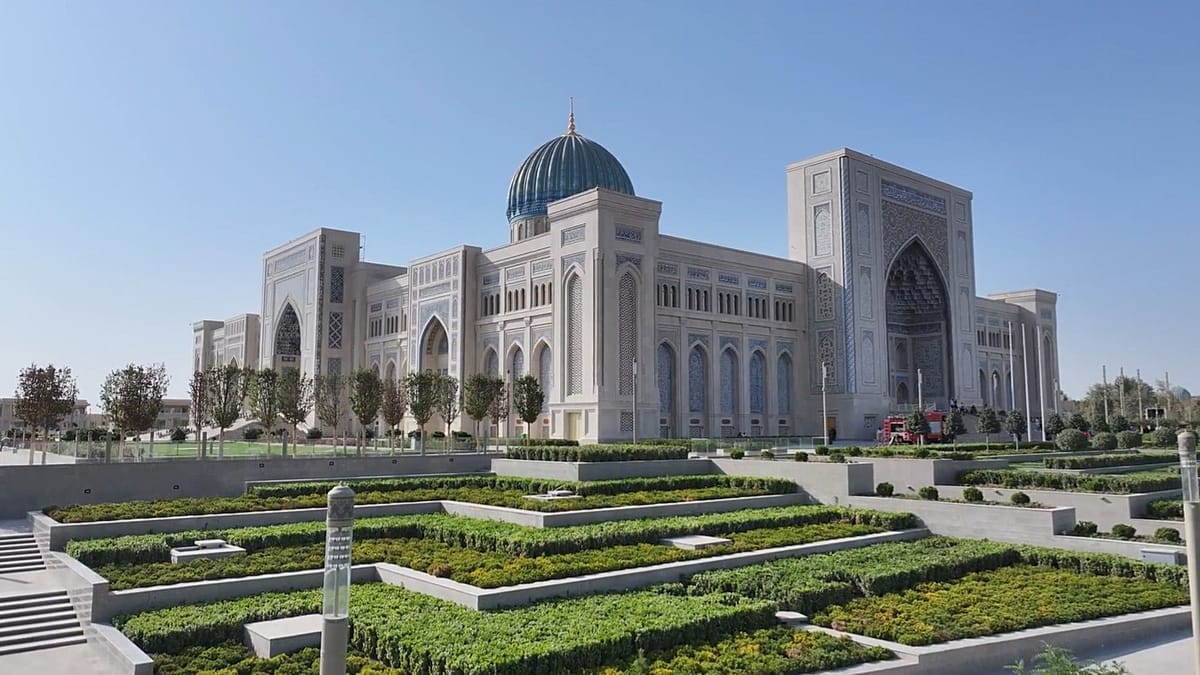
Uzbekistan has inaugurated the Centre for Islamic Civilization, a new complex dedicated to research, public education and the preservation of Islamic cultural heritage.
First announced in 2017 by President Shavkat Mirziyoyev at the United Nations General Assembly, the project brings together collections, research facilities and public spaces in a single site designed to make historical material accessible to a broader audience.
The centre combines museum exhibitions, research facilities and educational programmes, presenting the historical development of Islamic civilisation through manuscripts, artefacts and interactive displays.
At the opening ceremony, President Shavkat Mirziyoyev described the centre as a space that reflects the country’s historical and cultural development.
“At this center, it is possible to see the finest examples of Uzbekistan’s ancient history and civilization gathered in a single educational space, allowing visitors to gain a clear understanding of the intellectual and cultural potential of the Uzbek people,” he said.
Architecture and layout
The complex covers around 10 hectares and includes three floors with a total area of more than 42,000 square metres. A 65-metre dome dominates the main hall, while four main portals — Mirzo Ulug’bek, Kokand, Bukhara and Khorezm — draw on historical architectural traditions.
Inscriptions from the Qur’an and Hadith are integrated into the design, reflecting themes such as knowledge, tolerance and respect for human dignity.
According to its director, Firdavs Abdukhalikov, the project seeks to connect scholarly work with public engagement. “Bringing together artifacts, manuscripts, and exhibitions that reflect Uzbekistan’s long-standing intellectual and cultural traditions is part of a broader effort to preserve and showcase the contributions of Islam to learning and society,” he said.
“The Ulug’bek portal reflects the legacy of Mirzo Ulug’bek, a 15th-century astronomer and scholar, modelled on the Ulug’bek Madrasah in Samarkand,” said Rustam Jabborov, the centre’s scientific secretary.
Lead architect Abdukahhor Turdiyev noted that the site’s location next to the Hazrati Imom complex allows it to connect with the historic urban fabric while maintaining a distinct architectural identity.
Museum collections and exhibitions
The museum occupies more than 15,000 square metres and includes five main exhibition areas. It displays over 2,000 artefacts and more than 100 Qur’an manuscripts from different historical periods, including the Samanids, Ghaznavids, Timurids, Safavids and Shaybanids.
Among the items on display are a 1589 “Bozuband” manuscript, Safavid-era calligraphy and Seljuk works featuring Persian translations.
“We focus on curiosity, discovery, and problem-solving demonstrated by historical figures. The aim is to engage young visitors with stories rather than only artifacts, linking the lessons of the past to STEAM education taught in schools today,” said Ahmed Salim, founder of the 1001 Foundation, which designed the children’s interactive exhibitions.
Scholars from 40 countries, including more than 1,500 experts, contributed to the development of the centre’s content.
“We organised scientific expeditions and engaged with 20 countries, negotiating with dealers and galleries, including Sotheby’s and Christie’s. As a result, more than 2,000 artifacts were brought here. At the centre, we present history through individuals and civilizations, reflecting the ideas of enlightened rulers as envisioned by President Mirziyoyev,” Abdukhalikov added.
UNESCO representative Sara Noshadi stressed the broader context of the project: “It highlights the country’s historical authority in Islamic civilization while contributing to regional cooperation and understanding.”
Library and research facilities
The centre includes a library covering 3,105 square metres, with more than 45,000 printed works and approximately 350,000 digital resources. It can accommodate up to 310 users at a time and provides dedicated spaces for researchers and academic staff.
Collections include works on Uzbek reformers, historical scholarship and rare international publications. The facilities also include accessibility features such as adapted audio equipment, Braille materials and dedicated study spaces for visually impaired users.
International partnerships and research
The centre hosts offices for several international organisations, including ICESCO, IRCICA, the Oxford Centre for Islamic Studies, TURKSOY and the Temurids Society.
Researchers from Uzbekistan and abroad can collaborate on exhibitions, academic projects and educational initiatives.
“The centre highlights historical connections across Central Asia and beyond, showing how scholars, traders, and religious networks contributed to Islamic civilization and influenced European learning,” said Farhan Nizami, director of the Oxford Centre for Islamic Studies.
Visitor experience and digital tools
The centre is expected to receive around 5,000 visitors per day. It includes conference halls, multilingual digital guides and interactive exhibition areas designed for younger audiences.
“The children’s exhibitions do not rely on artifacts but on stories of pioneers like Al-Biruni and Amir Timur. We aim to inspire curiosity, problem-solving, and learning among young visitors, showing how historical figures contributed to science, mathematics, and medicine,” said Ahmed Salim.
QR codes placed alongside exhibits provide access to video and audio content in three languages, with plans to expand this to eight. Visitors can also explore digital reconstructions and multimedia presentations, including 3D installations that present aspects of Sufi thought and practice.