
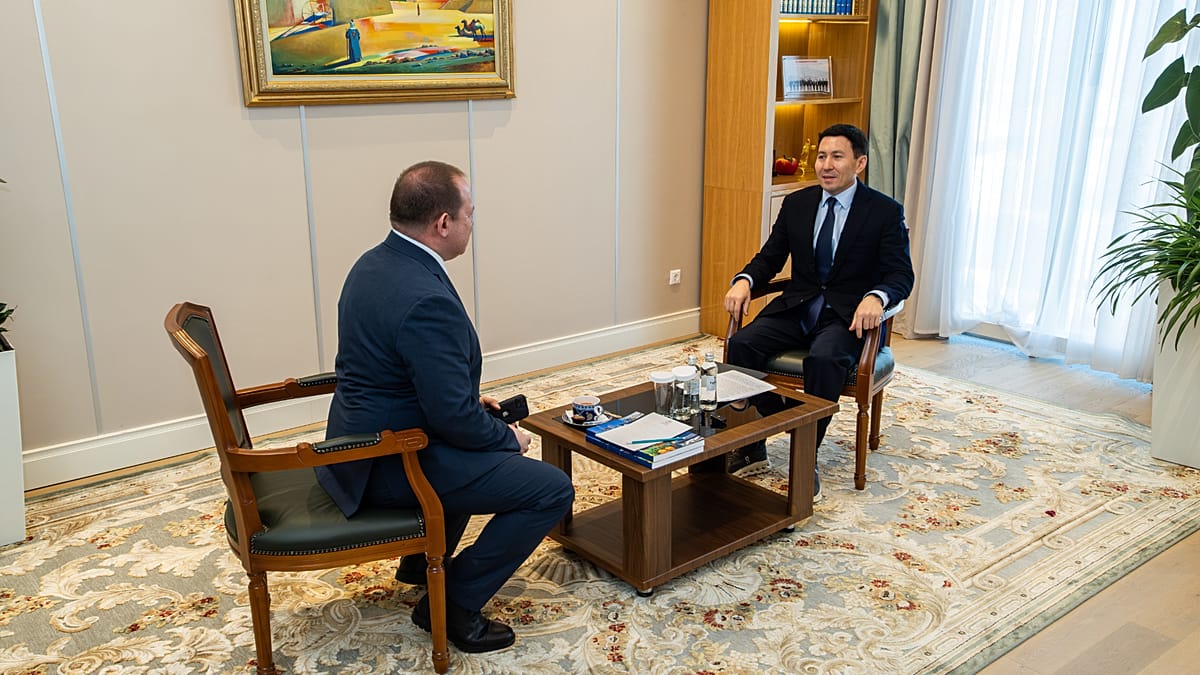
Kazakhstan has launched a new investment cycle for 2026–2028. The country aims at attracting over $25.5 billion in annual foreign direct investment. At the same time, almost 54 billion EUR of fixed capital should be put to use in diversifying, from resources to high-value manufacturing and technology. Domestic wealth and investment funds have a critical role to play in boosting key projects but also reinforcing government’s plans to develop the social services in the country. To better understand how this symbiosis of state needs and profit-driven investment works in Kazakhstan we sat down with the Chairman of the Management Board of Samruk Kazyna, Kazakstan’s sovereign wealth fund, Mr. Nurlan Zhakupov.
Mr. Zhakupov, Samruk Kazyna has joined the group of the 30 biggest sovereign funds in the world. It does what such funds normally do, develop projects which are then either available for purchase by other investors or maintained. However, you often stress that yours is a unique concept. Why? What is it that differentiates it from the similar funds in Singapore, Norway, or the Middle East?
Samruk Kazyna was established more than 17 years ago and the Singaporean Temasek Fund was taken as a role model. What the government did was put all the state-owned enterprises into Samruk Kazyna portfolio and the fund then started to manage them. We created a series of corporate standards starting from human resources, legal, financial, workflow, procurement and other standards, and unified the corporate governance for underlying assets for portfolio companies.
What differentiates us from the others is that our main goal is to increase the long term value of our portfolio companies on one hand, and on the other hand, Samruk Kazyna has a more hybrid structure and the focus on domestic development that shapes its global position. In other words, we want to increase the value of our underlying assets but we are domestic-centric at the moment, we wish to develop the assets that are of strategic importance to Kazakhstan.
Of course, we are quite keen on exploring foreign assets should they meet our return on investment criteria and thresholds. But, at the moment, I believe only 4% of our assets are located abroad — and the remaining 96% are in Kazakhstan.
In another words, you are designed to be an engine of Kazakhstan’s development. You take the assets that are strategically important to the country and develop them. Then they are up for privatisation if the right opportunity arises?
Yeah, you absolutely hit the nail on the head. We embrace the projects, support them from all the angles, technical, financial, logistical, whatever is possible and then we either privatise them or take them public. There are seven companies out of Samruk Kazyna that are publicly listed with a combined market cap of more than US$50bn. Two of them are traded at the London Stock Exchange – the Kazatomprom, the largest uranium producing company in the world, and the other one is Air Astana, Kazakhstan’s flag carrier airline.
It’s traded both on the London Stock Exchange and on the two local exchanges here in Kazakhstan. This model has proven to be successful because since the IPO (initial public offering), most of our companies have demonstrated significant, robust growth, and have brought high dividend yields to their shareholders.
How challenging is it, from the financial, investment point of view, that you cannot be purely opportunistic in your investment, like private equity or investment funds, but are required to facilitate country’s priorities? You even go into uncharted territory, like decarbonisation effort of Kazakhstan.
Kazakhstan has set its goal to reach carbon neutrality by 2060 and we are quite focused on reaching this goal within our portfolio of companies and within our strategy…It isn’t irreconcilable with business profitability model. Sustainability investment became profitable long ago. We have ventured into it with our partners from Masdar, Total Energies, Eni, China Energy, China Power International Holding and many others.
We are currently building almost 7-gigawatt capacity of renewable energy power. It’s basically wind and battery storage facilities and this is our input into carbon neutrality. And again, we reconcile two aims, on one hand we do it on a fully commercial basis and on the other hand, we make sure that this will improve Kazakhstan’s ecological, environmental situation and help to reach the goal of carbon neutrality.
Our project pipeline is full. 7 gigawatt is a big number. It is almost 10 billion of investments in the battery storage facilities. We have found a partner, a Chinese company called Sany Renewables and now we are building. We have built a plant which produces windmill equipment. So, we want to have a wind farm but for that wind farm we need equipment and that equipment will also be produced by us, together with our Chinese partner, Sany Renewable. Our plant will be supplying the windmill equipment, the nacelles, rotor hubs, and many other components and pieces of equipment.
And this is a good example of how you can actually reconcile responsible investment management and development of the country. We see that there is a huge demand for windmill equipment. We will have it ourselves, instead of importing the equipment we have agreed with one of the producers to localise it here in Kazakhstan.
It will create jobs, we will create added value, we will facilitate the transfer of technology, and supply the local market with the local products. Furthermore, we will focus on supplying this kind of equipment to neighbouring countries, Pakistan or Azerbaijan, for example, who are very ambitious about their renewables and environmental agendas.
From our insistence on creating jobs, it is clear that Samruk Kazyna is also socially conscientious, as I said, not purely opportunistic like the private funds. It also has in mind the overall development of the country.
It is generally known in Kazakhstan that many social projects rely on you. And you are quite active in that field. Does it hinder your business goals?
Our prime goal is and has to be to increase the value of assets under our management and make them more effective and profitable. Without that profit, there could be no socially responsible projects, they would not be possible. But, since we do ensure profitability, we perform two socially useful roles.
First, where possible, of course, we pay attention to creation of jobs, and, subsequently, the increase of taxes. It is the economic impact that is a big part of our routine. Then, we are very serious about helping local communities in the areas we operate in at the moment. We have financed more than 50 rehabilitation centers for people with special needs across Kazakhstan. Inclusivity is one of our main directions. We actually have three directions in our social corporate responsibility work stream.
Number one is inclusivity, number two is sports, and number three is medicine. Within the inclusivity category, as mentioned earlier, we have financed and constructed more than 50 rehabilitation centres for people with special needs. We have financed inclusion classes in Astana in more than 20 schools and this is a work in progress. … We have financed and constructed 19 sport complexes across Kazakhstan. And again, this is a continuous project. Every year we finance sports sections for kids with special needs for free. More than 1,200 children have an opportunity to exercise sports in line with their needs every year. Every year, we organise special summer camps for more than 600 kids.
In healthcare, we have financed and constructed a 250-bed, state of the art National Medical centre here in Astana for people with special needs. Also, we have constructed and put into operation the National Educational Medical Center for Infectious Diseases in Almaty with 250 beds. These two projects have the combined value of more than US$450mn. … And just like our portfolio companies that operate in almost each strategic sector of economy of Kazakhstan, these projects are managed via the Board of Directors.
Speaking of which, you recently announced during the Digital Bridge IT exhibition in Astana that you became the first company, or fund, in the region that employed an AI bot as a member of the Board of Directors.
Her name is Sky Samruk. She is a non-executive member of the Board of Directors of Samruk Kazyna with a voting right. She’s basically a neural network based on a local large language AI model. We have downloaded into this network all of Kazakhstan’s legislation, all the Samruk’s corporate governance standards, all the minutes from the board meetings since 2008, all the production, economic, financial, technical figures from all of the portfolio companies. And we trained this network for a significant period of time. Once we decided it was ready to go live and become operational we introduced her to the Board of Directors of Samruk Kazyna which is chaired by the Prime Minister. It’s a very interesting experience.
Has she already voted?
Oh, yes. We had the first Board meeting with the participation of Sky on the 17th of October. She voted on all the items. Moreover, we are doing this on our supercomputer. Kazakh Telekom, one of our portfolio companies has purchased a 17 petaflop capacity supercomputer … It’s a closed circuit so we are fully confident in the security of our data and confidentiality. Our board member Sky, she’s based and domiciled on our local supercomputer.
Before the end of the year, we aim to introduce seven high level AI assistants on the Samruk Kazyna level, which will be introduced to all the portfolio companies such as HR, AI assistant, legal AI assistant, financial AI assistant, procurement AI assistant, etc.
At the second stage, all portfolio companies will be introducing their own AI assistants in line with their production activities. If it’s on oil and gas, there will be a production of oil and gas AI assistant. If it’s logistics, logistics, if telecom then telecom. So, all the companies will have their AI assistance.
The idea is that within the course of two years, 70% of all of the managerial decisions must be made based on the AI assistance advice.
Moreover, we have cascaded the KPI to all the CEOs of the portfolio companies for 2026 to increase their planned EBITDA figure by 5% using AI tools.
You mean, just though the use of tools you expect to increase the EBITDA by 5%?
That’s our target for 2026 and ongoing. We understand that it’s an ambitious target. The companies will need to work very hard to reach it. But we aim for Mars in order to reach the Moon.
Let’s wrap up with a recent event. You went to Washington with the delegation of Kazakhstan for the 5+1 format of Central Asian countries’ cooperation with the United States. Samruk Kazyna signed quite a lot of the documents there. Notably the agreements about the purchase of aircraft, something about rare earths, and IT. How would you sum up the visit?
During the visit of His Excellency President Tokayev to the United States in November 2025, Kazakh delegations signed contracts with American business representatives for the total value of US$17bn, out of which almost US$10bn accounts for Samruk Kazyna.
Our subsidiary Air Astana, will purchase 18 new Boeing 787-9 “Dreamliners”. The catalogue value would amount to roughly US$7bn. Two aircraft will arrive this year, the third will arrive in 2027.
Another company from our portfolio, Kazakh Railways, has signed an agreement to raise financing from Citibank, backed by USEXIM bank, for the value of US$1.6bn in order to finance the purchase of Wabtec locomotives which are produced in Kazakhstan.
Wabtec has opened an assembly plant and produces state of the art locomotives here in Astana. We are buying locomotives from them but with the financing from US export Credit Agency via Citibank….
And another deal that we have agreed with the American company Cove Capital is to jointly develop largest tungsten deposit outside of China called North Katpar and Upper Kairakty. The total value of capex will amount to US$1.1bn as of now. Of course this will be subject to feasibility and we are very excited that we will be able to produce tungsten products with high added value and export them to third countries.