

The dispute surrounding Hungary’s 20 August state celebrations goes far beyond the question of whether there will be fireworks over the Danube. The controversy that has unfolded in recent weeks is about the use of public money, environmental protection, national traditions and the role of state representation, but above all about punishing the Lounge group owned by Gyula Balásy.
The situation is unusual in that while the government has confirmed that this year’s festive fireworks will go ahead, their organisation has been placed in completely new hands. The original contracts have been terminated, the previous main contractor has dropped out, and the state is promising that the event can be staged for a fraction of the previous cost.
Extravagant show or genuine greatness?
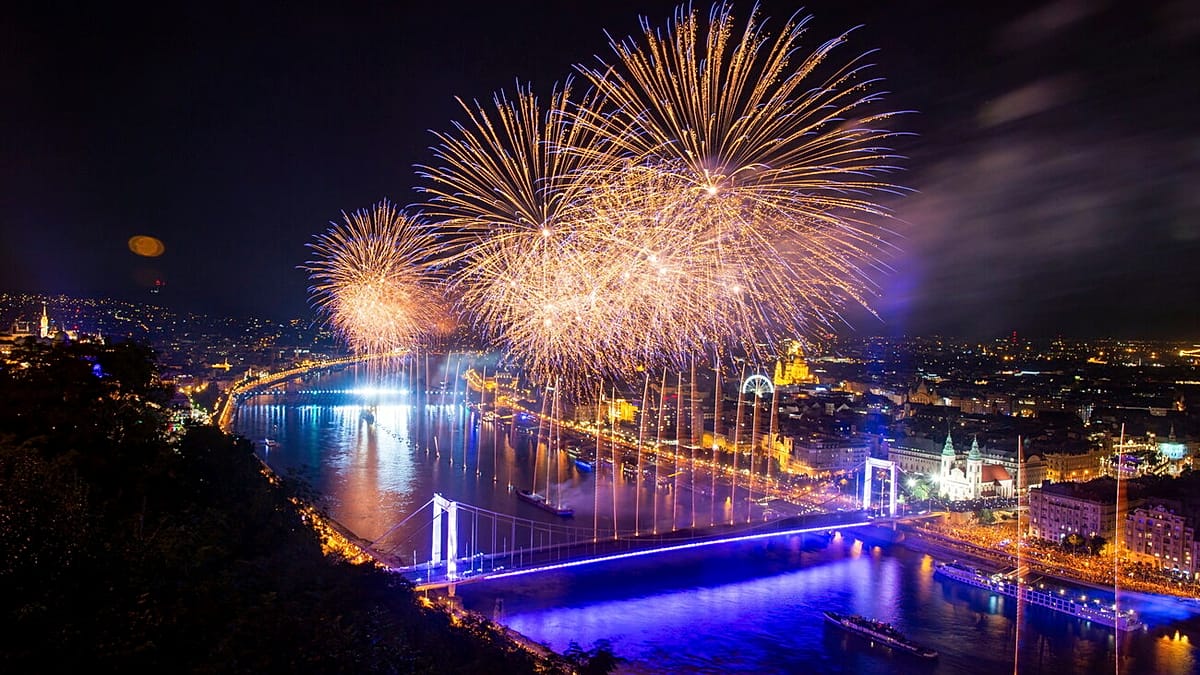
In recent years, the 20 August fireworks have become Hungary’s most divisive state event. Supporters say it is one of Europe’s largest pyrotechnic displays, a tourist attraction, a national holiday and a shared community experience. Critics, however, regularly argue that the multi‑million euro bill could be put to better use, while the fireworks also place a significant burden on the environment.
This year’s dispute, however, started from very different premises. After criminal proceedings were launched against the conglomerate, the Lounge group, which is connected to Fidesz, its bank accounts frozen and enforcement procedures began, the National Event Organising Agency terminated the previously concluded framework contracts. That meant that just a few weeks before the holiday, the gigantic series of events had to be practically reorganised from scratch.
Tears worth millions
In recent years, it had practically become routine for companies belonging to Gyula Balásy’s business interests to run the 20 August events.
Lounge Event was responsible not only for the pyrotechnic part of the fireworks, but for organising the entire programme series. From erecting stages through cultural events and marketing campaigns to security and logistics. In the past, it played a role in almost every major state event.
Under this year’s contracts Lounge Event concluded two separate agreements with the state. One, worth around 5 billion forints (€13.8m), covered the fireworks, while the other, worth some 12.5 billion forints (€34.7m), covered the organisation of the entire St Stephen’s Day programme series.
Together the two contracts represented a commission worth 17.5 billion forints (€48.6m). Half of this had already been paid out by the state as an advance by the time the contracts were terminated.
According to the Interior Ministry, the move was not purely a political decision, as the Lounge Group’s financial situation had made it doubtful whether it would be able to meet its commitments at all. Because the bank accounts were frozen, payments to subcontractors were also at risk, which, for an event of this scale, threatened its very feasibility. For that reason, the state launched an extraordinary public procurement procedure to select a new contractor.
We don’t yet know what it will be like, but it will be cheaper
Perhaps the biggest political stir was not caused by the termination of the contracts itself, but by the new government’s claim that the same celebration can be organised far more cheaply. The Interior Ministry says the previous arrangement was “unreasonably expensive”, so in the new tender, they have worked with a significantly reduced technical specification.
The hastily launched new public procurement for the state event series is already in the assessment phase and, since the company identified by the National Event Organising Agency in a negotiated procedure without prior notice due to time pressure was the only bidder, the Budapest‑based Hardrock Szolgáltató is very likely to be awarded the contract.
Current estimates suggest that the entire series of events could be staged for less than 4 billion forints (€11.1m).
Even allowing for the fact that the programme will be simpler, with certain elements dropped or scaled back, the difference is still substantial. The government, however, stresses that the cost‑cutting will not affect safety, the main programme elements or the fireworks themselves.
Péter Magyar has previously said that the fireworks and drone show were ordered and paid for by the previous government, and that is why the decision was taken to go ahead with them. At the same time, he indicated that the celebrations as a whole would be organised in a more modest form than before.
According to Gergely Karácsony, this would be the moment to close this chapter for good
The sharpest criticism has come from Budapest’s mayor, Gergely Karácsony. In his view, this would have been precisely the opportunity for Hungary to break the tradition of fireworks for good.
His argument is that the pyrotechnic display involves significant air and noise pollution, harms wildlife, and the public money spent on it would, in his view, be far better used elsewhere.
The mayor also emphasised that nowadays the spectacle could be replaced by modern technologies, such as light projections or drone shows.
Gergely Karácsony has clearly backed the initiative of the civil organisation aHang, which would rather spend the money freed up by cancelling the fireworks on drought protection.
Hundreds of thousands against the fireworks
On its own site, aHang has also launched a petition (source in Hungarian), and in just one week it has already almost reached the target of 300,000 signatures. Viktor Szalóki, the organisation’s political director, replied to Euronews’ questions in a letter.
In light of the new developments, what costs does aHang associate with the fireworks? And what could that money achieve?
“If we want there still to be something to celebrate on the day we mark the founding of the state, then we really do have to take the drought situation and our environment very seriously. When parts of the country are turning to desert, lakes are drying up, and heatwaves are sweeping through, nothing is more important than ensuring adequate support for this. Even if we only count the 4‑billion‑forint cost, it is clear that last year the government allocated 4.7 billion forints to the National Water Directorate‑General (OVF) for tackling drought. The OVF used this sum to tidy up channels, streams and rivers. For solving the water situation of Lake Velence, the government is reckoning with costs of 150 billion forints, yet in the recent past, expert opinions have appeared that see a much cheaper and faster solution. László Vazsonyi, a specialist at VulcanAgro, for example, has said that it would be enough to build a water conduit along the 15‑kilometre section between the Danube and Pettend, from where gravity itself would carry the water to Lake Velence, and its price would be a fraction of the planned 150‑billion cost.”
Has there been any kind of response from László Gajdos, the minister responsible for the living environment? And how open is the capital to the initiative?
“We have not yet received any response from László Gajdos; seeing the minister’s work so far, we are very hopeful that the ministry’s leadership will also be receptive in this matter.”
Gergely Karácsony recently posted a Facebook post (source in Hungarian) in which he set out that it was time to let go of the fireworks. In it, the mayor wrote: “What is more, this year more than 230,000 people have signed the petition supporting the use of the fireworks budget for drought defence. The issue of drought and water scarcity clearly cannot be solved in its entirety from this money, but what is certain is that every public forint would be well spent there.”
Would cancelling the fireworks be more of a practical step or a symbolic one?
“It would be both. Our position, and that of aHang, is that our campaign is not against 20 August but against expensive and environmentally polluting fireworks. The founding of our state can, and must, be celebrated in a fitting way, but we do not need to shoot billions of forints of public money into the sky to do so!”
Can you see any pattern among those who have signed the petition so far? Are they mainly urban or rural? Older or younger?
“People are joining the petition from a great many places, which perhaps best shows that the issue itself goes beyond the fact that ‘there are fireworks in Budapest’. It is much more about a way of thinking that in the long run brings a different kind of approach to the topic.”
“The petition itself originally started in 2022, when, in the middle of the economic crisis, the Orbán government announced that it would hold the biggest and most expensive fireworks display of all time. Even then, we did everything we could to draw attention to the fact that the money for fireworks had to be spent elsewhere and in a different way. That acted as a catalyst in public debate: for weeks the main topic was that, at local level, residents in countless provincial towns launched petitions calling for the fireworks budget in their municipality to be used for social spending. We then managed to achieve that in most county‑rank cities and large towns there are no longer any fireworks; their cost is used for other purposes, while – importantly – the founding of our state can still be celebrated with dignity and pride.”
It is about more than a nightly spectacle
This year’s debate is therefore not really about pyrotechnics. It is much more about what role the state should play in organising national holidays, how much public money it is justified to spend on representation, and to what extent the state‑event model that has taken shape in recent years can or should be reconsidered. Does a nation become great by wrapping its holidays in grandiose – often saccharine – finery, or by planning responsibly for the future?
There are, of course, those voices that remind us that in Hungary, hundreds of thousands of people live in circumstances that mean they cannot afford to go on holiday even once a year. For many of them, the only leisure outing for years has been to travel to the capital and watch the colourful fireworks. But that raises a rhetorical question: would it not be better if, through saving and planning, we were to create within a few years a country in which every family, every child can at least get to Lake Balaton for a few days? Would we still cling so tightly to half an hour of bangs and flashes then?
Only after this year’s celebrations will it become clear how far the cost‑cutting has gone at the expense of spectacle. The most interesting question, however, is what Hungarians will feel when they see a toned‑down 20 August. Will they blame the new government, or accept that it is finally time to let this go?