
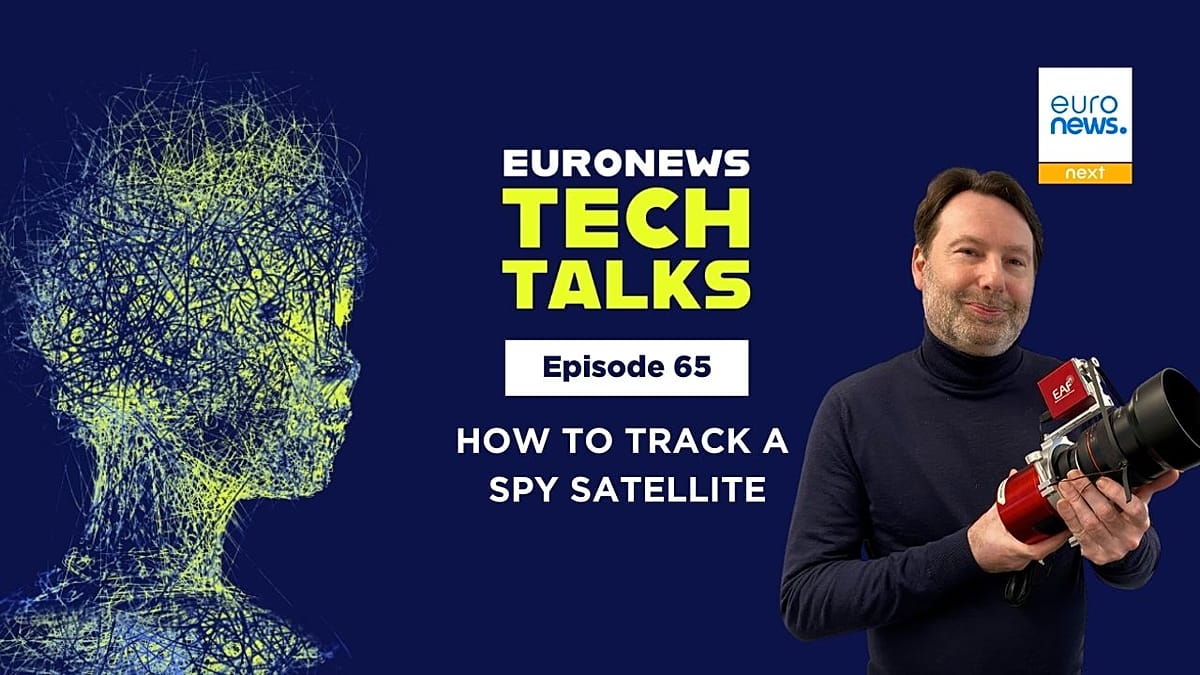
We all have a friend – or are that friend – who is obsessed with the stars.
The one who knows their stars from their planets in the night sky, when to see an eclipse, or who can point out constellations.
But spotting spy satellites is a rarer skill. It requires both technical knowledge and patience.
Marco Langbroek is one of the leading experts in his field.
A lecturer of space situational awareness at TU Delft in the Netherlands, he observes some of the most mysterious developments in space from his home in Leiden, the Netherlands.
He joined Euronews Tech Talks to tell us what is happening up there.
The steps to tracking a spy satellite
A key piece of information needed to track the satellites gathering intelligence for the military is when they are launched. This is something that cannot be kept secret.
“If you launch a spy satellite from Cape Canaveral, you can see it from New York,” Langbroek told Euronews Next. “And certain parts of the airspace and the ocean have to be closed, because the rocket stages from the launch will splash down there,” he continued.
Based on the areas that need to be closed for safety reasons, Langbroek explained, it is possible to estimate a satellite’s preliminary orbit.
Some spy satellites’ orbits are easy to find: “For Russian spy satellites and Chinese spy satellites, the orbits are known because the Americans published these orbits,” Langbroek said. “For certain classes of American military satellites and a few of their allies, like France and Italy, these orbits are not known, and they’re not being published”.
Once you know, or guess, a preliminary orbit of a satellite, it is possible to figure out when it will pass over a specific part of the Earth, and it’s possible to observe it.
“Some old school people in our network use binoculars, stopwatches and a star map and track it that way,” Langbroek explained. “The more modern observers like me use cameras to do that,” he continued.
Thanks to these pictures, it is possible to determine a satellite’s position relative to nearby stars and use that information to calculate its actual orbit, a key step in understanding the satellite’s function.
What is going on in space?
Among the developments Langbroek has observed in space is the increasing number of military satellites launched into orbit by several countries, including European states.
“In the current geopolitical situation, countries no longer want to be dependent on the United States for their intelligence gathering,” Langbreok pointed out.
Another trend is the growing number of satellite constellations, like Elon Musk’s company SpaceX’s Starlink.
Langbroek explained that these infrastructures have a clear defence purpose, as having 1000 satellites instead of one or two makes it more difficult for potential enemies to disable a network with anti-satellite weapons.
Yet these constellations pose a problem for existing tracking networks, as the high number of satellites makes it difficult for them to monitor activity in space, Langbroek explained.
And, last but not least, the Dutch expert claimed that movements in space are becoming more and more aggressive, with countries increasingly testing anti-satellite systems.
These systems include the activities of spoofing, jamming and stalking that we analysed in episode 64 of Euronews Tech Talks.
Jamming uses radio signals to interfere with satellite communications; spoofing involves sending fake signals to trick a satellite or receiver; and stalking refers to the unauthorised tracking of a satellite.
This tendency worries Langbroek very much: “As a society, we have become so dependent on satellite technology, much more than most people realise,” he stated.
For example, financial transactions, the internet, and electricity networks all depend on satellite technology.
“If countries as part of a conflict start to use anti-satellite systems, the chances are big that it also has repercussions for satellites of countries that are not part of the conflict.”
However, according to Langbroek, the aggressiveness is not irreversible.
He explained that if countries were more transparent about what they put into space, it could help make the environment safer and more peaceful, while increasing accountability.
In addition, according to the expert, countries should invest more in tracking capacities to better follow the objects in space.