
The opinions expressed in this article are those of the author and do not represent in any way the editorial position of Euronews.
Reverence for the dead runs exceptionally deep among the peoples of the Balkans. Religious differences have set them against one another many times over the centuries, yet Balkan Christians, Catholic and Orthodox alike, as well as Muslims, all regard respect for the dead as a defining part of their identity.
History has often shaped and sustained this tradition, but we should not look to history for an alibi for our own mistakes. History, after all, is made by people.
Ratko Mladić died at an advanced age in a prison in The Hague, after the UN’s International Criminal Tribunal for the former Yugoslavia convicted him of some of the gravest crimes committed during the 1990s war in Bosnia and Herzegovina, including the genocide against Muslims in Srebrenica, in the east of the country.
He was already old, ill and unkempt in 2011, when Serbian police arrested him in a village in Serbia, where he had spent the final days of his 16 years on the run in a relative’s house.
His death was entirely natural. That it occurred in a Hague prison was the consequence of a life sentence imposed by a court. His 16 years as a fugitive may not have been his decision alone, but also the decision of others who did not want to see him in the dock.
The man who spent the 1990s deciding the fate of thousands in Bosnia and Herzegovina had long since ceased to decide his own. Others had been deciding it in his name for years. Since his death, they have been doing so even more.
Who would take custody of his body from the prison and judicial authorities? Where would he be buried? Who would arrange its transport from the Netherlands to the burial place? Would a state be involved? And which state: Bosnia and Herzegovina, where one half hails him as a hero and the other loathes him as its worst criminal and mass murderer, or Serbia, where the division is no less bitter? How would the world respond to whatever protocol was chosen? And, ultimately, would Mladić’s death close one of the darkest historical chapters still remembered by living generations in the Balkans, or open another, perhaps even darker one?
Some see him as a hero, others as a war criminal
Those in the Balkans who had to answer these questions had a possible model in New Zealand’s prime minister, Jacinda Ardern. In 2019 she stood before parliament and vowed never to utter the name of the man who murdered 51 people in two Christchurch mosques, calling on the nation to consign the mass killer to collective oblivion.
But how could such a gesture be repeated in the Balkans, where hundreds of thousands still see Mladić as a hero and saviour of the nation rather than the war criminal the evidence presented at his trial in The Hague showed him to be? More to the point, how could such a deep division among Serbs simply be ignored, when Croats, Bosniaks and Albanians have all shown similarly divided attitudes in recent years towards war criminals from their own nations?
The ad hoc International Criminal Tribunal for the former Yugoslavia delivered justice to thousands of victims of the Balkan wars by convicting those responsible. But it did not bring reconciliation to the millions who survived and continued to live in the countries of the region.
The failure of that mission of international justice is now coming to a head in Serbia, which will be Ratko Mladić’s final resting place.
Family wanted Mladic to be buried in Belgrade
The Serbian authorities could not ignore this deeply rooted reverence for the dead or reject the family’s wish for Mladić to be buried in Belgrade, beside his daughter, who took her own life in 1994, in the middle of the war her father was waging only a few hundred kilometres away.
Nor could the authorities in Belgrade realistically have expected Mladić to be buried in Republika Srpska, one of Bosnia and Herzegovina’s two entities, where an overwhelming majority of the population and the entire political leadership glorify him as a liberator and hero.
Why the Bosnian Serbs and their leaders, who refuse to recognise even the central government in Sarajevo, let alone the judgments of a UN court, did not want their ‘hero’ and ‘father of the state’ on their own soil is a question for them. They should explain their hypocrisy to one another. Why celebrate Mladić if a pilgrimage to his grave requires travelling to another country, assuming they go at all?
Belgrade was therefore left with no politically painless option
Belgrade was therefore left with no politically painless option. Ignoring or suppressing the widespread conviction that Serbs were the greatest victims of the war in Bosnia and Herzegovina, and later the greatest victims of the Hague Tribunal, would have been political suicide for any government in Belgrade, and quite possibly a trigger for a wave of extremist violence.
Full state sponsorship of Mladić’s funeral ceremonies, on the other hand, would have run counter to every principle on which official Belgrade bases its policy, including its commitment to EU membership and good relations across the Balkans, which are a prerequisite for progress towards that goal.
Serbia and its president, Aleksandar Vučić, could have justified full state honours by invoking precedents that have, unfortunately, already been seen in the Balkans, but they chose not to do so. Rasim Delić, commander of the Army of Bosnia and Herzegovina, was buried in Sarajevo in April 2010 with the highest state honours even though he died a convicted war criminal. In addition to military and senior religious honours, Haris Silajdžić, then chairman of Bosnia and Herzegovina’s three-member Presidency, the country’s collective head of state, spoke at his funeral.
Croatia has seen similar eruptions of patriotism around its own warlords. Generals Ante Gotovina and Mladen Markačreturned to Zagreb in 2012 after being acquitted in The Hague and were greeted by thousands of Croats led by Zoran Milanović, then prime minister and now Croatia’s president. Their guilt was not established before the Tribunal, but for the more than 200,000 Serbs driven from Croatia, and for the families of hundreds who were killed, the two men remain, beyond doubt, among the worst war criminals of the conflict.
In Mladić’s case, the Serbian authorities stepped into a minefield by allowing the family to bury him where it wished, while preventing the funeral ceremonies from turning into a political campaign capable of setting the region alight, Serbia before anyone else.
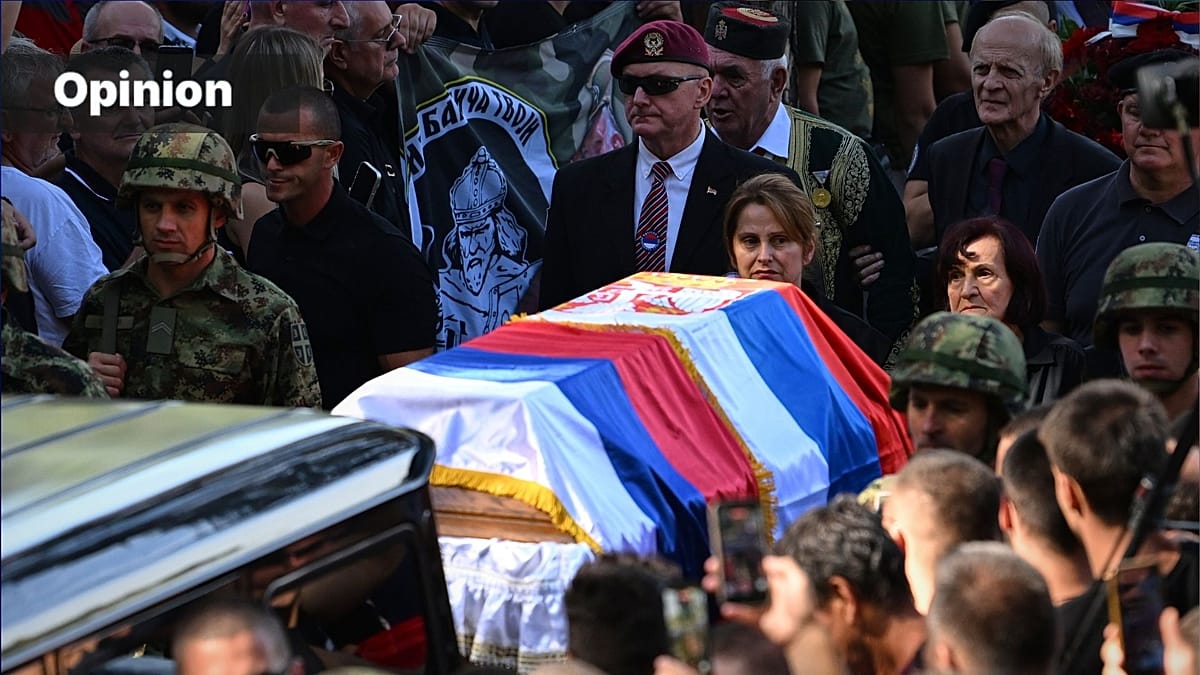
The memorial service and funeral were organised by family and friends
The Serbian state limited its role to providing basic logistics and security for the private gatherings surrounding Mladić’s funeral. His body was flown from the Netherlands to Serbia in a government aircraft, but it should not be forgotten that 15 years earlier Mladić had been extradited from Serbia to The Hague by the same means. The memorial service and funeral were organised by family and friends, not by the state. Gatherings of Mladić’s supporters in and around Belgrade were spontaneous, and certainly not organised by the state.
Such restraint will do President Vučić and his conservative coalition no favours when they contest snap parliamentary elections at the end of October. Many of his voters do not recognise the judgments of the Hague tribunal, including its verdict on Mladić. But that is the price Vučić is prepared to pay to ensure that the state itself does not become the instrument through which Mladić’s death is politicised.
Brussels is angry too, judging by Enlargement Commissioner Marta Kos’s decision to postpone her planned visit to Serbia in protest, although Vučić did not let the move pass without responding. But that, too, was a price Belgrade had to pay, since the alternative would simply have meant politicising Mladić’s funeral again, this time from the opposite side.
Will Mladić’s death create a new myth and send streams of pilgrims to his grave in Belgrade, as some in the region and elsewhere in Europe fear? It will not.
Above all, it will not because of the decisions taken in Belgrade, which prevented this expected event from becoming an arena for political conflict and competing interests. The storm Mladić brought with him to Belgrade will subside and be reduced to a family matter, where it belongs. It seems that someone has been rereading the words of the great Bosnian writer Meša Selimović, written exactly 60 years ago: ‘Solitary among the graves, I forgot about my hatred. It returned when I joined the men again.’
The author is Director of the International Security Institute in Belgrade and an expert in security and international relations.