
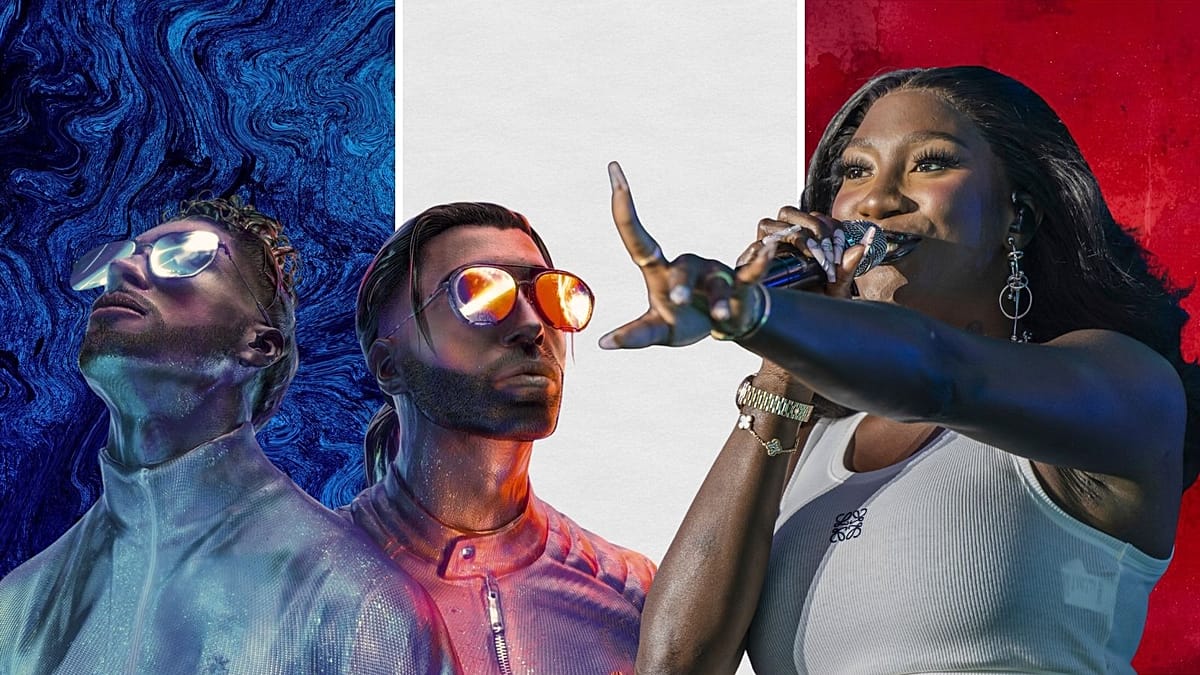
Over the steady beat of the cymbals, rap duo Lunatic find their pace and announce themselves on their debut track “Le Crime Paie”: “Wesh, wesh, écoute fils.”
That was in 1996.
Nearly three decades later, on the track “Bolide Noir”, London rapper Central Cee briefly laments, “I’m in Paris, tryna drop rizz, but they don’t understand ‘cos they’re speaking French. Why does she keep saying wesh?”
In the years between these tracks, “wesh” — derived from Darija, a dialect of Arabic from North Africa, and often used to emphasise statements or greet others — has solidified its place in spoken French. A word that was initially spread by diasporic communities living in France and was frequently heard in banlieues on the outskirts of Paris is now ubiquitous on the streets of French cities and recorded in the Le Robert dictionary.
“Wesh” is not the only word to have entered the French lexicon in this way. At the intersection of languages, musicians in France and Francophone Africa are penning a new identity for the French language — one that exists on the borders of cultures and is shaped through a history of colonisation, migration, and music.
The influence of Paris’ banlieue on the language of French rap and, by extension, French slang is unmistakable. Chart-topping artists like PNL and Kery James draw from their experiences in the French capital’s multi-ethnic and neglected suburbs not only in the stories they narrate, but also in the language they use to narrate them.
Verlan — a linguistic process that often alters the meaning of standard French terms — was used in the suburbs before making its way into widely-spoken French. Its vocabulary borrows from various languages, such as Arabic or Romani, according to a paper published in HAL Open Science. PNL’s tracks, in particular, are peppered with Arabic words within French sentences.
“Verlan is seen as a tool to create a sense of belonging in a society dominated by fixed representations, allowing immigrant descendants to finally construct positive hybrid identities,” the paper explains. Living in a hotbed of linguistic remixing and experimentation, artists have popularized a vernacular that can communicate their intersectional identities: multilingual and multi-ethnic; diasporic and French.
But the French language is not spoken, tended to, and expanded solely in France. More than 50% of French speakers globally live in Africa and the Middle East, according to the Organisation Internationale de la Francophonie. French colonialism carried and imposed its language on indigenous communities and stigmatized local languages — a policy that carried over post-independence in many former colonies, according to a paper on language policies in French colonies.
While the French language retains memories of a history of colonialism, it is still a fixture of daily life in postcolonial societies such as those in Africa.
“Language is a delicate issue in Africa,” Jean-Martial Kouamé, professor of linguistics and director of the Institute of Applied Linguistics at the Université Félix Houphouët-Boigny, told L’actualité. “Some see French as a vehicle for postcolonial influence, but for most people, it’s simply an African language.”
Over the years, the straitjacket around the usage and education of French has been undone, cut up, and refashioned: in Abidjan, Ivorians are combining the structure of French with Ivorian slang, or nouchi, to reinvent the language. Ivorian French has developed a strong kinship with nouchi over 30 years of language mixing.
This hybrid language is widely spoken and resonates with the public.“We’ve tried to rap in pure French, but nobody was listening to us,” Dofy, an Ivorian hip-hop artist, explained in the New York Times. “So we create words from our own realities, and then they spread.”
They spread, in fact, to French-speakers far beyond Côte D’Ivoire: the nouchi words “s’enjailler” (to enjoy) and “boucantier” (party animal) became ubiquitous on city streets in France and social media, ultimately cementing their place in the French dictionary Petit Larousse.
While the mixing of languages has expanded the way French is spoken, performed, and posted online, institutions like the Académie Française are slow to accept this changing linguistic landscape. Verlan, for instance, has been largely overlooked by the Académie, as explored in a paper on alternative linguistics practices.
When French-Malian singer Aya Nakamura performed at the opening ceremony of the 2024 Paris Olympics, it was a public recognition of the intersectional identities of the French population. Nakamura’s songs often incorporate expressions from other languages and urban slang into French lyrics, and many saw the performance and particularly its language as a reflection of contemporary France.
As French rap and hip-hop become more popular, their language finds its way beyond the Francophone world — most often through collaborations between English-language artists like Dave and Central Cee who have an established global following.
“A language that renews itself, that sees new words born within it, is a language that’s doing well,” linguist Aurore Vincenti told Franceinfo. As artists capture the diverse sounds of the Francophone world in their music, they expand the scope of the French language — which could be vital to its future.