
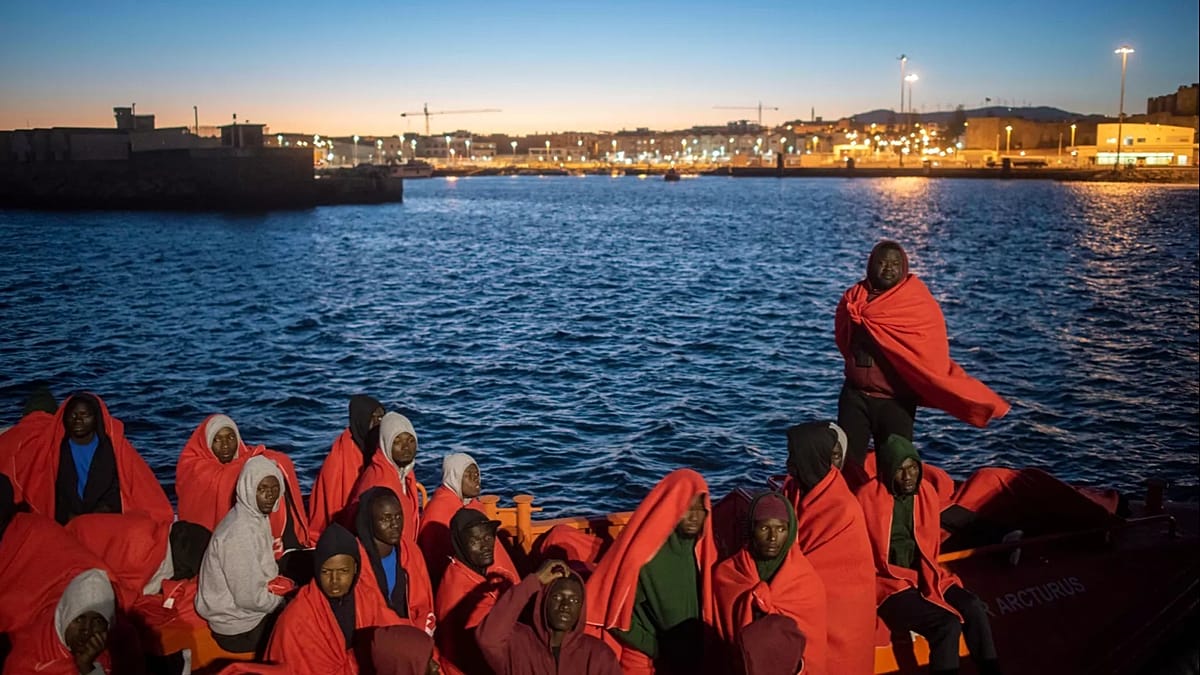
The European Union’s new Pact on Migration enters into force on Friday, meaning the bloc finally has a set of clear-cut rules to manage migration that applies to all EU member states – at least, on paper.
The pact includes eight legislative acts, which together are meant to improve member states’ cooperation on migration management, hold frontline states to stricter standards for minimising irregular entries into the EU, and speed up asylum procedures.
The new law introduces a border procedure which shortens the period to assess an asylum request for certain categories of applicants to 12 weeks, with 12 additional weeks to carry out returns for those who are not granted the protection.
It does not change the basic principle that any third national should ask for asylum only to the EU country of first arrival, but envisages a system of “mandatory solidarity” that offers countries three different options to manage migration flows:host a number of asylum seekers in its territory, pay a financial contribution to frontline member states, or help finance personnel, equipment, surveillance systems at the border and other operational costs.
But the so-called “mandatory solidarity” the pact binds EU countries to participate in is not actually mandatory – at least, not in the terms originally foreseen. Instead, EU countries have used a variety of tactics to reduce their commitments to helping frontline states and take in as few migrants as possible.
The outcome is that the 2026 figures fall far below the pact’s minimum annual threshold for member states’ contributions. Fewer than 9,000 asylum seekers will be relocated, even though some 669,000 individuals asked for asylum in the EU last year, with around 800,000 people already in the asylum system. Meanwhile, less affected member states will make only €76 million of financial contributions to support EU countries under migratory pressure.
Juan Fernando López Aguilar, a Socialist MEP who negotiated the solidarity mechanism in the previous parliamentary session, told Euronews the predicted contributions for this year are “ridiculous”.
So how did the pact’s minimum threshold fall apart?
Shrunken solidarity
According to the EU’s Asylum and Migration Management Regulation, which makes up the bulk of the pact, each year the Commission should propose a “solidarity pool” that defines the help member states need to offer each other for the following year.
The pool has two main elements: one, a quota of relocations of asylum seekers from countries considered “under migratory pressure”, and two, financial contributions from other member states, including via the financing of “alternative solidarity measures” such as construction and hardware procurement.
The solidarity pool has a minimum contribution threshold of 30,000 relocations and €600 million in financial contributions. The pool assigns a “fair share” to each member state based on population and GDP, and each government can then decide in what form to contribute.
The European Commission’s mantra has been that “solidarity is mandatory but flexible,” a phrase repeated many times by EU Internal Affairs and Migration Commissioner Magnus Brunner.
For 2026, Spain, Italy, Greece and Cyprus were considered under migratory pressure and therefore meant to benefit from the solidarity. Czechia, Croatia, Austria and Poland were granted a total exemption from their quotas, for being classified as “facing a significant migratory situation.” The remaining 19 countries have to contribute by paying or relocating migrants.
According to MEPs who saw the full proposal for the solidarity pool, which was not made public, the Commission set the minimum number of relocations and size of financial contributions as low as possible to accommodate member states’ low ambitions. Despite this, national governments have found ways to further reduce the number.
During the process that set the contributions for 2026, member states argued that the first round solidarity contributions should be prorated, as the new migration rules will only cover the second half of 2026 rather than a full year. Despite this rule not being explicitly provided for in the law, it was agreed to reduce the size of the solidarity pool.
In a meeting held in Brussels on 8 December 2025, EU Interior Ministers agreed to 21,000 relocations “or other solidarity efforts,” and €420 million in financial contributions, specifying the contributions expected from each member state.
The minimum threshold has come under pressure from other angles too. According to several EU officials, the question of where the threshold should sit and whether there should be one at all is legally fraught, with the Commission and some member states taking different views.
The legal text of the agreement specifies that the solidarity pool “shall be at least” 30,000 relocations and €600 million, but that it should also be set “on the basis of the needs identified by the Commission.”
This phrasing has been interpreted by the Council’s legal service as meaning the minimum threshold could potentially be reduced further – that while the European Commission will maintain the baseline in its proposals and encourage member states to stick to it, it cannot legally oblige the member states to comply.
Reluctant members
Meanwhile, during the negotiations that established the pool, Hungary and Slovakia deliberately decided not to make any contributions, neither in relocations nor in money – a clear violation of the “mandatory solidarity” principle that so far has met with no sanction from the Commission.
The dialogue between Brussels, Bratislava and Budapest is ongoing, and an EU official told Euronews that the new Hungarian Prime Minister, Péter Magyar, is more keen to cooperate than his predecessor Viktor Orbán.
But Magyar has also clearly stated his country will not take any asylum seekers from the others, and it does not provide any financial contribution to the pool by the end of 2026, it could face a Commission infringement procedure.
According to people familiar with the matter, the system can still function without Hungary’s and Slovakia’s contributions. But declining to participate in the solidarity pool could set a disruptive political example, encouraging other countries to do the same.
While Hungary and Slovakia refuse to contribute in any way, other governments are simply reluctant to take in migrants. Of the 19 EU countries obliged to contribute, only seven have chosen to accept relocations, and nine are making financial contributions only.
And even where relocations are being accepted and payments made, the real number of people transferred from one country to another and the amounts of money contributed will be even smaller than the figures on paper – thanks to another legal trick.
The Council’s allocation of quotas also includes the fair shares of countries under pressure, which contribute to the total calculation but not to real solidarity on the ground. The Spanish government, for example, has pledged €42 million to the pool, but will in fact pay nothing as Spain is classified as under migratory pressure and will thus be a net beneficiary of this year’s cycle.
Considering only the “real” pledges made by countries effectively obliged to offer solidarity – that is, those deemed not under pressure – the total numbers stand at 8,878 relocations and €76.3 million.
Solidarity in jeopardy
The upshot of this is that solidarity payouts to Spain, Italy, Greece, and Cyprus for the first cycle have been significantly reduced. This is why Spain and Cyprus abstained in last December’s vote to set up the solidarity pool, which was approved by a large majority of EU countries.
“The extraordinary discrepancy between the identified needs and the legal obligations and the final content of the decision does not ensure effective solidarity […] nor does it guarantee compliance with the obligation of all countries to contribute,” reads a Spanish statement included in the meeting minutes.
Madrid considers the help from the other countries “very insufficient” and fears that this year’s cycle could also set a precedent. Various observers agree with that diagnosis.
“Numbers are deliberately at the lower end and have come down in the process,” Lukas Gehrke, director of the Brussels office of the International Organization for Migration, told Euronews.
Others think that the focus should be on the mechanism functioning effectively and that the numbers can be assessed over time. Brunner, for one, believes the level of solidarity could be sufficient for the current situation.
“The member states tell us that for the moment it is enough, but of course we don’t know how the situation will evolve,” he told Euronews on Thursday.
Swedish MEP Tomas Tobé, who is the Parliament’s rapporteur for the regulation, answered Euronews’s question at a press conference by saying the current numbers are an “acceptable beginning” but that “there is room for improvement.”
Even fewer ‘real relocations’ expected
Beyond the general reduction, member states also have another legal tool at their disposal to avoid taking part in real relocations of asylum seekers from other EU countries.
This is the so-called “responsibility offset”, another form of granting solidarity support considered equivalent to physical transfers. Under this system, an EU country can take care of a specific number of “secondary movement” asylum seekers – individuals who are currently in its territory, but who should have asked for asylum in their first EU country of arrival.
This quota would then be deducted from the relocations the given member state has to accept, reducing the actual transfers under the pool’s requirements.
Germany in particular is expected to invoke the offset, having struck bilateral agreements with Greece and Italy. According to another diplomat, the same pattern is being followed by multiple other countries, among them France, as it is easier to put into practice and more convenient for domestic public opinion than accepting new arrivals.
As a result, fewer than 1,000 asylum seekers will be physically transferred in 2026 from one country to another.
“We will see very few flights or buses carrying asylum seekers across Europe,” the diplomat told Euronews.
The tens of thousands of annual relocations supposedly mandated by the pool’s “minimum threshold” will have to wait.