
Spain is being urged to strengthen its climate resilience and advance decarbonisation efforts to protect its economy.
A new report from the Organisation for Economic Cooperation and Development (OECD) found the Spanish economy has held up “remarkably well” following a slow recovery from the COVID-19 pandemic.
Steady GDP growth has been recorded in recent years, with Spain surpassing many of its European peers. This has been driven by a plethora of factors, including tourism, investments from the EU Recovery and Resilience Funds and increased government spending.
However, researchers warn that Spain is among the European countries “most exposed” to climate change, with the country experiencing some of the most severe human and economic losses on the continent.
A threat to Spain’s growth
“Rising temperatures, frequent and intense droughts, floods, heatwaves and wildfires increasingly threaten the country’s future growth, environment and public health,” the report reads.
“Enhancing resilience will require targeted adaptation investments and robust infrastructure.”
Despite advances in disaster risk reduction and climate change adaptation, economic and human losses from disasters are on the rise. These disasters are increasing in severity and frequency.
Experts predict that extreme weather in Spain has already resulted in €12.2 billion worth of losses in 2025, and that will increase to €34.8 billion by 2029.
How is climate change harming Spain’s economy?
The report describes flooding as one of Spain’s most “damaging natural hazards”, which is being intensified by the urbanisation of high-risk areas.
Just last month, heavy rain flooded roads and left tourists stranded asStorm Alice battered parts of the Mediterranean coast. Flash floods hit Catalonia, rapidly transforming streets into rivers of mud, while train services between Barcelona and Valencia were temporarily suspended.
In Ibiza, dozens of flights were cancelled as emergency crews were dispatched to rescue several people trapped inside vehicles on the island.
Still, the extreme rainfall seemed like nothing compared to the flash floods that struck Valencia last year, which killed 229 people. The DANA (Isolated High Level Depression) unloaded torrential rains that set historic records: more than 770 litres per square metre in 24 hours in Turís and overflowing rivers in the Rambla del Poyo.
Experts say there is no doubt that these kinds of explosive downpours are “intensified” by climate change, even if an exact cause can’t be identified.
Heatwaves and health risks
The increased duration and frequency of heatwaves are also increasing health risks and reducing productivity in major cities.
According to the OECD report, this raises the need for “further integrating heat adaptation into urban planning and building codes”.
Spain’s 2025 summer was the hottest on record, with average temperatures of 24.2℃ between 1 June and 31 August. The highest single-day temperature of 45.8℃ was recorded in Jerez de la Frontera, in southern Spain, on 17 August during a heatwave.
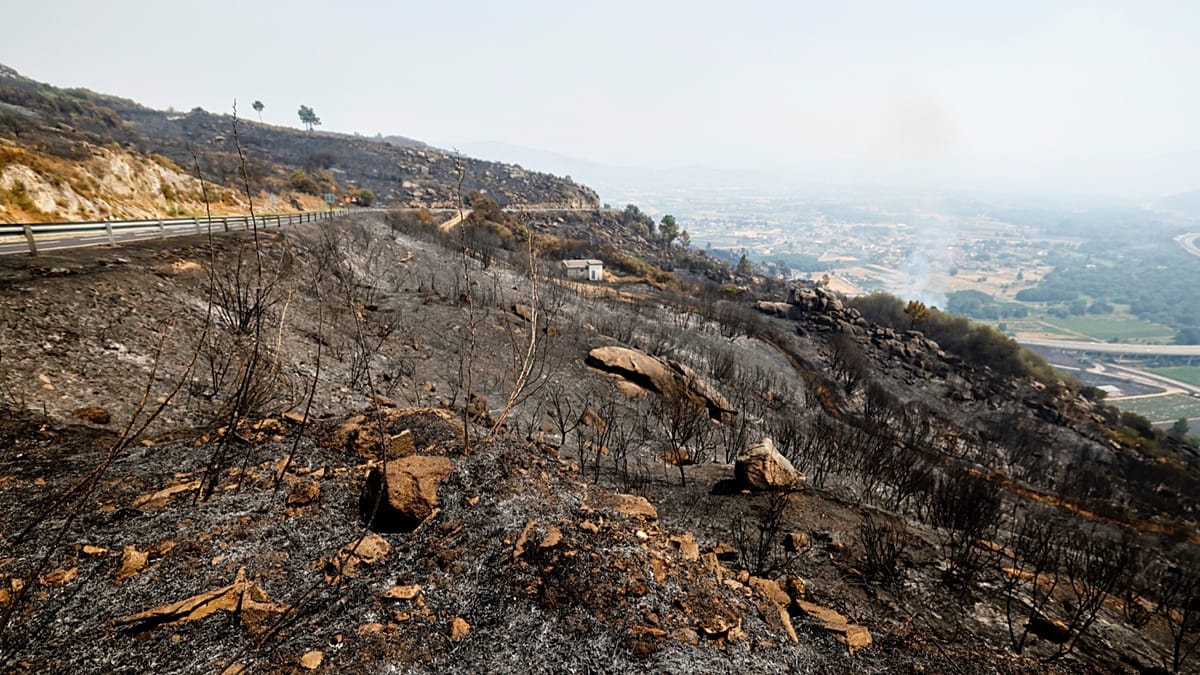
These scorching temperatures, combined with strong winds, created the perfect conditions for wildfires to rapidly spread across the country.
Since the start of 2025, more than 380,00 hectares of land have been burned, almost five times the yearly average, claiming the lives of at least eight people.
Scientists warn that the hot, dry and windy conditions that fuelled the fires are now around 40 times more frequent and around 30 per cent more intense than they would be in a world without climate change.
“With every fraction of a degree of warming, extreme long-lasting heatwaves will continue to intensify, increasing the chance of huge wildfires like the ones that burned vast areas of the Iberian Peninsula,” warned Dr Clair Barnes, researcher for the Centre for Environmental Policy at Imperial College London.
Spain’s renewable energy drive
Despite the country’s devastating extreme weather events, Spain has significantly expanded its renewable electricity capabilities – with solar and wind power now supplying more than half of its annual generation.
While this means Spain is on track to meet its decarbonisation goals, the OECD warns that electricity demand is projected to rise by more than 40 per cent by 2030.
“This growth reinforces the need to continue expanding investments in grid infrastructure, interconnections and storage, while implementing measures to face curtailment and grid congestion,” the report adds.
Spain is also struggling to slash transport-related emissions, which account for one-third of its overall footprint. Experts argue that rising vehicle ownership and weak price signals to switch to cleaner alternatives have “partially offset efficiency gains”.