
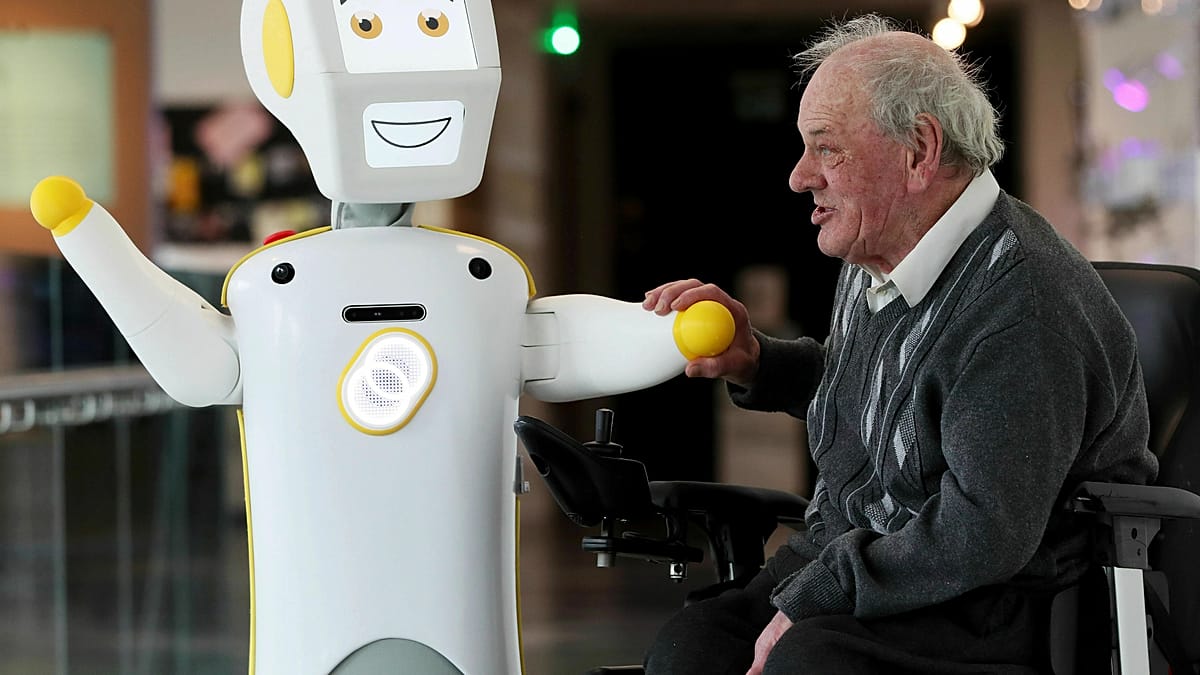
At Paris’ Broca Hospital, elderly patients are taking part in experiments involving several different robots.
The NAO robot uses questions and exercises to encourage conversation and cognitive stimulation. In one session, it asks patients to complete familiar proverbs.
“I’m going to give you the beginning of a proverb, and you can try to tell me how it ends,” the robot tells them.
Another device, Paro, is designed to provide therapeutic comfort. The robotic seal is equipped with sensors that allow it to respond to a patient’s movements and sounds.
Then there is Miroki, a robot designed to interact with patients through conversation.
For 72-year-old Michele, the experience is unusual but not unsettling. “No, I’m not worried, but I prefer human contact,” she says.
Patients react differently
Researchers say there is no single response to the technology. “There are all sorts of reactions,” says Lea Vecchioni, a psychologist and research engineer at the Broca Living Lab.
“Some patients are almost amazed. They find it remarkable to see in real life the sort of things they’ve only seen on television.” But others, she says, “clearly reject the technology and the robots”.
The researchers are looking at whether the machines can help patients engage with different forms of therapy.
“The robot can act as a facilitator that helps engage patients in therapy sessions,” says Maribel Pino, a cognitive psychology researcher and research director at the Broca Living Lab.
The potential applications include cognitive stimulation, speech and language therapy, physiotherapy and psychomotor rehabilitation.
AI personalised for each resident
In southern France, another experiment is using AI in a care home setting. At La Septfontoise in Tarn-et-Garonne, staff are testing Livana, an AI system designed to support residents when they become agitated.
The technology works through a phone and can create personalised conversations. Before the experiment began, staff collected biographical information about residents with the consent and cooperation of their families. That can include details about their interests and life stories.
The information is then used to personalise the system’s voice and the content of its interactions. “The voice can have elements that help soothe the resident, based on their interests and life story,” says psychologist Elodie Jammes.
The system is being explored as a non-drug approach for residents living with Alzheimer’s or other neurodegenerative conditions.
A tool for caregivers
For La Septfontoise director Ghislaine Verines, the technology could provide another form of support for both residents and staff.
“The aim of the trial is to explore non-drug approaches that can improve residents’ wellbeing, while also providing additional support for care staff,” she says.
The experiments are taking place as researchers look for new ways of supporting people with cognitive disorders.
But Pino says the role of robotics should remain clearly defined. “I don’t think robotics should be thought of as a replacement tool,” she says.
“They are still tools, however sophisticated their conversational abilities or presence may become.” And there is one thing, she says, that technology cannot provide. “They will never replace the essential human relationships people need.”
Technology, but not instead of people
The French experiments show the range of ways AI and robotics are being explored in dementia care. Some technologies aim to stimulate conversation.
Others focus on therapy, comfort or personalised support.
But the researchers emphasise that their purpose is not to replace caregivers. Instead, the trials are testing what technology can add to care while keeping human contact at its centre.
Video editor • Yolaine De Kerchove Dexaerde