
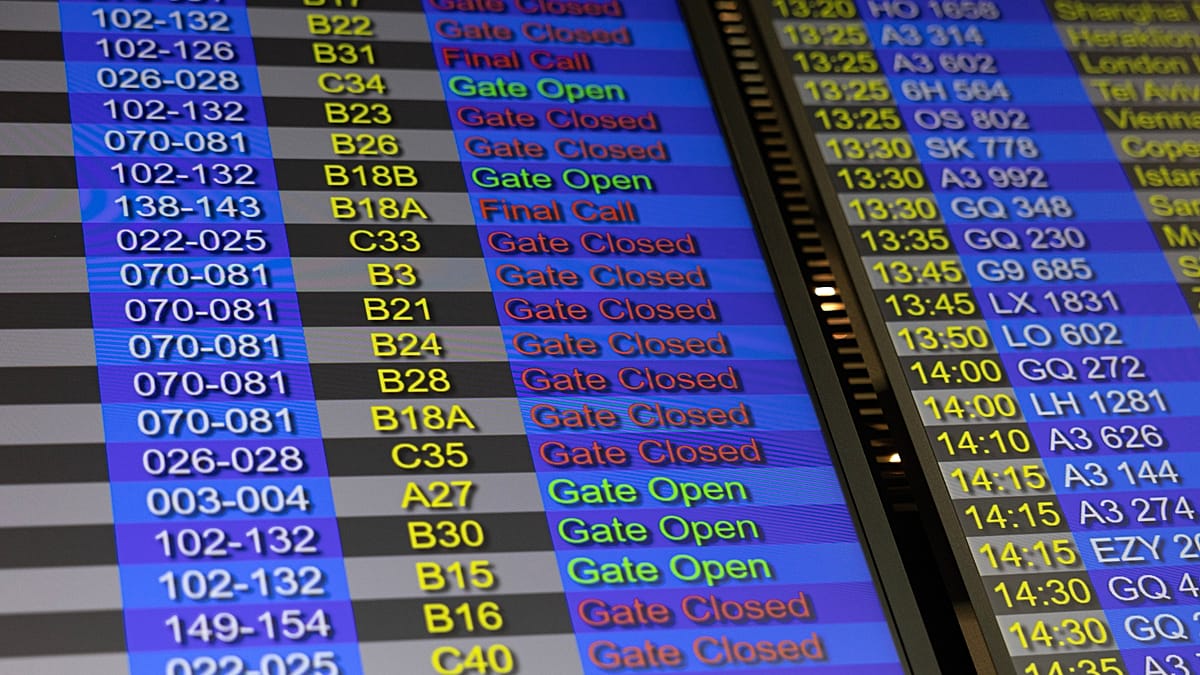
On the screens at the Control Centre in Athens, the symbols representing aircraft form an ever denser network. At the height of the summer season, air traffic controllers are called on to manage thousands of flights in Greek skies that seem to be reaching the limits of their capacity.
Olga Toki, vice-president of the Hellenic Air Traffic Controllers Association, paints a picture of intense strain: Traffic is so heavy, she says, that at certain times it is hard to find any additional space for new aircraft.
The figures illustrate the scale of the burden. According to the Hellenic Civil Aviation Authority, in low-demand months, Greek airports usually handle around 1,000 to 1,500 flights a day. In the first week of July, however, the daily average soared to 2,700 flights.
The picture is similar across the wider region. Eurocontrol estimates that air traffic in south-eastern Europe, which includes Greek airspace, is about 40% higher than in 2019.
The increase goes hand in hand with the spectacular rebound of Greek tourism. Visitor arrivals reached 38 million last year, surpassing the previous record of 2019 by 23%, in a country of around 10 million inhabitants.
The malfunction that exposed the system’s weaknesses
The pressure on the system had become evident long before the peak of the summer season. On 4 January, a serious malfunction in the communications system between controllers and aircraft exposed the weaknesses of the existing infrastructure.
Controllers could still see the flights on their radar screens, but they could not communicate by voice with the pilots. The authorities were forced to close Greek airspace for several hours, resulting in flight cancellations and aircraft being diverted to neighbouring countries.
The incident accelerated the announcement of a major modernisation programme with a budget of around €300 million. Among other things, it provides for the installation of new digital communications systems and the replacement of ageing radar equipment.
Installation of the new systems began in mid-August, and the overall plan foresees the completion of the upgrades by 2028.
At the same time, Greece is under pressure at the European level as well. The European Commission took the country to the Court of Justice of the European Union last year, arguing that it had failed to adapt its air navigation procedures in time to the international Performance-Based Navigation (PBN) standard.
Heavy traffic, limited staff
Inside the control room, Greek airspace is divided into ten sectors. Each sector is overseen by one controller, assisted by a colleague. In summer, though, the surge in traffic runs up against another long-standing problem: staff shortages.
Shift supervisor Giorgos Stamoulakatos estimates that the current 154 controllers fall well short of the service’s real needs, which he puts at around 250.
Recruitment has been stepped up, with 92 new controllers due in 2025 and another 77 in 2026. However, this reinforcement cannot deliver results immediately, as it takes about five years of training before a new controller acquires the necessary operational experience.
Twice as many aircraft in the space of an hour
Areti Anastopoulou has worked in air traffic control for more than three decades. One of her tasks is to organise the sequence of aircraft coming in to land, ensuring the necessary distances between them.
Under normal conditions, she explains, a controller can handle around 20 aircraft in an hour. In peak periods, however, that number can reach 40, inevitably causing delays and adding to the pressure.
In one illustrative case, 33 aircraft landed in just one hour, even though the planned upper limit is 28. She says she has repeatedly had to ask crews to reduce speed or change course in order to maintain the required safety distances.
As she points out, controllers are making an extremely demanding effort to keep operations safe in an environment where margins are becoming ever tighter.
Additional pressure from the Middle East
Geopolitical instability in the Middle East has added to the already strained situation. According to Eurocontrol, about 300 extra flights now pass through Greek airspace every day, a number that accounts for almost 6% of total daily traffic.
Greece’s geographical position creates further demands. As Olga Toki points out, beyond commercial flights the competent services also monitor the activities of Turkish aircraft and unmanned systems, further increasing the workload.
Delays increasingly felt by passengers
Inevitably, the consequences are felt all the way to the arrivals halls.
Jose Lopez, who recently arrived in Athens from Barcelona with a delay of about half an hour, did not find the experience particularly surprising. For mid-August, he said, such a delay is not unusual, and in the past he has faced much longer waits.
Christos, who works at a large hotel in Athens, is less forgiving. According to him, delays are more frequent than last year, and he has sometimes had to wait as long as seven hours for guests arriving from the United States.
For controllers, the issue is not the growth of tourism as such, but whether the infrastructure can keep pace with it. As Anastopoulou sums up, tourism is a crucial asset for the Greek economy, but the constant increase in flights cannot be sustained without corresponding investment in human resources, technology and infrastructure.